
Since the previous research note · Earlier expectation not tested
Track continuity
Since the previous research note: How repeated bacterial and calcium-lactate baths sealed mortar cracks
Previous expectation: Durable bacterial mineral sealing delivered through a practical external treatment could help maintenance crews reduce water entry into existing cementitious structures.
What this study adds: This study examines a Bacillus mucilaginosus healing agent containing spores and calcium nitrate for early-age cracks, reporting closure, permeability repair and decreasing deposition with depth. It contributes a different formulation and a spatial account of mineral deposition without testing the earlier treatment's durability or delivery.
What changed in this study
A crack can become much less visible while still leaving space inside a cementitious specimen. Measuring its opening answers one question; testing water passage answers another. An experimental report dated October 19, 2022, brings those measurements together with an observation that helps explain their meaning: bacterial mineral deposits were concentrated near the crack surface and became less abundant with depth.
The researchers studied Bacillus mucilaginosus and prepared a healing agent containing bacterial spores and calcium nitrate for early-age cracks. After 28 days of wet–dry cycling, the abstract reports crack closure reaching 95.62%, with a crack width up to 0.339 millimeters, and a water-permeability repair rate of 87.54%. These are substantial reported sealing results under the experiment’s conditions. They do not measure recovery of strength, stiffness, or load-bearing capacity.
Closure describes how much the measured opening has diminished. Permeability repair addresses how the specimen’s ability to let water through has changed. The two percentages therefore describe different properties and cannot be compared as though they were scores on the same scale. In particular, the permeability figure should not be translated into a percentage of all incoming water blocked without knowing the authors’ calculation and reference baseline. The reported crack width is an experimental detail, not a universal limit for cracks this system could treat.
How the bacterium helps minerals form
The biological component supplies an enzyme called carbonic anhydrase. The researchers investigated an extracellular form, meaning that it acts outside bacterial cells. The authors describe it as accelerating the reaction of carbon dioxide with water, a step that can help supply dissolved carbon for calcium carbonate formation in an alkaline environment.
The ingredients have distinct jobs. Spores provide the bacterial component of the healing agent; calcium nitrate provides a source of calcium ions. The enzyme speeds a chemical step involving carbon dioxide and water. Under suitable conditions, dissolved calcium and carbonate can then form solid calcium carbonate, or CaCO3. This conversion of dissolved ingredients into mineral deposits is the precipitation in the paper’s title.
That sequence also explains why the team examined temperature, initial pH, and calcium-ion concentration in relation to bacterial growth and enzyme activity. A useful mineral-forming system needs conditions that support its biological activity as well as its chemistry. Temperature and acidity or alkalinity can affect those processes, while calcium availability is part of the mineral-forming reaction. The abstract describes these investigations without giving enough results to specify an operating range or an optimum recipe.
Following the deposits into the crack
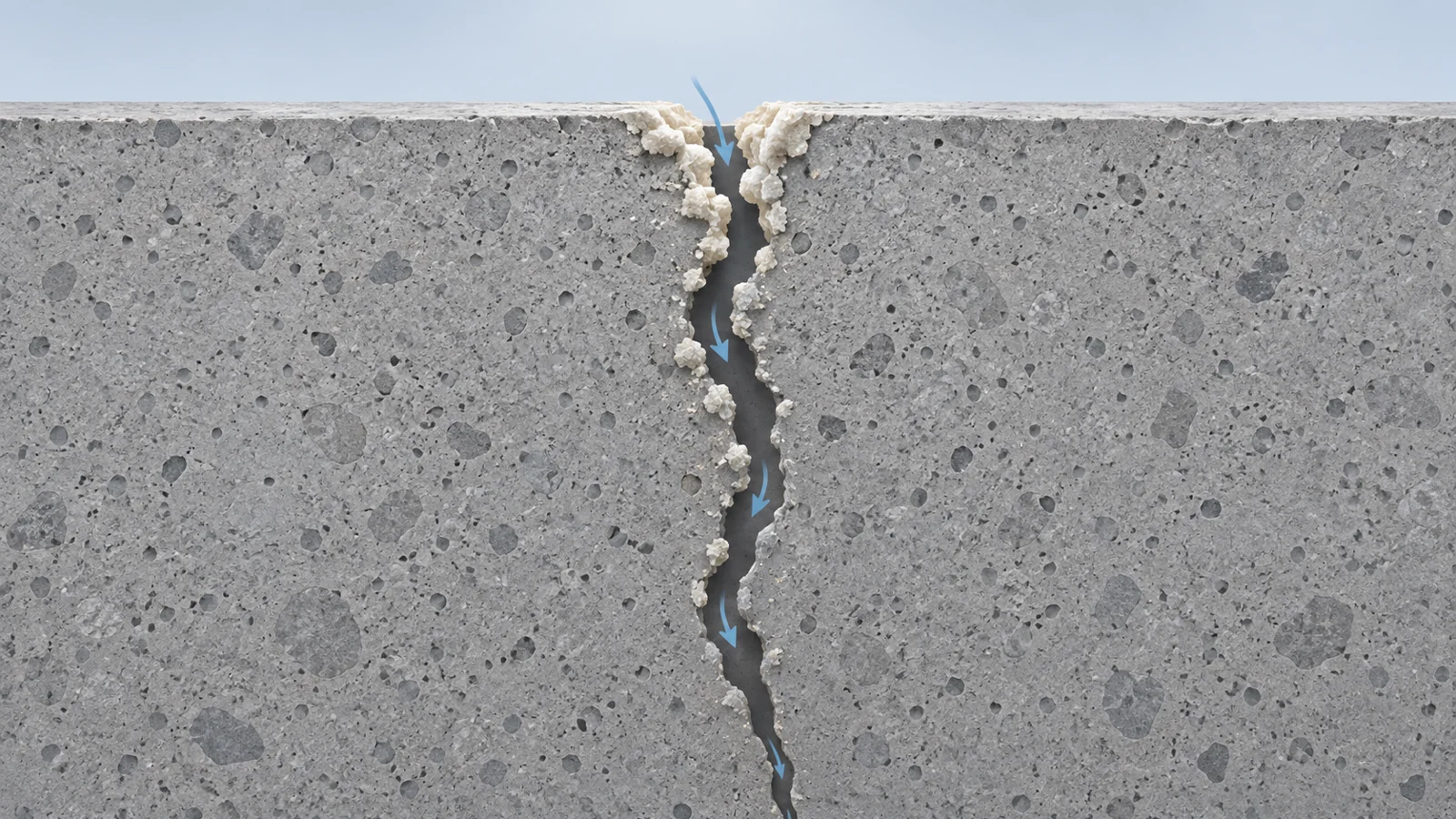
The most revealing spatial observation is that deposits decreased as crack depth increased. Healing therefore had a profile through the specimen, with more material near the exposed opening and less farther inside. A surface measurement alone cannot describe that distribution.
A constriction near an entrance can make a water pathway harder to traverse even when space remains beyond it. That provides a physical way to understand why surface closure and improved water sealing can accompany uneven deposition. It is an interpretation consistent with the reported pattern, rather than a measured account of exactly where resistance to flow developed. The abstract gives no numerical healing depth and does not establish uniform mineral filling throughout the crack.
The researchers examined material from the crack mouth using scanning electron microscopy with energy-dispersive spectroscopy, which can characterize appearance and elemental composition, and X-ray diffraction, which helps identify crystalline material. They report that the diffraction analysis identified calcite, a form of calcium carbonate. This anchors the mineral identification to deposits at the opening; it does not establish the composition or quantity of material at every depth.
The details needed to judge repeatability
This account rests on the abstract of a single version 1 experimental report. The abstract uses both concrete and mortar terminology, so it does not justify assuming tests on structural-scale concrete. It mentions a reference comparison but does not describe the reference composition sufficiently to isolate how much improvement came from the bacterial formulation relative to other processes in the specimens.
Sample counts, variability, statistical analysis, and the precise definitions of the repair metrics are unavailable in the supplied abstract. Those details would determine whether the headline values describe typical behavior, selected results, or a wider spread of responses. The wet–dry cycling schedule also matters for reproducing the exposure. A duration of 28 days alone does not say how long specimens spent wet or dry. These are gaps in the available account, not proof that the complete study omitted them.
The evidence provided does not establish repeated healing, long-term bacterial survival, or durability under service exposure. Nor does the authors’ description of the process as environmentally friendly establish a life-cycle benefit, net carbon removal, or an absence of environmental impacts. Those outcomes require evidence beyond observing mineral formation and short-term sealing.
What this could change
If the sealing effect persists under service exposure and the healing agent can be incorporated or delivered practically, early cracks could become less effective routes for water entry. Mineral formation at those pathways could give concrete asset owners a material-level barrier that helps limit water-related deterioration. The potential benefit follows from maintaining resistance to water passage over time, with the possibility of reducing some future maintenance needs. The October 2022 result supports investigating that capability; a longer service life remains a conditional payoff rather than a demonstrated outcome.
Key Sources
- Primary source: Biomineralization process of CaCO3 precipitation induced by Bacillus mucilaginosus and its potential in bacteria-based self-healing concrete
DOI or Journal Page · Peer-Reviewed Paper · 2022-10-19