
Since the previous research note · Earlier expectation not tested
Track continuity
Since the previous research note: How bacterial minerals narrow cracks and change water passage
Previous expectation: Persistent bacterial mineral sealing could reduce water entry and related deterioration if the healing agent could be delivered practically.
What this study adds: The current source adds reinforced-beam simulations comparing load capacity, bending and loading arrangements, with numerical verification against two earlier experimental beams. Those results do not test the earlier conditional forecast about persistent resistance to water entry.
What changed in this study
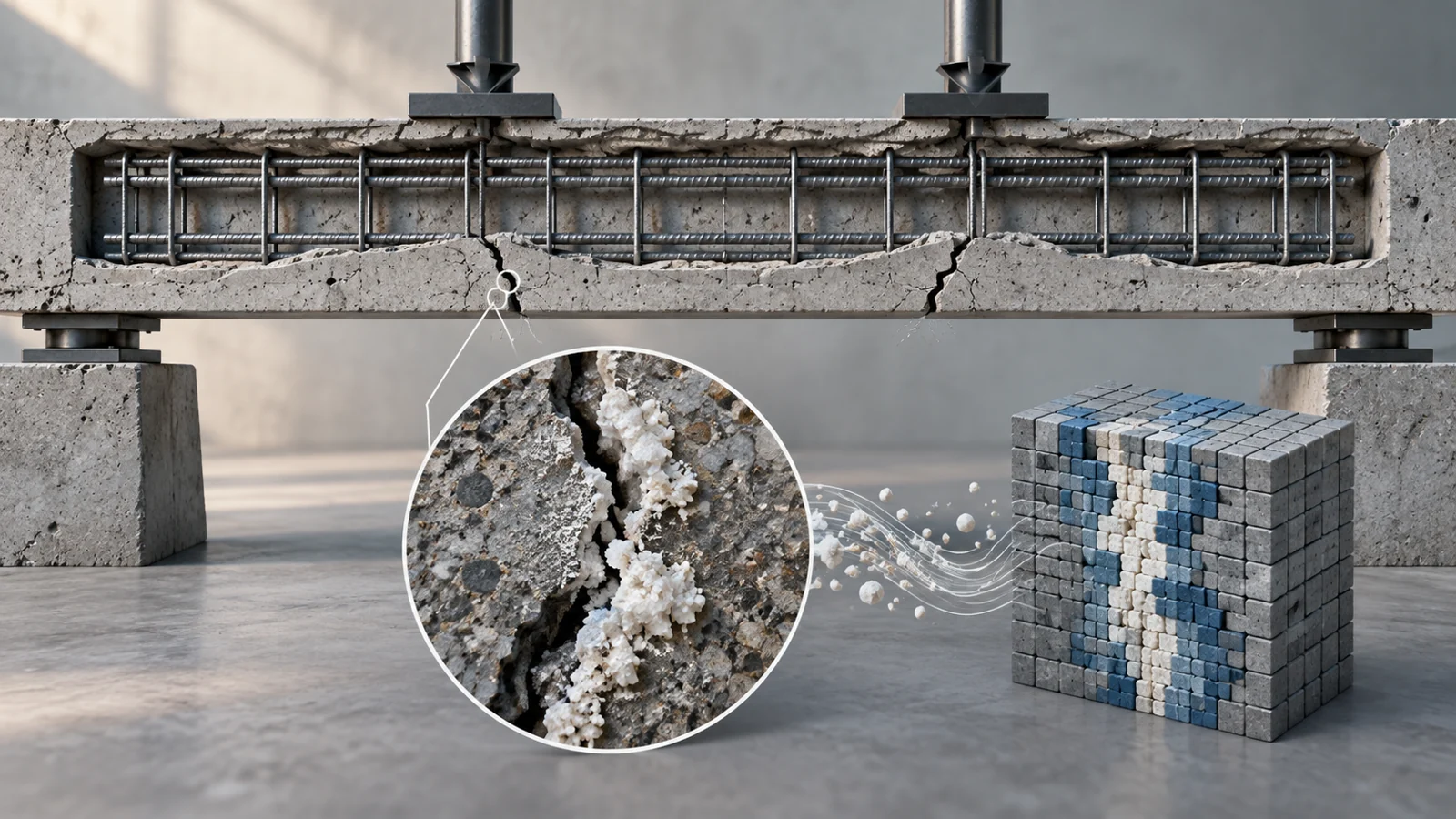
Concrete cracks. Repairing those cracks can be expensive, so researchers have explored concrete designed to seal its own cracks using bacteria that may promote calcium-carbonate formation. The October 2022 study Finite Element Analysis of Self-Healing Concrete Beams Using Bacteria asks a more structural question: what happens when that idea is represented inside a reinforced concrete beam model and the beam is loaded toward failure?
Its most attention-grabbing result is a 20.2% increase in modeled beam capacity for one bacterial formulation. In this context, capacity means the load at which the modeled beam fails. It does not mean that a physical beam was repaired and then shown to carry 20.2% more weight. The study also reports a much larger 74.5% increase, but that comparison changes the placement of the load rather than the bacterial concrete. The two numbers answer different engineering questions.
A beam is a different test from a concrete specimen
Much bacterial-concrete research has focused on material specimens such as cubes and cylinders. This study moves the question into reinforced beams, where concrete, steel reinforcement, supports and loading arrangement interact. That matters because a beam is not judged only by the properties of its concrete. Its response also depends on where stresses develop, how cracks grow and whether the reinforcement yields before the concrete fails.
The researchers used ANSYS 15.0 to construct three-dimensional models. Concrete, reinforcing steel and the steel plates used at the loading and support locations were represented as separate parts. The concrete element could represent tensile cracking and crushing under compression. The reinforcement was represented as a member that could carry tension or compression, while the plates distributed the contact at the supports and loading points.
The model then provided a controlled way to vary three things: the amount of bacteria relative to cement weight, the bacterial type and the way the beam was loaded. The concentration cases were 1%, 2% and 3%. The bacterial comparisons included Bacillus subtilis, E. coli and Pseudomonas species. Loading was applied at one point, two points or four distributed points.
That design makes the paper useful as a structural comparison. It does not turn every modeled result into a physical demonstration of self-healing. The numerical beams are a way to ask how a beam would respond if the assumed material changes were present.
The model changes after cracking begins
The biological premise is that bacteria could help form calcium carbonate when cracks open, potentially changing the concrete around the damaged region. The computer model represented that premise indirectly. As the modeled load increased, the concrete first used its ordinary material properties. Once the load step associated with the beginning of cracking was reached, the model changed the concrete properties to represent bacterial activation.
In ANSYS, this was handled by gradually changing the material inputs from those assigned to concrete without bacteria toward those assigned to bacterial concrete. The study describes this as a way to simulate activation after cracks appear. The calculation therefore contains a clear boundary between the proposed mechanism and its numerical treatment: the model does not watch mineral formation take place particle by particle. It changes the mechanical properties used in later load steps.
The material values used for the models came from compressive- and tensile-strength testing reported in earlier experimental work. That gives the calculation numerical inputs for comparing beams, but it also means the quality of the structural prediction depends on how well those inputs and the activation rule represent the behavior of an actual cracked beam.
A numerical check came before the comparisons
Before varying bacterial concentration, species and loading, the researchers checked the model against two beams from earlier experimental work. One was a control specimen. The other was a bacterial-concrete beam containing fly ash. Both were reinforced concrete beams measuring 230 by 300 by 1500 millimetres, with specified longitudinal reinforcement and stirrups.
The modeled failure load for the control specimen was 91.4% of the earlier experimental failure load. For the bacterial-concrete beam with fly ash, the corresponding figure was 94.5%. The predicted failure loads and associated displacements were described as being in good agreement with those earlier results.
This check is important because it gives the model a connection to observed beam behavior before the new comparisons are made. It is also a limited check. The two beams help test whether this modeling approach can reproduce those particular cases; they do not physically confirm every later combination of concentration, bacterial type and loading arrangement in the eight-beam parametric study.
The 20.2% result has a narrow denominator
The headline bacterial result comes from a two-point-loading comparison in which the concrete formulation was varied while the other comparison conditions were held constant. The bacterial type was Bacillus subtilis, and the concentration was defined as bacterial weight relative to cement weight. The model compared 1%, 2% and 3% concentrations with a conventional control beam without bacteria.
At 3%, the modeled Bacillus subtilis beam had a capacity 20.2% higher than the control. The 1% case increased capacity by 16.2%, while the 2% case increased it by about 17%. Within the three concentrations tested, 3% produced the largest modeled capacity gain. That is a result among the selected values, not a universal optimum for all mixtures, structures or service conditions.
The bending results add a useful complication. At the shared load of 286.5 kilonewtons, the modeled mid-span deflection was reduced by 2% for the 1% case, 14.8% for the 2% case and 15.7% for the 3% case. The 1% and 2% concentrations therefore produced similar capacity gains, yet their modeled bending responses differed substantially.
That distinction is central to reading the result. A beam can reach a higher modeled failure load without every measure of its movement changing in the same proportion. Capacity and deflection describe different parts of the response. One concerns how much load the beam carries before the modeled failure endpoint; the other concerns how far it bends under a specified load.
Bacterial type changes the pattern
The species comparison was made at the same 3% concentration. Bacillus subtilis produced the largest reported capacity increase, 20.2%, compared with 16.1% for E. coli and 14.9% for Pseudomonas species.
The capacity gains were not accompanied by proportional reductions in deflection. At the same load, Bacillus subtilis reduced deflection by 15.7%, while E. coli reduced it by 4.7%. The Pseudomonas case increased capacity but did not reduce deflection in the reported comparison. That exception is why “stronger” and “bends less” should not be treated as interchangeable descriptions of a beam’s behavior.
The calculation thus points to a response shaped by both the assumed concrete properties and the bacterial formulation used to supply them. The result is not merely that adding more bacteria produces one steadily improving outcome. Different response measures can separate, and different bacterial types can produce different combinations of capacity and bending.
Load placement changes the question
The 74.5% figure belongs to a different comparison. Here, the bacterial formulation was held fixed at 3% Bacillus subtilis, while the loading arrangement changed. The researchers compared a one-point load, a two-point load and distributed loading at four points.
The beam loaded at four points had a capacity 74.5% higher than the beam loaded at one point. It was also 13% higher than the beam loaded at two points. The correct denominator for the 74.5% statement is therefore the failure load of the one-point-loading beam, not the control beam without bacteria.
Changing where the load enters a beam changes the stress distribution and the locations where cracking develops. A load concentrated at one point creates a different structural demand from loads spread across four points. The larger percentage consequently describes the effect of the loading arrangement within this model. It is not an additional 74.5% contribution from bacteria, and it cannot be added to the 20.2% formulation comparison.
This is a useful engineering separation. One experiment or model run can ask whether changing the material formulation changes the response. Another can ask how the same formulation responds when the boundary condition is changed. Combining those answers would make the numerical result sound more dramatic while making its meaning less precise.
Failure still has a physical sequence
The modeled endpoint was not just a single number on a load-capacity chart. As loading rose, cracks began as vertical flexural cracks associated with tensile stress at the underside of the beam. They grew in width and length and then turned diagonally as they moved upward toward the loading point. The reported failure mode was diagonal tension failure.
The reinforcement in the modeled beams reached its yield stress before the concrete failed. That sequence corresponds to a ductile mode of failure, which the paper identifies as desirable in beam design. In practical terms, the beam’s response includes a stage in which the steel has yielded before the concrete reaches its failure condition, rather than the concrete failing first without that warning through deformation.
The crack path and the order of yielding matter alongside maximum load. Two beams might have similar failure loads but offer different warning, deformation and damage patterns on the way there. In this study, those physical details remain part of the modeled response. They help explain what the capacity number represents: not an abstract strength score, but the endpoint of a changing crack-and-reinforcement sequence under a specified load arrangement.
The practical gap is keeping the function available
For the idea to move from a material assumption to a working structural capability, bacteria would have to remain useful inside concrete and become active under the conditions represented by the model. The paper identifies nutrition and the use of capsules to preserve bacteria until cracks occur as important areas for further study. It also points to temperature, structural scale, different structural elements and experimental testing as relevant variables.
Those questions affect the transfer from a numerical beam to a real one. A model can change material properties after a cracking step, but a physical structure must contain whatever biological system supplies that change. The bacteria must be accommodated within the concrete, and the conditions around a crack must support the intended process. The study does not resolve how that practical chain would perform over repeated cracking, in different environments or across larger structural systems.
The same caution applies to the beam comparisons. The verified control and bacterial-concrete cases provide a useful numerical anchor, while the eight-beam parametric study extends the calculation to selected formulations and load arrangements. Experimental work would be needed to test those specific predictions and to examine whether the assumed property changes persist in actual reinforced members.
What this could change
If physical beam tests eventually show that bacteria can be preserved inside concrete, become active when cracks form and produce the property changes represented here, engineers could have a new way to combine structural load-bearing with a built-in response to cracking. The potential beneficiary would be infrastructure that is difficult or disruptive to repair, because a reliable self-healing function could help retain structural performance while reducing the need for some interventions.
That future depends on more than reproducing a 20.2% modeled capacity increase. The biological process would need to work in real reinforced members, under relevant temperatures and scales, with a failure response that remains acceptable. The value of this study is that it moves the question toward that structural level: it shows how bacterial concrete might be evaluated not only as a material that seals cracks, but as a beam whose capacity, bending and failure sequence can be compared under defined conditions.
Key Sources
- Primary source: Finite Element Analysis of Self-Healing Concrete Beams Using Bacteria.
DOI or Journal Page · Peer-Reviewed Paper · 2022-10-26