
Since the previous research note · Earlier expectation not tested
Track continuity
Since the previous research note: Can a porous mineral shelter keep concrete repair bacteria ready?
Previous expectation: Protected bacterial spores might retain repair capacity through years of dormancy and eventually help seal small concrete cracks.
What this study adds: The current study connects enzyme screening and alkaline survival with calcite bridging and mechanical recovery in small mortar specimens after 28 days of wet curing. It addresses strain selection and nutrient matching without testing the earlier carrier-aging forecast.
What changed in this study
Concrete can fail through openings that are barely visible. Microcracks let water and other aggressive agents move into the material, creating conditions that can accelerate damage to the cement matrix and steel reinforcement. Repairing those cracks after they appear is costly and labor-intensive, so researchers have been testing whether bacteria can deposit minerals inside them while the concrete is still in service.
A study published on March 6, 2026, tested that idea with indigenous bacteria collected from extreme environments in Iran. Its central achievement was not simply finding organisms that could make calcium carbonate. It connected enzyme activity and survival in cement-like alkaline conditions with mineral bridging and measured strength recovery in small mortar specimens. The experiment focused mainly on narrow, approximately 0.3 millimeter gaps assessed during 28 days of water curing.
Concrete cracks are small openings with large consequences
The repair process depends on a chemical sequence. Calcium carbonate, or CaCO₃, can form when carbonate is available to combine with calcium ions and crystallize inside a crack. Bacteria may help create the conditions for that reaction through enzymes.
Urease breaks down urea, producing carbonate-related products and increasing alkalinity as part of the reaction. Carbonic anhydrase, or CA, accelerates the conversion between carbon dioxide and bicarbonate. Those are different routes toward greater carbonate availability for mineral formation. Measuring both activities can therefore reveal more about a candidate than measuring either one alone, but it does not mean every bacterium uses both pathways equally or that the two enzymes’ combined causal effect has been isolated.
The cement environment creates the harder biological problem. Fresh or young cement can be extremely alkaline, while cured cement remains chemically demanding. A bacterium that produces a strong signal in a culture assay may lose activity or viability when exposed to those conditions. For crack healing, mineral-forming chemistry and persistence inside the material have to meet in the same organism and formulation.
Screening for activity was only the first filter
The researchers screened more than 200 environmental bacterial isolates for urease and carbonic anhydrase activity. They combined normalized measurements into a study-specific enzyme activity index, or EAI, to rank calcification potential. The index was not a universal biological scale: its weighting was fitted through regression against observed crack-healing and ultrasonic outcomes from the experiments.
The study then challenged promising organisms in simulated concrete pore solutions at approximately pH 12.5 and 13.5. The solutions represented different cement-like alkaline conditions, including a harsher environment associated with young cement. Spore formation and survival mattered because a strain that loses its useful activity under alkaline exposure cannot contribute reliably to mineral formation in a mortar matrix.
The screening results made that practical filter visible. Some isolates that looked promising from enzyme measurements were ultimately set aside because they survived poorly. The researchers selected robust spore-forming candidates that combined enzyme performance with alkaline tolerance. The selection logic is important: enzyme production in a favorable laboratory culture was treated as one part of the problem, not as proof that a strain would remain useful inside cement.
A controlled test inside a tiny mortar cube
The main mortar experiments used standard 50 millimeter cubes made with Type I ordinary Portland cement and natural sand. Each bacterial formulation was incorporated into a separate batch. Most of the healing analysis used gaps created by inserting thin steel plates into fresh mortar and removing them after 24 hours, producing approximately 0.3 millimeter pre-formed cracks.
The specimens were then cured in water at room temperature for 28 days. No additional nutrients were supplied during that curing period, although the initial mortar formulations differed in their calcium and nutrient ingredients. The study also used controlled mechanical loading in preliminary experiments to create more irregular cracks, but the principal analysis centered on the uniform, plate-formed gaps. That difference matters because a narrow, regular opening presents a more accessible test for mineral deposition than a large or tortuous field crack.
Compressive strength was measured for cracked and corresponding uncracked cubes, with results averaged across three replicates. The healing ratio compared the strength of a cracked specimen after treatment with that of its uncracked counterpart. A value near 100 percent represented recovery to the corresponding baseline; a value above 100 percent represented a higher measured value under the test conditions.
What the repaired crack actually showed
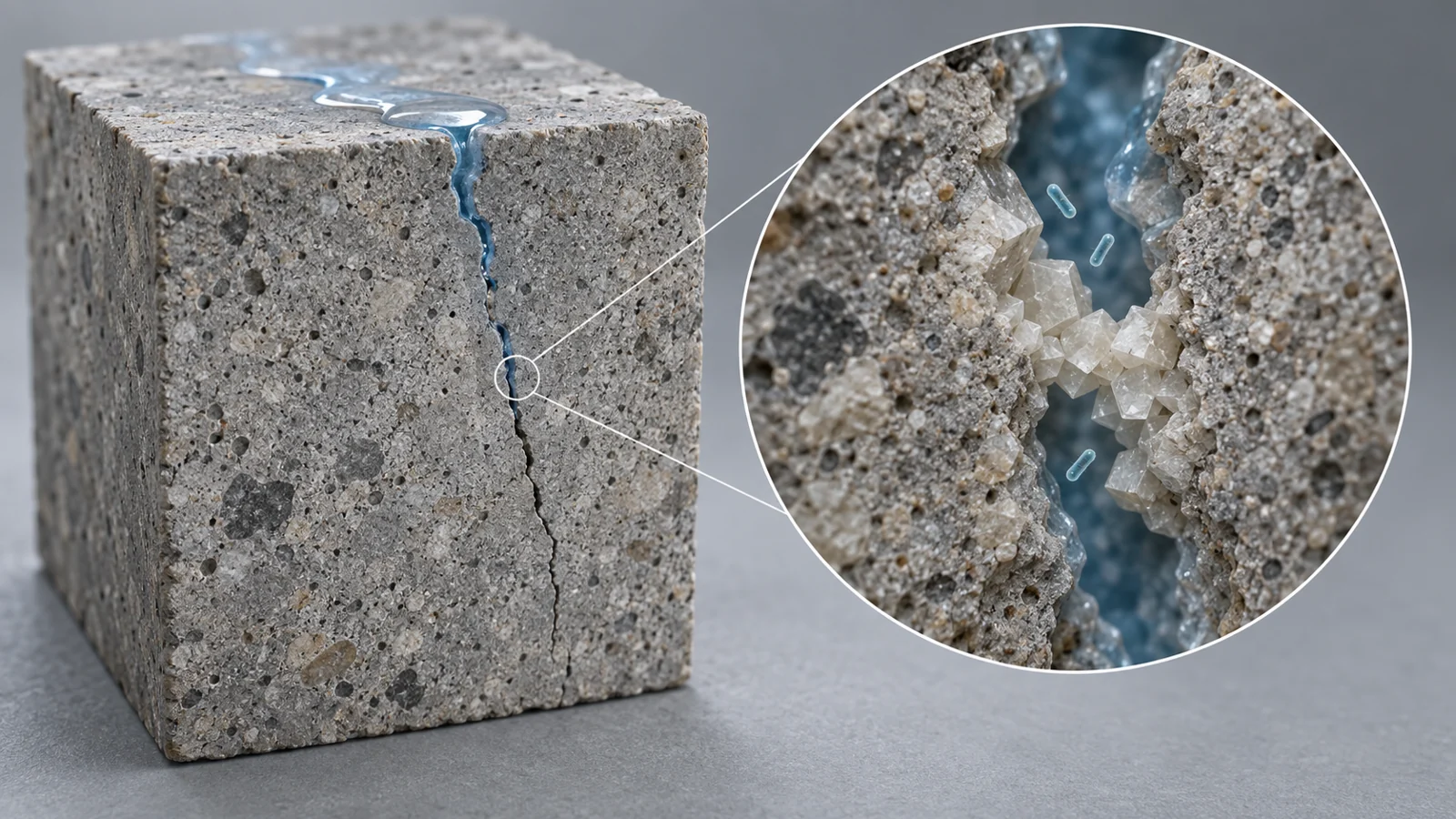
Several measurements pointed to mineral deposition rather than simple visual concealment. White crystalline material was visible in many treated gaps, and microscopy showed dense, rhombohedral crystals bridging opposing crack faces in specimens treated with organisms such as S. pasteurii. Control cracks remained more open and were lined mainly by ordinary cement hydration products.
X-ray diffraction identified the precipitate as calcite by matching its diffraction pattern with a calcite reference. That result establishes the mineral phase detected in the tested deposits. It does not by itself describe how durable those crystals would be under years of environmental cycling, but it helps distinguish a calcium carbonate repair product from an unspecified surface deposit.
Ultrasonic pulse velocity added a different kind of evidence. The control group had a normalized ratio of approximately 0.6, while most bacterial treatments reached values near or above 0.9. In a small cube, faster sound transmission is consistent with improved internal continuity across a crack. The researchers appropriately treated these readings as comparative evidence of internal recovery, not as definitive proof that every crack was completely closed or that the specimen had regained all of its original structural behavior.
The strength results supplied a separate mechanical test. For the S. pasteurii formulation using calcium nitrate, the cracked-healed specimens reached approximately 46 MPa compared with approximately 47 MPa for the matching uncracked specimens. That near-baseline result is notable within this experiment because it connects visible calcite bridging and ultrasonic recovery with a direct load-bearing measurement. It remains a result from small mortar cubes under controlled curing, rather than a demonstration that a concrete structure is ready to return to service without conventional assessment.
Nutrients changed the bacterial advantage
The bacterial strain was only one part of the repair ingredient. The calcium source and surrounding nutrient chemistry also changed how different organisms performed. The reported urease-oriented S. pasteurii responded better to a calcium nitrate and urea formulation than to calcium lactate. In that comparison, the calcium nitrate mixture produced slightly higher strength values, including the approximately 46 MPa healed result.
E10.2 showed the opposite preference in the reported tests, performing better with calcium lactate and bicarbonate. The authors associate that response with conditions that provide carbon dioxide-related substrate and a more favorable environment for carbonic anhydrase activity. For S. pasteurii, they propose that urea hydrolysis and calcium nitrate create a strongly alkaline, calcium-rich setting that accelerates urease-driven calcite formation.
The observations support nutrient-pathway matching as a design consideration. A formulation that favors one metabolic route may not favor another, even when both bacteria can contribute to calcium carbonate precipitation. The proposed chemical explanations help interpret the pattern, but the experiments do not show that every step in those explanations was independently isolated across all strains and mixtures.
The unresolved distance to infrastructure
The study’s most persuasive evidence concerns a tightly controlled scale: narrow gaps, small cubes, selected bacterial formulations and 28 days of water curing. Wider cracks and highly irregular crack geometries were not the focus of the principal conclusions. The preliminary mechanically induced cracks show that irregular damage was considered during the work, but they do not establish the same level of performance as the predominantly pre-formed cracks.
Crack width is likely to affect how nutrients, water and bacterial activity reach the damaged area, as well as how quickly mineral precipitation can bridge the gap. The results therefore speak most directly to early-age or service microcracks of roughly the tested size. They do not establish repair of large structural cracks, field service life, fewer maintenance interventions, commercial readiness, or quantified economic and environmental benefits.
The enzyme index also needs careful interpretation. Because its weighting was fitted against healing and ultrasonic results from the study, a high score is associated with performance within that experimental setting. It has not yet been shown to predict outcomes for new strains, new nutrient regimes or industrial concrete mixes. Independent testing would be needed before the index could be treated as a dependable selection tool beyond the conditions in which it was developed.
The work also leaves open a separate question about long-term protection. It tested acute alkaline survival and short-duration mortar performance; it did not test whether carrier-protected bacterial spores would retain repair capacity through years of storage or aging. That longer pathway remains distinct from the achievement demonstrated here, which is the connection between microbial screening and mineral repair in small mortar specimens.
What this could change
A reliable way to match bacteria with cement chemistry could eventually make autonomous sealing of small concrete cracks more adaptable to local materials and local microbial resources. If the enzyme-and-survival screen continues to perform under longer curing periods, wet-dry cycling, wider ranges of crack geometry and larger concrete mixes, engineers could gain a practical route toward repair ingredients tailored to the chemistry of a particular application rather than relying on one universal strain.
That possibility could help extend the useful life of some concrete elements by slowing the movement of damaging agents through early or service-related microcracks. Indigenous isolates might also reduce reliance on imported biological agents. For that infrastructure benefit to become credible, however, mineral bridges and laboratory strength recovery would need to translate into durable performance at construction scale. This study supplies a promising selection principle and a clear laboratory demonstration, not the final evidence for that transition.
Key Sources
- Primary source: Microbial-induced calcite precipitation by indigenous alkaliphilic bacteria: a dual-enzyme strategy for crack-healing in cementitious materials.
DOI or Journal Page · Peer-Reviewed Paper · 2026-03-06