
Since the previous research note · Earlier expectation not tested
Track continuity
Since the previous research note: At a Vilnius footbridge, rain meets concrete designed to seal cracks
Previous expectation: Repeated biological sealing of small cracks under outdoor service conditions could eventually reduce deterioration and maintenance if structural performance remained adequate.
What this study adds: The current source examines resident calcifying bacteria on treated indoor walls and reports improved calcifying capacity in a three-species mixture. It adds a treatment-composition direction without establishing the earlier forecast about repeated outdoor sealing and infrastructure protection.
What changed in this study
A study of indoor micro-cracked concrete walls examined two connected questions: which calcifying bacteria were present at the treated surface, and what happened when selected bacteria were tested together for mineral formation. The results point toward a possible way to refine biological surface repair, while keeping the practical question of lasting crack sealing open.
A surface coating on a cracked indoor wall
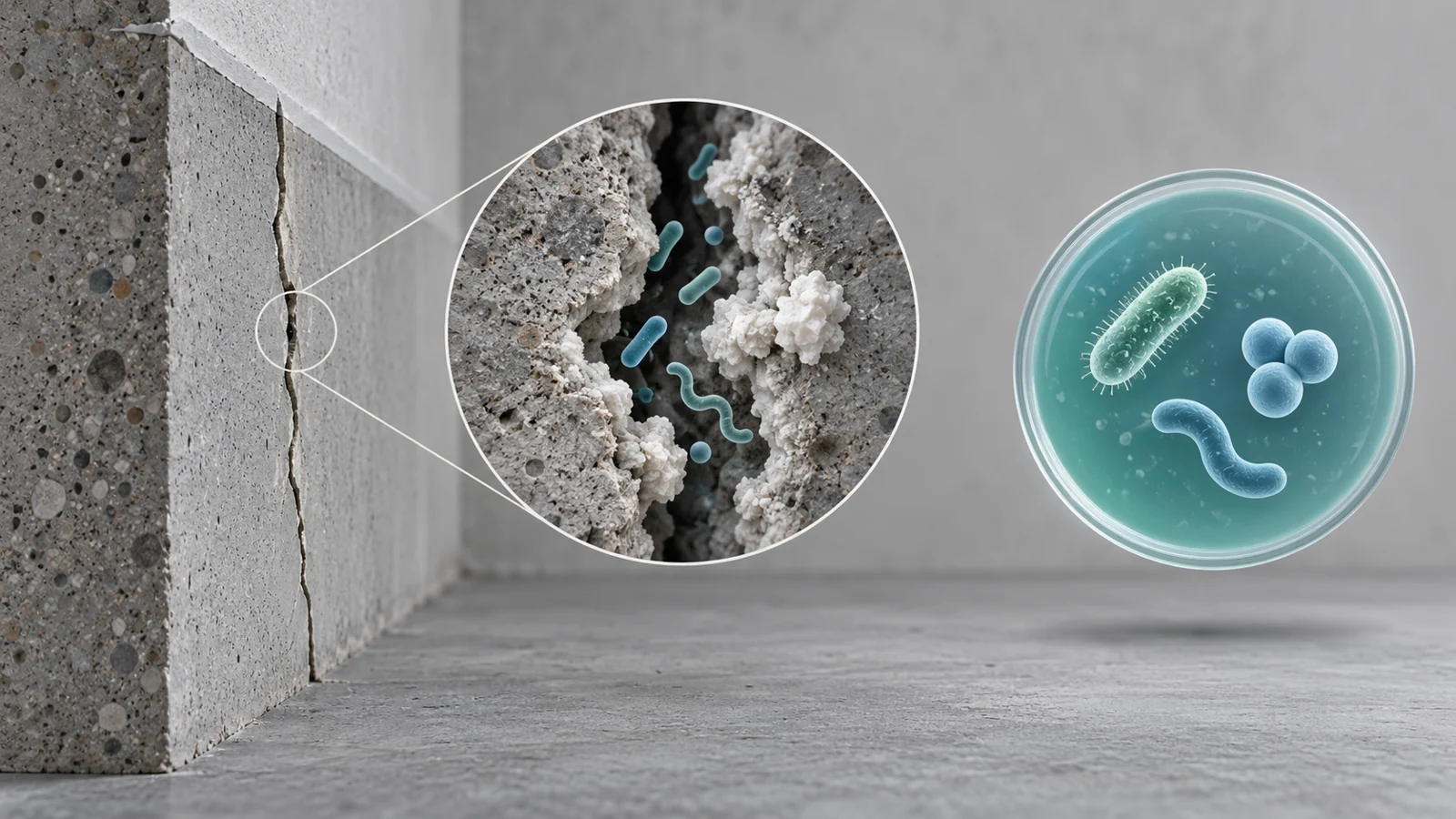
The biorepair treatment was based on an organo-mineral coating generated by Alkalihalobacillus pseudofirmus cultured in the presence of calcium lactate. In plain terms, the treatment used bacterial activity to create a mineral-containing layer on concrete with small cracks.
Researchers assessed indigenous calcifying bacterial communities before treatment and after one year. The focus was the biology of the treated surface: which groups were present, how their proportions differed across the wall, and what calcifying behavior appeared in isolated bacteria and a candidate mixture.
The community changed across the wall
The resident bacteria were not distributed uniformly. Depending on the sampling area, calcifying strains from either the Firmicutes or Actinobacteria phylum were dominant. The proportions of several genera also changed, including Bacillus, Brachybacterium, Microbacterium and Rhodococcus.
That pattern makes the wall more than a passive background for the treatment. Its surface supported a changing collection of calcifying groups, and the authors describe those indigenous bacteria as likely contributors to the treatment’s effectiveness. That remains an interpretation of the community findings: the shift in proportions does not identify which organism caused a repair effect or show that the community change improved the wall.
The isolate tests point to a candidate mixture
The study also reports results from isolated bacteria. Microbacterium and Rhodococcus showed calcifying capacity, and their growth rates were greater than the rate observed for Alkalihalobacillus pseudofirmus in the reported comparison. Growth rate and mineral-forming capacity are separate observations. A bacterium that grows faster is not automatically the one that produces the most useful mineral deposit.
A consortium containing Alkalihalobacillus pseudofirmus, Rhodococcus cercidiphylli and Microbacterium schleiferi demonstrated improved calcifying capacity in the reported test. The finding gives the treatment-design idea a specific form: instead of considering one organism alone, researchers can assess a defined combination of bacteria for its overall mineral-forming behavior.
The three-species mixture is a candidate formulation in this set of results. The evidence does not establish that it was the treatment applied to the walls throughout the one-year observation period, nor does it show that the organisms carried out complementary biochemical roles. The authors’ proposal that a consortium could improve treatment robustness is therefore best understood as an interpretation about treatment composition.
Mineral formation is an early repair signal
For people responsible for maintaining concrete, a greater capacity to form mineral is relevant because a surface deposit could help address a small crack. It is still an early biological endpoint rather than a complete measure of repair. A useful treatment would need the deposit to persist at the crack, remain attached to the concrete and perform under the conditions faced by the wall.
These biological findings alone cannot establish how quickly cracks seal, whether permeability falls, whether strength recovers or how long a repair lasts. They also do not establish how the indoor treated surface would respond to outdoor weather or structural loading. The study connects community composition, isolate growth and consortium calcification, but those observations should not be read as proof of durable engineering performance.
The practical advance is more focused: bacteria already associated with a treated concrete surface can be examined alongside defined mixtures, and one reported consortium showed improved mineral-forming capacity. That narrows a biological treatment question without resolving the full performance question.
What this could change
If the candidate consortium’s improved mineral formation translates into a persistent deposit that remains effective at small cracks, biological surface treatments could become a more capable maintenance option for existing indoor concrete walls. A formulation informed by resident calcifying bacteria might eventually help address minor defects without treating every repair organism as an interchangeable choice.
That benefit depends on the mineral-forming result becoming dependable surface repair under real use. If it does, the approach could give building maintainers another way to delay deterioration in cracked indoor concrete; if it does not, the result remains a useful guide to which biological mixtures deserve closer testing.
Key Sources
- Primary source: Impact of a biorepair treatment on the diversity of calcifying bacterial communities at the surface of cracked concrete walls.
DOI or Journal Page · Peer-Reviewed Paper · 2022-12-07