
Since the previous research note · Earlier expectation not tested
Track continuity
Since the previous research note: A bacterium and thickener were tested together to repair concrete cracks
Previous expectation: A bacterial crack treatment might reduce recurring repair work if its repairs persist in real service conditions and the formulation proves practical.
What this study adds: The September 2023 study examines a different formulation using alginate-encapsulated Bacillus spores, with separate measurements of mineralization, colony recovery and crack closure. It identifies sustained curing heat as a vulnerability for B. pseudofirmus and reports narrow-crack filling under water immersion.
What changed in this study
Concrete cracks are more than surface blemishes. Openings can let water, oxygen, and dissolved ions move inward, creating conditions that contribute to corrosion around embedded steel reinforcement. A crack may not immediately compromise concrete’s compressive performance, yet it can make the material more vulnerable over time.
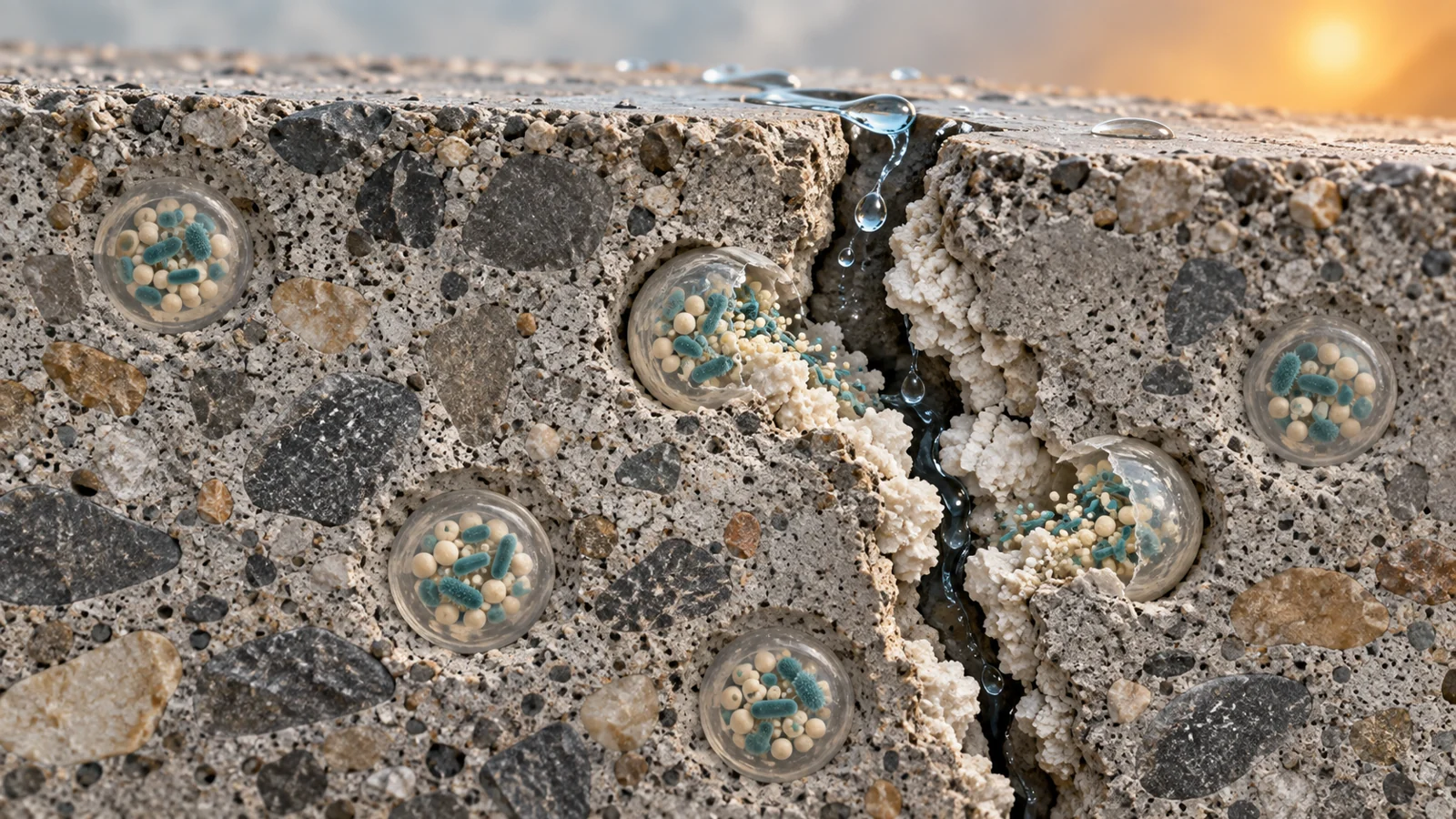
Self-healing concrete aims to address that pathway from inside the material. One approach places dormant bacterial spores in small capsules mixed into cement-based material. When a crack exposes the capsule to water, the bacteria may become active and produce calcium carbonate, a mineral that can accumulate within the opening.
A laboratory study published September 26, 2023, tested whether that idea could work with three non-ureolytic Bacillus species: B. pseudofirmus, B. cohnii, and B. halodurans. The researchers used calcium alginate microcapsules containing bacterial spores and nutrients, then evaluated cement paste and mortar specimens. Their results show both the promise and the narrow operating window of this kind of repair. Some small cracks filled under water, but imposed high temperatures sharply reduced recoverable bacteria in a controlled curing experiment, and wider cracks did not fill completely.
The problem begins with a narrow opening
The study’s central challenge was not simply whether bacteria could make a mineral. It was whether enough of them could remain available after being placed inside a material that changes chemically and warms as it hardens.
The capsules combined calcium alginate with spores and nutrients. Alginate provided the capsule structure, while the nutrients gave the bacteria material to use if conditions allowed them to reactivate. The choice of non-ureolytic bacteria meant the process did not rely on breaking down urea. The researchers chose this route in part to avoid ammonia release associated with ureolytic activity.
That distinction matters because “bacterial healing” is not one single event. A spore must first remain recoverable after encapsulation and mixing. A surviving or reactivated cell must then be able to drive mineral formation. Finally, the mineral must appear in a crack in an amount and pattern that reduces the measured opening. The paper tested these stages separately rather than treating one result as proof of all three.
A mineral-forming test came before the mortar
The first comparison took place in a calcium lactate culture medium, outside the cement specimens. The researchers measured calcium ions remaining in the medium after the spores had been activated and grown. A falling calcium concentration indicated that calcium carbonate was being precipitated.
All three species showed mineralization activity. B. pseudofirmus produced the strongest result in this separate assay: after seven days, the free calcium concentration was 1.742 millimoles per liter, compared with 5.941 for B. cohnii, 5.789 for B. halodurans, and 11.20 in the bacteria-free control. The assay therefore identified B. pseudofirmus as the strongest mineral producer under those culture conditions.
That ranking was useful, but it was not the same as a crack-healing result. A species that converts calcium efficiently in a liquid test still has to remain recoverable inside cement paste or mortar and operate within a real crack. The researchers consequently counted colonies recovered from the hardened specimens and later examined crack width directly.
Colony counting is a practical way to estimate how many spores can grow under the test conditions. To perform it, the team removed capsules from the cementitious material, dissolved the calcium alginate, diluted the sample, spread it on nutrient agar, and counted colonies after incubation. The method gives a concrete measure of recoverable growth, but it does not count every cell that is metabolically active yet unable to divide. An undetectable colony count after a treatment therefore should not be read as proof that every spore was dead.
Across the cement paste and mortar measurements, the species did not rank identically in every setting. B. pseudofirmus and B. halodurans retained the highest reported viability after the capsules were incorporated into cement paste, while B. halodurans had the strongest reported survival in mortar. Considering mineralization, recoverable bacteria, and crack filling together, the authors judged B. pseudofirmus the most promising of the three for this capsule system.
Curing heat changed the odds
Concrete does not harden at a constant temperature. Cement hydration generates heat, and the researchers tested how that exposure affected B. pseudofirmus in mortar. After an initial setting period, specimens were held for three days at assigned temperatures of 20, 40, or 80 degrees Celsius. The team then stored them under the study’s later conditions and measured recoverable spores at several time points.
The difference was substantial. After 28 days, the mortar treated at 40 degrees Celsius yielded 2.1% of the recoverable spores measured in the 20-degree control. Following the 80-degree treatment, recoverable colonies were undetectable at the first seven-day measurement.
This experiment does not establish an instantaneous lethal temperature, nor does it define a common limit for every Bacillus species or every concrete mix. It does show why construction temperature history belongs in the design problem. A capsule may be chemically well chosen and still contribute little to later healing if the hardening environment leaves too few spores able to grow when a crack forms.
Small cracks closed more readily than wide ones
The crack tests used mortar specimens containing each bacterial species. After cracks were created, the pieces were joined and immersed in tap water. A digital microscope tracked the width at selected points over a 56-day recovery period.
The most favorable results occurred in openings of about 0.13 millimeters. The results passage reports that cracks in this range filled after 14 days for specimens containing B. cohnii and B. halodurans; across the species, the abstract describes filling within 14 to 28 days. This was visible narrowing under continuous water immersion, not a measurement of restored strength.
The wider openings, ranging from 0.213 to 0.288 millimeters in the reported crack-healing analysis, did not fill completely during the study. After 56 days, the healing coefficients were 0.497 for B. pseudofirmus, 0.466 for B. cohnii, and 0.484 for B. halodurans. A coefficient of 0.497 means that the measured width of the B. pseudofirmus crack was reduced by approximately 49.7% under the test calculation. It does not mean that 49.7% of specimens were repaired, that half the original strength returned, or that the crack became watertight.
The bacteria-free controls help put the result in context. Samples without bacterial spores, including capsules containing nutrients only, also showed some narrowing, with healing coefficients no greater than 0.2. Concrete can therefore close part of a small crack through its own autogenous processes under favorable conditions. The bacterial capsules increased the observed closure in this setup, but the result belongs to a comparison between specific laboratory mixtures and controls, not to every self-healing concrete design.
Water made the laboratory result easier to read
The specimens were kept in water, and the measured water pH remained between 8.4 and 9.7 during the study. Those conditions gave the bacteria a consistent environment in which calcium carbonate formation could occur. They also simplified comparison among the species by reducing variation in moisture exposure.
Real structures experience a more changeable history. Outdoor concrete may encounter drying and rewetting, temperature swings, and freeze–thaw cycles rather than continuous immersion. The study’s water bath therefore provides a useful test environment for observing crack closure, while leaving the durability of that closure in service unresolved.
There is also an attribution problem. A narrower crack is evidence of a changed material geometry, but by itself it does not prove how much of the closure came from bacterial mineralization. The researchers identify the observed closure as an indirect indication of bacterial activity and call for bacterial identification and quantification under realistic conditions. The findings do not establish reduced reinforcement corrosion, durable watertightness, restored load-bearing capacity, or longer infrastructure service life.
The practical bottlenecks are consequently linked. Capsules need to preserve enough recoverable spores through mixing and hardening. Their contents must be distributed where cracks are likely to occur. The bacterial and nutrient levels may need adjustment, and additional protection may be needed against alkaline conditions and hydration heat. A formulation that performs in a water-immersed mortar sample still has to show that its mineral filling persists when the surrounding environment changes.
What this could change
A workable version of this approach could give maintainers a way to fill some small cracks from within concrete components that are difficult or expensive to access, including parts of bridge infrastructure. Internal mineral formation could reduce the need for repeated local interventions and help extend the practical options for inspecting and maintaining aging structures.
That benefit remains conditional. It depends on scalable capsule production, enough bacterial viability after construction, reliable performance across real moisture and temperature exposure, and evidence that visible crack narrowing translates into a meaningful protection effect. The September 2023 study supplies an important laboratory step by showing how species choice, capsule survival, curing heat, and crack width interact. It does not yet show that the same system can deliver durable repairs in service.
Key Sources
- Primary source: Bacterial Viability in Self-Healing Concrete: A Case Study of Non-Ureolytic Bacillus Species.
DOI or Journal Page · Peer-Reviewed Paper · 2023-09-26