
Since the previous research note · Earlier expectation not tested
Track continuity
Since the previous research note: Combining bacteria changed mortar strength, but more was not always better
Previous expectation: A reproducible bacterial mixture could give cast mortar useful starting strength and reduced water uptake, provided those advantages persist at production scale and in service.
What this study adds: The current study examines a different requirement for bacterial concrete: protecting Bacillus subtilis spores during fire exposure using carbon-fiber or gelatin carriers and relating thermal predictions to observed recovery. It does not test the earlier mixture or its manufacturing forecast.
What changed in this study
Concrete can contain bacteria that help seal cracks by depositing calcium carbonate, giving the material a biological repair function alongside its ordinary structural role. Fire puts both roles under pressure. Heat can damage the concrete and the carrier surrounding the bacteria, while the bacteria themselves must remain viable and later regain activity under suitable conditions.
A study published on August 1, 2025, examines one part of that problem: how quickly heat reaches bacterial spores inside different protective carriers. Its contribution is a thermal model for fire-exposed self-healing concrete, checked against furnace observations, microbial recovery and mechanical measurements. The central result is useful, but easy to overread. A modelled delay before an internal temperature threshold is reached is not the same as proving that a concrete element will still heal after a fire.
Concrete’s repair function begins inside the material
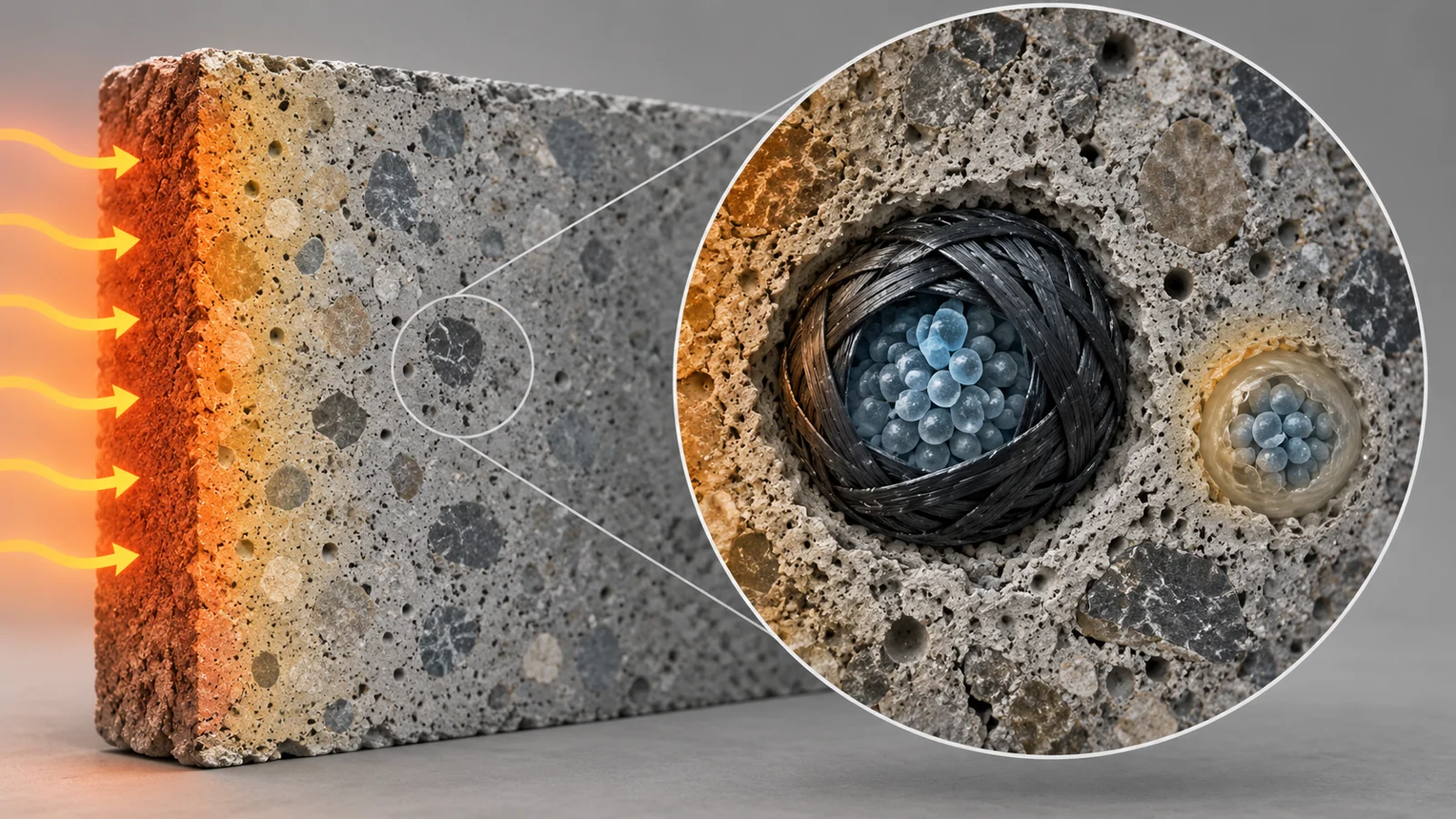
The study used Bacillus subtilis spores held in two types of carrier. One was a carbon-fiber bacteria ball coated with cement paste. The other was a gelatin capsule also coated with cement paste. Both were placed inside concrete specimens, with calcium lactate providing a nutrient source.
This arrangement creates several layers between the furnace and the bacterial core. The surrounding concrete is the outer environment, the cement paste adds a mineral protective layer, and the carrier forms the more immediate enclosure. Heat therefore has to travel inward rather than reaching the spores directly from the furnace atmosphere.
The carrier material matters because the layers must remain physically present while heat moves through them. Gelatin, an organic material, began degrading at temperatures as low as 200 °C in the study’s comparison. Once that layer breaks down, the cement coating has to provide most of the remaining protection. The carbon-fiber system retained a more effective thermal barrier under the tested conditions, helping delay the temperature rise around the spores.
Protection also has a second requirement after the fire. A carrier that blocks heat completely but prevents later access to moisture or nutrients would not necessarily support useful repair. The relevant design problem is therefore not simply to make the thickest possible shell. It is to preserve the bacteria during exposure while leaving a route for activation and mineral formation afterward.
Heat has to cross several barriers
The model treats heat transfer through the multilayer system by resolving conduction through the carbon-fiber, cement-paste and concrete regions. Their thermal conductivity, density and heat capacity influence how quickly temperature changes move inward. The calculation follows the temperature rise at the bacterial location and identifies the time at which it reaches 70 °C, a simplified inactivation threshold used by the study.
That threshold gives the model a clear decision point, but it is not a complete description of biological survival. Bacterial inactivation can depend on both temperature and exposure time, and the study acknowledges that its fixed threshold simplifies this process. A bacteria-containing carrier may also experience uneven heating, local damage or changing material properties as the surrounding concrete deteriorates.
The carbon-fiber carrier’s advantage was not only biological. The experimental comparison also found better mechanical retention for carbon-fiber specimens than for gelatin specimens across the fire exposures. The carbon-fiber system helped preserve the integrity of the embedded region, while early gelatin degradation was associated with void formation and greater loss of strength.
The model clock is longer than the furnace test
The furnace work followed a modified ISO 834 temperature trajectory toward selected targets of 200, 400, 600 or 800 °C. After reaching each target, the furnace held that temperature for the remainder of a one-hour exposure. Thermocouples embedded at different depths recorded the internal thermal environment. The specimens then cooled gradually inside the furnace for 24 hours before mechanical and microbial analyses.
The reported carbon-fiber model outputs were approximately 19.48 hours at 200 °C, 8.41 hours at 400 °C, 5.37 hours at 600 °C and 3.94 hours at 800 °C. These numbers describe the model’s estimated time to the selected internal temperature threshold under its simulated conditions. They are not equivalent to observed bacterial survival durations from furnace tests lasting one hour.
That difference is especially important for the nearly four-hour figure at 800 °C. It does not mean the experiment kept bacteria alive for nearly four hours at an 800 °C furnace temperature. The furnace exposure was temperature-capped and lasted one hour, while the model extended the thermal calculation beyond that experimental clock. The result is best read as a prediction about heat penetration in a specified multilayer arrangement, not as a demonstrated post-fire biological outcome.
The model also found that encapsulation thickness strongly influenced protection. Encapsulation layers of at least about 1.75 mm were associated with substantially longer predicted protection. Such a result can guide comparisons between carrier designs, but it remains tied to the materials, geometry, bacterial strain and fire schedule examined in the study.
The 800 °C result needs two readings
At lower furnace temperatures, the model and biological observations point in a broadly consistent direction. Carbon-fiber specimens showed high recovery and full healing at 200 °C, while the gelatin system showed only partial viability. At 400 °C, the carbon-fiber system retained moderate recovery and good healing, whereas the gelatin system showed no healing activity.
The picture became less favorable at 600 °C. Carbon-fiber specimens showed marginal recovery and isolated healing, while the gelatin system had no viable bacteria detected. The study also reports calcium carbonate precipitation in carbon-fiber specimens after exposure to 600 °C, providing evidence that at least some protected bacteria retained enough activity to begin mineral formation.
At 800 °C, however, the two parts of the evidence do not line up cleanly. The modeling discussion describes the temperature in the carbon-fiber encapsulated region as remaining below the 70 °C threshold during the one-hour exposure. The biological account reports no detectable self-healing and complete inactivation at that furnace temperature. The current findings do not reconcile those accounts, so the near-four-hour model output cannot be treated as proof that useful repair bacteria remained afterward.
Several features of the model could matter to that disagreement, but the study does not establish one as the explanation. The calculation uses a fixed inactivation threshold, while real inactivation is time-temperature dependent. It also simplifies or omits thermal cracking, explosive spalling, moisture migration, vapor pressure, evolving porosity, temperature-dependent material properties and the breakdown of interfaces. Each of those processes could alter heat paths or carrier integrity, but the evidence does not justify assigning the mismatch to any single one.
Survival is only the first step toward repair
A temperature below a chosen threshold is not the same as a repaired crack. Useful biological recovery requires a sequence. Some bacteria must remain viable in protected locations, regain activity when conditions permit, access moisture and nutrients, and deposit enough mineral to affect a crack. The amount and distribution of surviving bacteria matter as well.
The 600 °C results illustrate why an average survival signal can coexist with weak overall performance. Localized shielding near the concrete core may allow isolated colonies to survive, while most of the bacterial population is lost. Those survivors may produce calcium carbonate in particular locations without supplying enough activity to heal larger or more widely distributed cracks.
This population-level behavior also helps explain why the study’s threshold should not be read as an absolute boundary between repair and no repair. The model tracks a temperature condition within an idealized layered system. The experiments observe biological activity across specimens in which carriers occupy different positions and may experience different thermal histories. The biological outcome is therefore spatial as well as thermal.
The study’s viability trends were based on three independent biological replicates for each condition, with reported variation within about 8% standard deviation. That supports comparison of the tested conditions, but it does not turn every modelled duration into a directly measured survival time. Nor does mineral precipitation alone establish complete crack closure, restored structural capacity or readiness to return a fire-exposed structure to service.
Strength remained a separate problem
The carrier comparison also produced a mechanical result that should not be folded into the bacterial result. At 600 °C, the paper reports residual compressive strength of about 40–45% for carbon-fiber specimens and below 25% for gelatin-based specimens. The difference supports the carbon-fiber system’s relative advantage under the tested exposure, alongside the evidence of better thermal protection.
Those figures still describe substantial damage. Retaining more compressive strength than the comparison system is not the same as retaining original strength. Biological sealing is also not the same as mechanical restoration. A surviving bacterial population might help reduce the pathway for water ingress through some later cracks, yet the concrete element would still need adequate structural performance for its intended use.
This separation matters for any practical interpretation of fire-resilient self-healing concrete. The carrier must protect bacteria, preserve enough of the concrete’s mechanical function, and support later activation. A design that succeeds on only one of those measures would not by itself demonstrate a reliable post-fire repair system.
A proof of concept with a defined boundary
The study presents a proof-of-concept model for Bacillus subtilis spores in two cement-coated carrier systems under the selected modified ISO 834 conditions. Its predictive scope is not established across other bacterial strains, encapsulation designs or fire exposures. The one-hour, temperature-capped furnace protocol is a controlled test arrangement, not a complete representation of every fire history that concrete may experience.
The model’s value is therefore comparative and diagnostic. It gives researchers a way to ask how carrier material, layer thickness and heat transfer affect the timing of exposure at the bacterial core. The accompanying furnace, microbial and mechanical observations show where those calculations align with specimen behavior and where interpretation remains unsettled.
Future versions would need a more realistic treatment of bacterial inactivation, changing thermal properties, moisture and vapor movement, cracking, spalling and carrier breakdown. Those additions would not automatically validate the current predictions. They would make the calculation better suited to testing whether a protected bacterial population can remain biologically useful after a particular fire exposure.
What this could change
Fire-exposed concrete that retains some functional repair bacteria could eventually help infrastructure owners limit water ingress through later cracks and reduce deterioration associated with those pathways. That possibility depends on several conditions holding at once: the protective carrier must remain effective under representative fires, surviving bacteria must reactivate and produce useful mineral sealing, and the remaining concrete must still meet the structural requirements of its setting.
The study moves that possibility closer to a measurable engineering question by connecting carrier design with heat penetration, bacterial recovery and residual strength. It does not yet establish certified fire resistance, field deployment, quantified maintenance savings or a safe return-to-service rule. Its practical promise remains conditional on resolving the gap between a predicted thermal delay and demonstrated biological repair.
Key Sources
- Primary source: Validated thermal model for bacterial survival in fire-resistant self-healing concrete.
DOI or Journal Page · Peer-Reviewed Paper · 2025-08-01