
Since the previous research note · Earlier expectation not tested
Track continuity
Since the previous research note: How a soil bacterium changed laboratory mortar strength while calcium set the terms
Previous expectation: A bacterial cement formulation could reduce deterioration and disruptive repairs if its laboratory gains survive realistic service conditions and practical delivery constraints.
What this study adds: A different strain, ITBMC36, produced calcite-rich deposits in externally treated mortar cracks and reduced early water absorption, alongside a complete genome that identifies candidate mineralization and survival functions. This supplies a distinct crack-sealing and water-entry milestone rather than testing the earlier Bacillus albus W39 calcium-dependent strength result.
What changed in this study
A crack in concrete is more than a line on the surface. It can create a route for water and aggressive chemicals to move into the material, accelerating deterioration. A study published on June 30, 2026, tested whether one externally applied bacterium could help close that route in a controlled mortar experiment.
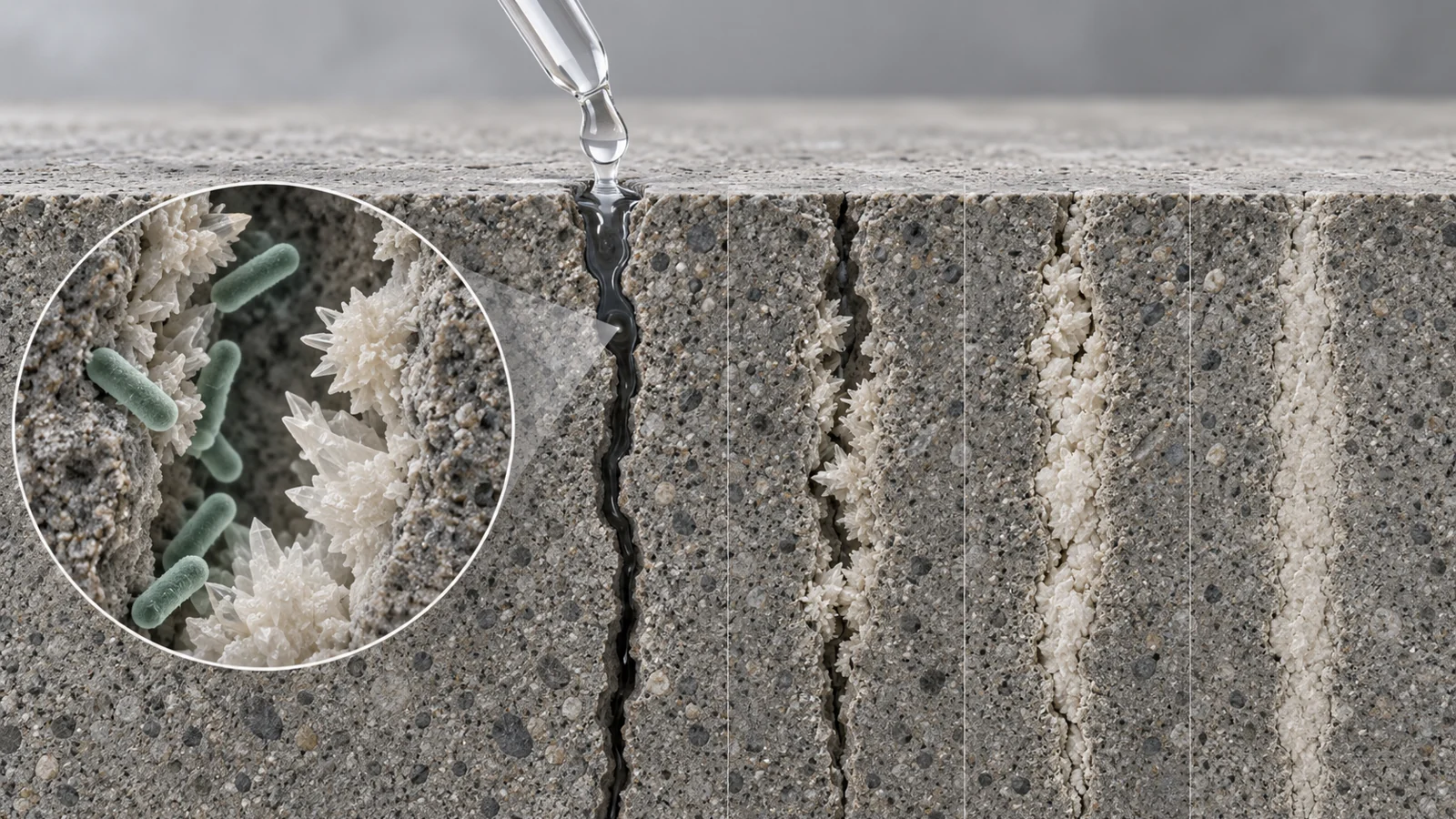
The strain was called ITBMC36. It was isolated from limestone samples and later identified through genome-based analysis as Bacillus paralicheniformis. Researchers applied a single 1 mL aliquot of bacterial suspension directly into artificial cracks in mortar. The cracks averaged 0.5 ± 0.1 millimetres wide. The specimens were incubated at 37 °C and observed over 35 days. Control cracks received sterile growth medium instead of bacteria.
The result was a gradual mineral deposit inside the treated cracks. Deposits were visible by day 7, the cracks appeared largely sealed by day 25, and near-complete visible closure was observed by day 35. The experiment also measured water absorption, giving the crack photographs a more practical companion: how much water could enter the mortar during soaking?
A single dose, followed for 35 days
The test was designed to separate several conditions rather than compare only treated and untreated material. It included intact mortar, cracked mortar without bacterial treatment, and cracked mortar treated with ITBMC36. The broader specimen groups contained ten independent samples each, while the image-based crack assessments used six specimens at defined observation points.
This arrangement made it possible to follow the treated cracks as they changed and to compare them with both an open-crack condition and the ordinary pore structure of uncracked mortar. The bacterial suspension was delivered from outside after the cracks had formed. Nothing in this setup shows a bacterium embedded throughout the mortar before damage or a material that can autonomously respond to repeated cracking.
The visual sequence is important because the mineral did not appear as an instantaneous coating. It accumulated during the observation period. By the end of the experiment, the deposits had filled most of the visible crack space in the treated specimens, while the sterile-medium controls showed no visible crack sealing over the same period.
How the bacteria can make a mineral deposit
Microbially induced calcite precipitation, or MICP, uses bacterial chemistry to promote the formation of calcium carbonate. Calcite is one crystalline form of calcium carbonate, the mineral that dominated the deposits in this study.
A central pathway is ureolysis. Urease breaks down urea, producing ammonia and carbon dioxide. The ammonia raises the local pH, shifting the surrounding chemistry toward carbonate ions. When calcium is available, those ions can combine to form calcium carbonate crystals. Carbonic anhydrase supports a related part of the process by accelerating the conversion between carbon dioxide and bicarbonate.
Exopolysaccharides can form a biofilm matrix that provides sites where calcite crystals begin to grow. In plain terms, the chemistry changes the ingredients and conditions for precipitation, while this matrix may help organize where crystals form.
The mineral tests matched that explanation without reducing it to a single crystal type. X-ray diffraction showed that the culture precipitate was mainly calcite, with smaller amounts of vaterite and aragonite. Deposits recovered from treated mortar cracks were also calcite-dominant. They contained mostly calcium, carbon and oxygen, with smaller quantities of elements likely incorporated from sand and cement. The crack-closing material was therefore not simply an unidentified white residue; it was predominantly calcium carbonate in a calcite structure.
The strongest comparison happened in culture
ITBMC36 produced 26.73 ± 0.81 grams of recovered mineral precipitate per litre in B4 medium. Under the same culture conditions, the reference strain Sporosarcina pasteurii DSM33 produced 22.60 ± 0.81 grams per litre. ITBMC36 also showed higher measured urease activity: 35.71 ± 1.24 U/mL compared with 28.27 ± 1.57 U/mL for the reference strain.
Carbonic anhydrase activity did not differ significantly between the two strains. That combination gives the comparison a narrower meaning than a general ranking of repair ability. In the culture assay, ITBMC36 generated more recovered precipitate and had higher urease activity, while the carbonic anhydrase measurement was similar. The paired results do not establish that it sealed mortar cracks better than the reference bacterium, because the verified comparison of the two strains was made in culture and enzyme assays rather than in a matched mortar-repair experiment.
The culture test itself followed a defined laboratory procedure. Bacteria were grown in B4 broth under static conditions for 14 days, then the recovered material was washed, dried and weighed. That mass is useful evidence of precipitation under those conditions. It is not a direct measurement of how much mineral will form inside a crack exposed to changing weather, mechanical stress or repeated water movement.
A complete genome adds candidate mechanisms
Hybrid sequencing produced a single circular chromosome 4,410,549 base pairs long. The assembly was assessed as complete, with low estimated contamination, providing a detailed genetic resource for interpreting the strain’s laboratory behaviour. Genome-based taxonomic analysis placed ITBMC36 within Bacillus paralicheniformis.
Several features connect naturally with the measured precipitation results. The chromosome contains a clustered urease system, including genes for the main urease components, accessory proteins needed for assembly and activation, urea transport and nickel handling. It also contains five putative carbonic anhydrase genes. The presence of several candidates may support carbon dioxide and bicarbonate conversion, although a gene annotation is not the same thing as a direct measurement of each gene’s activity in a mortar crack.
The genome includes other groups that could matter in a cementitious environment: genes associated with biofilm formation, matrix scaffolding, oxidative-stress defence, osmoprotection, pH homeostasis and sporulation. Sporulation and germination genes were especially numerous in the targeted analysis. Those findings make the strain biologically interesting because they suggest ways it might cope with difficult conditions or organize material around itself.
They remain potential explanations rather than a complete account of what happened in the mortar. The measured urease activity is an experimental phenotype. The five carbonic anhydrase genes are predicted functions. Neither result by itself demonstrates gene expression at the crack, the causal contribution of any individual locus, or long-term survival inside concrete. The genome helps connect the observed chemistry to plausible cellular functions, but it does not replace testing those functions under the conditions where a repair would need to last.
The useful water change appeared early
Crack closure matters partly because an open crack can admit water. The water-absorption results showed a time-dependent difference between the groups. Untreated cracked mortar absorbed the most water throughout the experiment. ITBMC36-treated specimens absorbed less water during the early 3–12-hour soaking period, indicating that the mineral filling restricted the initial route into the crack.
At 24–48 hours, water uptake in treated specimens increased and approached that of intact mortar as the cement matrix became saturated. This pattern is more informative than describing the treatment as waterproofing. It suggests that the bacterial deposit changed the early entry behaviour of the damaged specimens, while the surrounding mortar still took up water through its own pore structure during longer soaking.
The finding gives the visual crack sequence a functional dimension. The deposit was not only visible under a stereomicroscope; it was associated with lower early water absorption in the treated group. At the same time, the measurement does not show that the mortar regained its original strength, became permanently impermeable or received lasting protection from every aggressive substance that water might carry.
The laboratory crack is only one kind of damage
The mortar model used drying-induced microcracks because they offer relatively consistent widths and controlled comparisons. Real structures can develop cracks through loading, thermal movement and other combinations of stress. A load-induced crack may differ in shape, internal damage and transport behaviour from the drying cracks used here.
That difference matters for the meaning of visible closure. A mineral layer can fill the opening seen from above without restoring the load-bearing properties of the surrounding material. The study therefore represents a proof of concept for externally treated, small mortar cracks rather than an engineering demonstration under service conditions. It also does not test whether the treatment can respond again after a repaired region is damaged a second time.
Delivery creates another practical dependency. In this experiment, the bacteria were applied directly into an existing crack as a suspension. A field treatment would need to retain an effective population or its active chemistry where the repair is needed, despite drying, washing and other exposure cycles. Encapsulation, carrier-assisted delivery and embedded formats are possible areas for comparison, but they were not evaluated by this external application experiment.
The chemistry brings a further question. Ureolysis can generate ammonium, so the amounts of urea and calcium and the handling of resulting by-products will matter if the process moves beyond laboratory specimens. Future testing will need to combine crack closure with permeability or sorptivity, chloride penetration, wet–dry and other exposure cycles, and recovery of mechanical properties. Those measurements would show whether a mineral deposit remains useful after the kinds of stresses that make repair valuable in the first place.
What this could change
A biological treatment that can keep small cracks from admitting water could eventually give infrastructure owners another way to slow deterioration before larger, more disruptive repairs are needed. For people using buildings, roads and transport structures, the practical benefit would be less frequent interruption and a longer interval before damaged material requires direct intervention.
That possibility depends on more than a convincing photograph. The mineral seal would need to remain effective under realistic cracking and exposure, the bacteria would need a workable delivery route, and the chemical by-products would need to be acceptable for the intended setting. ITBMC36 supplies a distinct laboratory milestone: one externally applied strain combined measurable precipitation, calcite-rich crack deposits and reduced early water entry. Whether that combination can become a durable maintenance capability remains a question for engineering-scale testing.
Key Sources
- Primary source: Genomic and Functional Characterization of the Calcite-Precipitating Bacterium Bacillus paralicheniformis ITBMC36: A Promising Agent for Self-Healing Concrete.
DOI or Journal Page · Peer-Reviewed Paper · 2026-06-30