
Since the previous research note · Earlier expectation not tested
Track continuity
Since the previous research note: Selecting bacteria and shaping calcite for concrete repair
Previous expectation: The previous research note left open whether strain selection and calcite control could move from repeated 45 °C laboratory treatment toward practical bacterial concrete repair.
What this study adds: This study did not test that route. It shifted the track to a different bottleneck: embedding bacteria in methylcellulose pellets and measuring whether that delivery approach can restrict water entry through small mortar cracks without unacceptable handling and strength penalties.
What changed in this study
Bacteria added to mortar face a difficult assignment. They must survive mixing and the alkaline conditions of hardening cement, then remain available to help seal cracks that develop afterward. A laboratory study published on October 15, 2021, investigates whether packaging them in small methylcellulose pellets makes that assignment easier.
The pellets helped cracked mortar restrict water flow faster than either plain mortar or mortar containing directly added bacteria. They also reduced the flow of the fresh mixture and lowered its eventual compressive strength. The advance concerns how to deliver bacteria inside a construction material while preserving the properties that make the material useful.
The clearest performance result is reduced leakage through small laboratory cracks—a specific measure of healing that needs careful interpretation.
A small package that responds to water
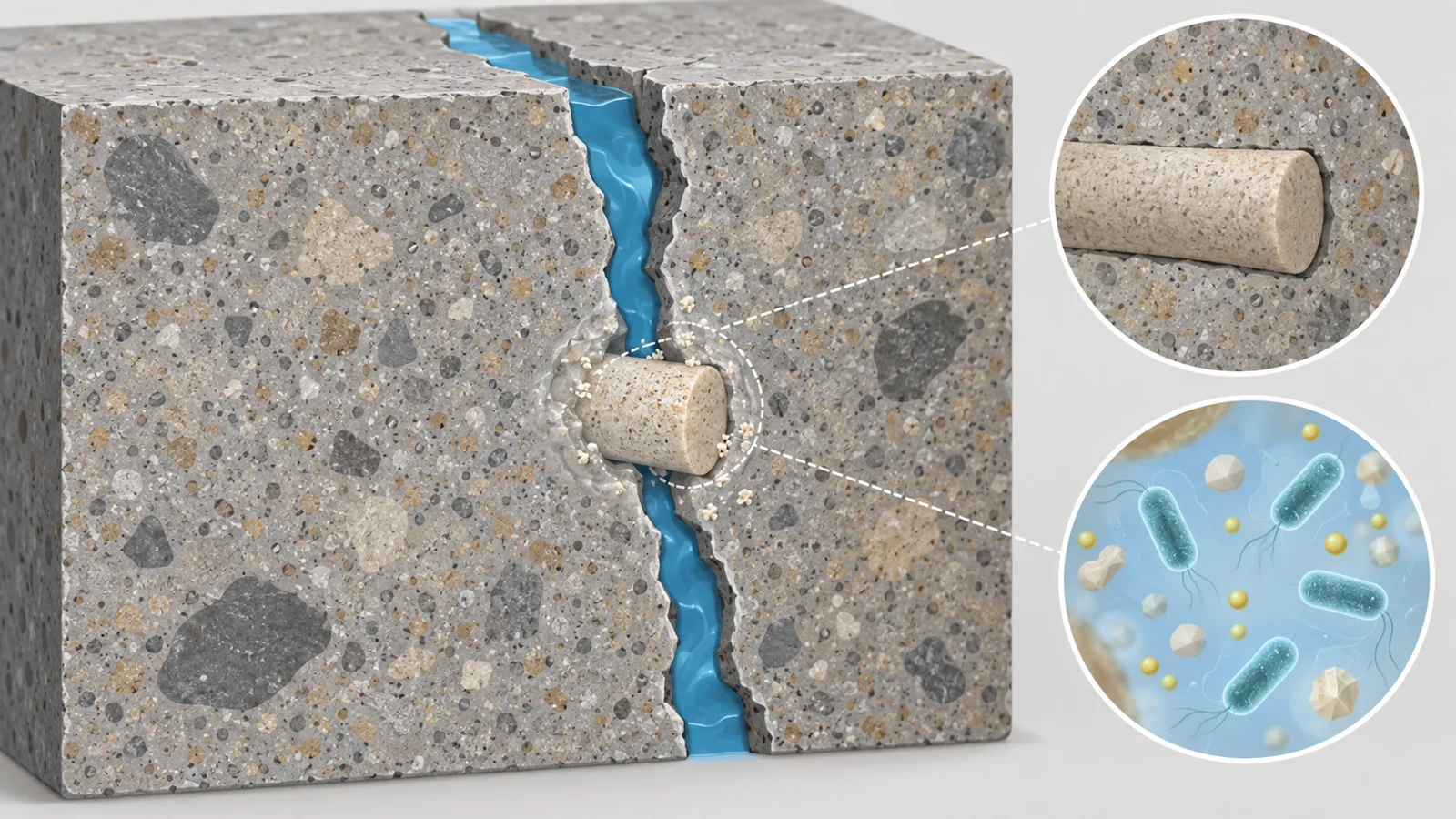
The researchers made short cylindrical pellets roughly 2 millimeters in diameter. Methylcellulose formed the main binder, with microcrystalline cellulose helping strengthen the pellet. Supporting materials included silica and diatomaceous earth, a porous material that could hold bacteria and nutrients on its surface. The bacterial pellets carried spray-dried, cocultured Lysinibacillus boronitolerans YS11 and Bacillus sp. AK13, together with nutrients.
Packaging these ingredients puts a local supply of bacteria and food inside the mortar. The proposed benefit extends beyond keeping them together. Methylcellulose swells more in neutral water than in strongly alkaline surroundings, offering a possible way to protect the contents during early hardening and make them more accessible when water enters a crack.
Separate immersion tests supported that difference in water response. After 24 hours, pellets in water had expanded to an average thickness of about 5.3 millimeters, compared with approximately 2.4 millimeters in sodium hydroxide solution and 3.1 millimeters in calcium hydroxide solution. The pellets therefore swelled in alkaline liquids too, although less than in water. Describing them as completely unchanged inside an alkaline environment would miss a feature that also matters for mixing and handling.
At a water-exposed crack, swelling could occupy some of the available space and create a favorable location for bacterial growth and mineral accumulation. The intended biological process is microbially induced calcium carbonate precipitation, in which bacterial activity helps produce mineral deposits that can obstruct water passage.
Those steps form the authors’ explanation of how the carrier could work. The experiment measured swelling separately from its observations of bacteria and cracked mortar. It did not directly follow the entire sequence of a local pH change, release from a pellet, and mineral production inside a crack.
What the bacterial measurements reveal
To investigate survival inside mortar, the team crushed samples taken at curing ages from one to 28 days, extracted material into a liquid, and cultured diluted portions. The resulting colony counts measured bacteria that could be recovered and grow under the test conditions.
Both direct addition and pellet delivery suffered substantial losses relative to their initial bacterial inputs. Nevertheless, the colony-recovery results supported better retention with the pellets. This matters because a carrier must keep some usable biological capacity through the hostile early stages of cement hardening before it can contribute to later sealing.
Colony recovery is distinct from watching bacteria operate in a crack. It does not count every living cell in place or establish how rapidly those cells produce minerals. The paper also contains inconsistent numerical descriptions of bacterial loading and survival, so the results do not support a single dependable survival multiplier or a precise percentage saving in bacteria.
Surface imaging supplied a different kind of evidence. Fluorescence staining revealed bacterial distributions, including clusters around pellets. Optical observations showed more extensive crystal coverage on the bacterial-pellet mortar surface than on the plain or directly dosed bacterial mortar.
Together, these observations support the idea that pellets provide a local environment associated with bacterial presence and crystal accumulation. They do not, by themselves, identify the crystals’ mineral form or measure how much that accumulation contributes to sealing.
Healing measured by the water that gets through
The researchers compared four formulations: plain reference mortar, mortar containing directly added bacteria and nutrients, mortar with empty pellets, and mortar with bacterial pellets. Both pellet formulations used an addition equal to 5% of the cement mass. The directly dosed and pellet formulations started with different bacterial inputs, making this a comparison of complete formulations rather than an equal-dose test of packaging alone.
For the permeability experiment, mortar cylinders were cured for 14 days, split, and secured with spacers to create narrow cracks. Measured widths ranged from about 0.25 to 0.34 millimeters. The specimens remained submerged between measurements, and water flow through each crack was tested under a fixed water head.
The paper’s “healing rate” describes the reduction in water flow relative to the initial measurement for that cracked specimen. A 90% healing rate therefore means that water flow fell by 90%. It does not mean that 90% of the crack area disappeared, that the same proportion of its volume filled, or that the mortar recovered 90% of its load-bearing capacity.
For an approximately 0.3-millimeter crack, the reported results show how the formulations separated over time:
Mortar formulation Reduction in water flow at day 7 Reduction in water flow at day 28 Plain mortar 33.5% 52.7% Directly added bacteria 43.1% 85% Empty pellets 63.7% 81.2% Bacterial pellets 77.2% 96.1%
Bacterial-pellet mortar exceeded a 90% reduction by day 14 after cracking. The progression indicates faster restriction of water passage under the study’s curing conditions, as well as the highest reported day-28 result among the four formulations.
The controls help explain why that result cannot all be assigned to bacteria. Plain mortar reduced its own permeability substantially, consistent with the intrinsic healing processes of cementitious materials. Empty pellets also produced a large improvement, showing that a carrier formulation can help obstruct water passage without its own bacterial payload.
The bacterial pellets performed better than the empty pellets, which is consistent with an additional benefit associated with the bacteria-containing formulation. But subtracting the two percentages would not isolate a purely biological effect. Swelling, local conditions, nutrients, and bacterial activity can interact, and the formulations were not otherwise identical in every relevant respect.
There is another useful distinction. At a comparable crack width, both pellet mortars already allowed less water through at the initial measurement than the other mortars. Because subsequent healing percentages use each specimen’s own starting flow, the percentages describe improvement from different initial conditions. The carrier influenced water passage before the monthlong healing comparison was complete.
The carrier also changes the mortar
A useful additive must work during construction as well as after cracking. Fresh mortar needs enough flow to be placed and consolidated, while hardened mortar must meet its intended mechanical requirements. The pellet formulation affected both stages.
Immediately after mixing, bacterial-pellet mortar spread to 134 millimeters in the flow test, compared with 164 millimeters for plain mortar. After 60 minutes, those values were 93 and 127 millimeters, respectively. The pellets therefore reduced initial flow and left a less fluid mixture as time passed. These measurements concern handling behavior; they are separate from the later leakage test.
The authors suggest that pellets absorbed some of the available water even in alkaline mortar. That explanation fits the separate observation that alkaline conditions reduced swelling without eliminating it. The same water response intended to help an exposed crack can thus affect the fresh mixture before a crack exists.
Compressive-strength testing revealed a further cost. At 28 days, plain mortar reached 60.6 megapascals. The direct results section reports that bacterial-pellet mortar was 12.38% lower, while empty-pellet mortar was 10.9% lower. Their similar strength development suggests that adding the carrier formulation itself accounted for a substantial part of the mechanical change.
Direct bacterial addition also reduced strength, with the paper reporting an average reduction of about 30% across the tested curing ages. That figure covers a different time basis from the pellets’ day-28 figures and should not be read as an exact same-age comparison.
These were strength measurements on mortar specimens at different curing ages. They did not test whether sealing a previously formed crack restored its mechanical strength. For engineering use, the relevant challenge is to retain the water-entry benefit while bringing the mixture’s handling and strength within the requirements of a particular application.
Where the laboratory evidence stops
The demonstrated conditions were favorable for water-dependent healing. Small, deliberately induced cracks remained submerged between tests. A crack in service may experience intermittent rain, drying, changing temperatures, or movement, none of which was resolved by this experiment. The study also does not establish performance in larger cracks, repeated healing after new damage, or bacterial survival over years.
The permeability figures come from laboratory comparisons, with the paper describing fitted trend lines for five specimens. They support a formulation-level result at the tested scale, rather than a universal sealing percentage for concrete structures. Mortar contains cement paste and fine aggregate; transferring its behavior to structural concrete requires further evidence.
Some reporting details also resist a more precise interpretation. Bacterial-loading and survival summaries conflict across the paper, preventing a reliable claim about exactly how much bacterial input the pellets save. That leaves the main permeability comparison useful while limiting numerical claims about why it occurred and how efficiently the bacteria were used.
No field maintenance savings, production economics, carbon savings, or extension of service life were measured. Those outcomes depend on more than sealing a laboratory crack once.
What this could change
If embedded bacterial carriers can retain their sealing behavior under practical exposure conditions and meet material requirements, they could give construction materials a built-in way to restrict water entry through small cracks. The causal benefit would begin locally: water reaches an exposed carrier, swelling and biological activity help obstruct the passage, and less water continues through that route.
For infrastructure owners and maintenance teams, dependable behavior of that kind could reduce the need to locate and treat some small cracks after construction, particularly where access is difficult. It could also help limit the water entry that contributes to deterioration. The prospect is a material that performs part of its own ingress control during use, with less subsequent intervention—a capability that makes effective bacterial delivery worth pursuing.
Key Sources
- Primary source: Use of Methylcellulose-Based Pellet to Enhance the Bacterial Self-Healing of Cement Composite.
DOI or Journal Page · Peer-Reviewed Paper · 2021-10-15