
Since the previous research note · Partly supported
Track continuity
Since the previous research note: Bacteria may close concrete cracks, but strength still matters
Previous expectation: Bacterial concrete might eventually reduce disruptive repairs if local healing persists after construction while the material retains the strength its application requires.
What this study adds: In a different concrete formulation containing recycled tire rubber, one bacterial mixture nearly matched conventional-control compressive strength and exceeded its measured flexural strength, while water-cured cracked specimens showed reported closure over 80 days. This supports part of the materials-performance premise without testing field maintenance savings or post-healing strength recovery.
What changed in this study
Concrete can absorb a large amount of material, but choosing a substitute for ordinary sand is not simple. Crumb rubber made from discarded tires offers a potential outlet for waste, yet its softness and weak bonding with cement can reduce the strength of the finished material. A laboratory study published on 28 April 2025 tested whether two bacterial strains could offset that penalty while also helping deliberately cracked concrete close its cracks.
The study examined Sporosarcina pasteurii and Rhizobium leguminosarum in rubberized concrete, meaning concrete in which part of the sand was replaced with crumb rubber. The result is not a demonstration that any tire-rubber mixture can match ordinary concrete. It is a more specific finding: one tested combination nearly recovered the conventional control’s resistance to crushing and exceeded its measured resistance to bending, while separate water-cured specimens showed substantial visible crack closure over time.
The material tradeoff starts with the aggregate
The researchers replaced 15% of the sand by volume with two sizes of crumb rubber. That percentage refers to the sand fraction, not to 15% of the entire concrete mixture. The rubber-only formulation was labelled M1. The conventional concrete, with no rubber or bacteria, was M0.
Nine further mixtures, M2 through M10, contained the same rubber replacement together with both bacterial strains at different reported concentration settings. The comparison therefore had three useful reference points: ordinary concrete, rubber-only concrete, and rubberized concrete modified with the two-strain bacterial mixtures.
Fresh concrete also has to be workable enough to place and compact. In the tests, adding rubber reduced the slump, a simple measure of how readily the fresh mix flows. The authors attributed this partly to the rubber’s shape and surface texture. Bacterial additions increased the reported slump in several mixtures, especially at higher settings, but the mixture that flowed most readily was not automatically the mixture with the best hardened strength. Workability and later mechanical performance are related parts of construction, not interchangeable measurements.
One combination nearly closes the strength gap
The clearest comparison comes from the 28-day results. Compressive strength measures resistance to crushing. Flexural strength measures resistance to bending failure, which matters when a slab, beam or other component is loaded in a way that creates bending.
| Mix | Description | Compressive strength at 28 days | Flexural strength at 28 days |
|---|---|---|---|
| M0 | Conventional concrete | 35.30 MPa | 3.84 MPa |
| M1 | 15% sand replacement with crumb rubber | 17.30 MPa | 1.82 MPa |
| M6 | Rubber plus the tested bacterial combination | 34.38 MPa | 4.32 MPa |
The rubber-only mix reached less than half the control’s compressive result in this comparison and had a much lower flexural result. M6, by contrast, reached 34.38 MPa in compression, close to M0’s 35.30 MPa. Its flexural strength was 4.32 MPa, above the control’s measured 3.84 MPa.
The paper reports these as increases of 98.7% in compressive strength and 137.4% in flexural strength. Both percentages use M1, the rubber-only concrete, as the denominator. They do not mean that ordinary concrete became nearly twice as strong. They describe how much the bacterial mixture improved the performance lost after rubber replaced part of the sand.
The concentration pattern also matters. The highest reported bacterial settings did not produce the highest mechanical values. M6, associated with the paper’s strongest 28-day mechanical results, used an intermediate pairing rather than simply the maximum setting for both organisms. More bacteria was therefore not a sufficient explanation for better hardened performance in this experiment.
The proposed repair happens through mineral deposits
The authors connect the strength recovery and crack closure to the formation of calcium carbonate, or CaCO₃, within pores, voids and cracks. Their proposed division of roles is not a separately isolated proof of each organism’s contribution. Instead, it is an interpretation of the combined two-strain mixtures and the observed material changes.
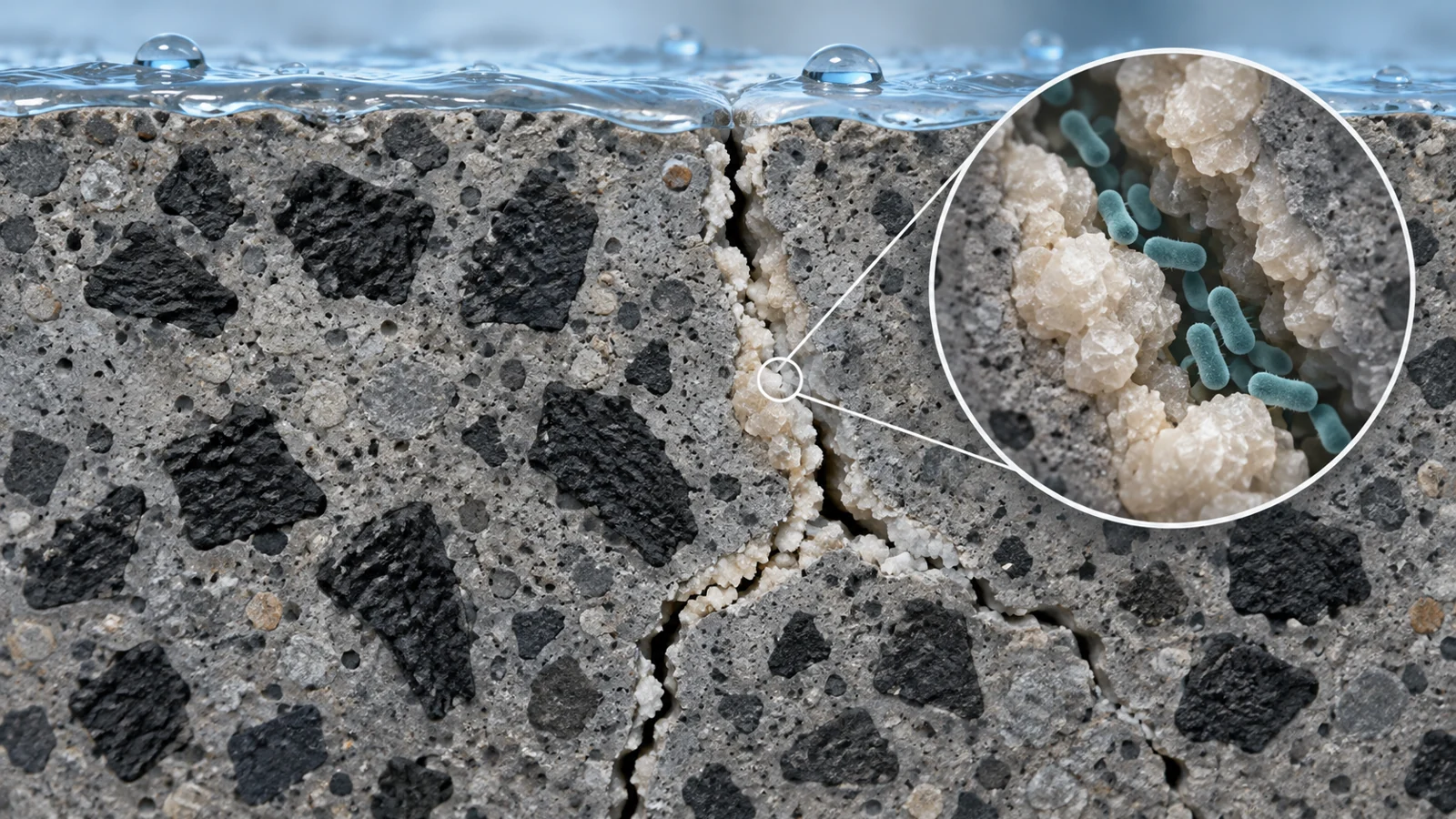
Sporosarcina pasteurii is discussed as a calcium-carbonate-producing bacterium. The precipitated mineral can occupy empty spaces and microcracks, creating a denser region inside the cement matrix. Rhizobium leguminosarum is discussed as producing a biofilm that can help bind particles and reduce the size of pores. In practical terms, the proposed process is less like rubber growing across a crack and more like mineral matter being deposited into spaces that weaken the cement structure.
The microscopy work examined four mixtures at 56 days: the conventional control, the rubber-only mix, and two bacterial mixtures including M6. Scanning electron microscopy was used to view features such as voids and cracks, while energy-dispersive X-ray analysis helped characterize elements in the material. The authors interpreted the bacterial samples’ denser appearance, reduced voids and calcium-rich observations as consistent with CaCO₃ formation and filling. Because the two organisms were used together, the experiment does not show how much of the observed change came from either strain alone or whether their effects were synergistic.
Cracks were followed under water curing
The healing observation used a different schedule from the strength tests. Concrete specimens were first water cured for seven days. The researchers then applied 30–40% of the ultimate load to create deliberately damaged specimens with reported crack widths ranging from 0.41 to 1.25 millimetres. After loading, the specimens were returned to water curing and inspected over time.
After 28 days of healing, white mineral deposits had partially covered the crack surfaces and filled some voids. The authors report approximately 90% healing for the illustrated M6 specimens and 88% for M9 at that stage. The reported result was stronger after 80 days: the illustrated bacterial mixtures were assessed optically as having reached complete crack closure, with M6 and M9 each reported at 100% in the corresponding observations.
The timing is important. The compressive tests were reported at 7, 28 and 56 days, and the flexural tests at 28 and 56 days. The crack observations followed intentionally damaged specimens through separate water-curing intervals of 28 and 80 days. A later visual assessment of a crack is not the same measurement as the original load test.
Visible closure is only one part of performance
The water-cured crack experiment shows that mineral deposits can visibly fill and cover cracks under the conditions used. It does not show how much load-bearing capacity a cracked specimen recovered after healing. The strength comparison and the crack-healing observation also do not function as one combined test of a single component before damage, after damage and after repair.
The reported crack range was broad, and the supplied results do not establish that every width healed completely in every mixture. The study also leaves open whether the bacteria remain functional through repeated damage, whether the same process works when moisture is intermittent rather than continuously available, and how the material performs under realistic combinations of traffic, vibration, temperature and structural loading. Those questions are central to any claim about infrastructure lifespan or reduced repairs.
This boundary is especially relevant because a mineral-filled surface can look repaired while the internal load path remains partly weakened. The experiment makes a promising materials observation, but it does not yet convert visible closure into demonstrated structural recovery or field durability.
What this could change
A reproducible version of this mix could give concrete producers a way to use some recycled tire rubber without accepting the full strength loss seen in the rubber-only formulation. Components designed for suitable loads could combine a waste-reuse benefit with a bacterial treatment that helps address some local crack damage when water is available for the healing process.
For asset owners, the practical attraction would be more than a sealed line on the surface. If the material retained application-appropriate strength and healed relevant damage repeatedly under service conditions, it might reduce the frequency or disruption of localized repair work. Any maintenance saving would be a downstream possibility, not a result measured in this laboratory study.
The path to that outcome depends on repeatable production, performance matched to each construction use, and healing that remains effective under realistic moisture and loading cycles. The 2025 results support the possibility of useful recycled-rubber concrete with bacterial assistance. They do not yet establish a ready-made structural material or a proven reduction in construction waste, cost or maintenance.
Key Sources
- Primary source: Characteristics of bacteria based self healing rubberized concrete for sustainable and durable construction.
DOI or Journal Page · Peer-Reviewed Paper · 2025-04-28