
Since the previous research note · Earlier expectation not tested
Track continuity
Since the previous research note: How bacterial mineral deposits formed at small concrete cracks
Previous expectation: Stable bacterial mineral deposits might reduce water entry through small cracks and postpone some sealing work if they remain effective under service conditions.
What this study adds: This study compares direct bacterial incorporation with wood-ash carriers in water-treated mortar, then reports mechanical properties for concrete containing the selected carrier treatment. It adds evidence about delivery and material performance, without establishing the earlier forecast's durable moisture-protection outcome.
What changed in this study
A concrete crack can appear to close without showing that a damaged structure has regained its original load-bearing capacity. That distinction frames a January 2023 study of Bacillus cereus MG708176, an endospore-forming bacterium that produced calcium carbonate and tolerated the study’s alkaline test conditions.
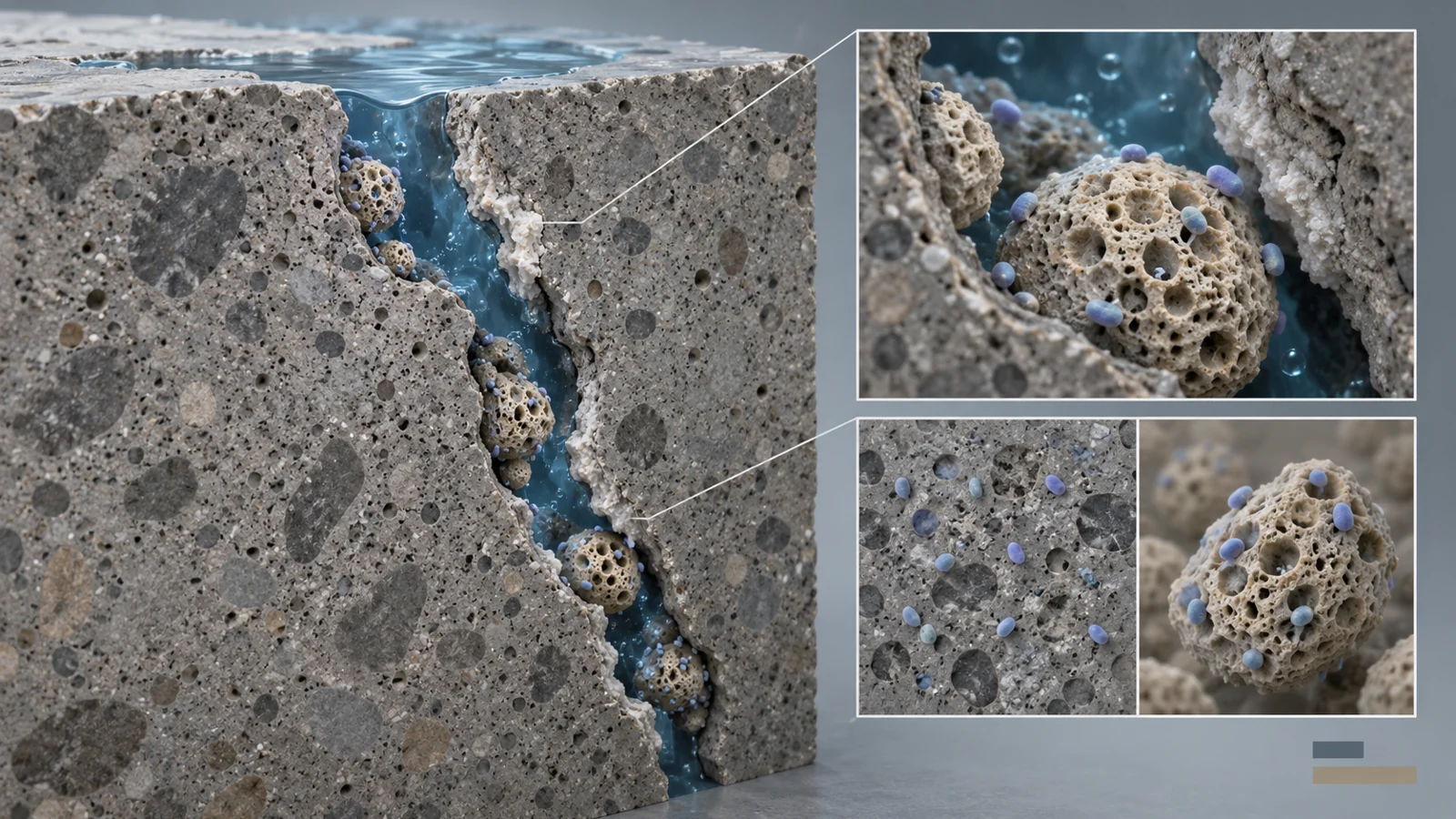
The researchers focused on delivery. Instead of mixing bacterial spores directly into cementitious material, they placed them on fine wood ash before adding them to mortar and concrete. The study then compared visible crack healing in mortar with strength measurements from concrete specimens. Its central contribution is therefore about both biological activity and the carrier that helps place it inside the material.
Why the carrier matters
Concrete becomes chemically harsh during cement hydration, which can expose bacterial cells or spores to damaging conditions. The researchers treated wood ash as a physical carrier intended to keep spores distributed and protected within the mixture. The bacterium supplied the biological activity; the carrier provided a sheltered location; nutrients supplied materials for the reaction; and the resulting mineral deposits were expected to help fill cracks and pores.
The isolate tested positive for urease activity and calcium-carbonate precipitation. Calcium carbonate appeared in a nutrient medium containing urea and calcium chloride, and the strain tolerated the alkaline characterization medium up to pH 14. These tests explain why the researchers considered this particular isolate suitable for a cement-based experiment. They describe properties of the tested strain under laboratory conditions, rather than a general rule for all bacteria or concrete formulations.
The proposed sequence was that activated spores would use the supplied nutrients and contribute to calcium-carbonate formation when cracks exposed the relevant interior regions. The carrier was important because the researchers connected its use with better preservation of the biological ingredient inside the concrete. That interpretation makes the delivery system part of the engineering question, rather than treating the bacterium as a stand-alone additive.
A staged comparison in mortar
The first experiment used four mortar mixtures. One control contained the ordinary mortar constituents without wood ash or bacterial spores. A second contained wood ash but no spores. A third received bacterial spores directly, without a carrier. The fourth contained spores immobilized on wood ash.
Those controls allowed the researchers to separate several effects. Wood ash could influence the mortar independently of bacteria, while direct inoculation showed what happened when spores were present without the proposed carrier. The wood-ash bacterial mixture could then be compared with both untreated mortar and the carrier-only treatment.
The mortar beams measured 40 by 40 by 160 millimeters. After cracking and water treatment, the study presented stereomicroscope images associated with 7-, 14-, and 28-day assessment points. The specimens containing bacterial spores on wood ash were reported as completely healed at all three points. Directly inoculated specimens were reported as completely healed at the 7- and 14-day points, while the authors described weaker healing at the later point.
The images support a difference between the two delivery methods under the tested conditions. They do not provide a universal crack-sealing rate: the reported schedule does not resolve one unambiguous elapsed healing duration, and the study extracts do not establish a precise maximum crack width.
Microscopy added a structural view of the repaired regions. The researchers identified calcite and ettringite in bacterial concrete cracks and described a composite structure called “BacillaFilla,” made up of calcite, filamentous bacterial cells, and bacterial secretions described as levan glue. In their interpretation, these materials helped knit the crack area together. The control images were described as looser and lacking the same calcite features.
What stronger concrete specimens actually measured
After selecting the bacterial wood-ash method as the preferred mortar treatment, the researchers used a separate concrete comparison. The control, labelled C, contained the concrete constituents and wood ash without bacterial spores. The treatment, labelled T, contained the same basic arrangement with wood ash and spores. This was a comparison between newly prepared formulations, not a test of a previously fractured structural member returning to its former capacity.
The concrete tests were performed after 28 days. Three specimens were examined for each reported strength measurement, and the results were given as means with standard errors. The bacterial wood-ash concrete reached a tabulated compressive strength of 41.2 ± 3.23 MPa, compared with 31 ± 1.90 MPa for the wood-ash control. Compression describes resistance to being squeezed, which is important for concrete but represents only one type of load response.
Splitting tensile strength was 4.55 ± 0.30 MPa with bacterial wood ash and 3.69 ± 0.43 MPa in the control. This test concerns resistance to forces that tend to pull the specimen apart. Flexural strength, which concerns bending, was 6.98 ± 1.06 MPa in the bacterial treatment and 4.98 ± 0.33 MPa in the control. The table marks the treatment and control values as significantly different at the reported threshold of P ≤ 0.05.
The paper’s summary also gives percentage improvements of 24.7%, 18.9%, and 28.6%. Those figures do not align consistently with the tabulated means and their denominators, and the tensile and flexural assignments are inconsistent across the supplied descriptions. The absolute table values are therefore the clearer numerical basis. Direct calculations from those means give differences of roughly 33% for compression, 23% for splitting tension, and 40% for flexure, without replacing the study’s statistical analysis.
These measurements show how the tested formulations performed under specified loads after curing. They should not be read as proof that an already cracked beam, wall, or bridge component recovered its original structural capacity. Visual closure and specimen strength are related results, but they answer different questions.
From carpentry waste to a prepared carrier
The proposed carrier was not simply loose ash added to the mix. The researchers obtained sawdust from carpentry shops and burned it in an electric oven at 570 °C. They sieved the ash to obtain particles around 0.2 millimeters and remove coarser material.
Separately, the bacterial isolate was cultured, and spores were harvested through repeated processing. The suspension was heated at 80 °C for 35 minutes to inactivate vegetative cells, and viable spores were counted. The ash was then impregnated with spores and nutrients, including calcium chloride, urea, and yeast extract. Loaded particles were dried at 37 °C for five days before being introduced into mortar or concrete. The tested concrete mixture used 1.3 × 10⁷ spores per cubic centimeter of the entire mixture.
This sequence makes the waste-derived idea more tangible while showing why a low-cost raw material is not the same as an established low-cost healing system. Burning, sieving, loading, drying, handling, and quality control all form part of the preparation. The study supports wood ash as a candidate immobilization material, but it does not establish total production cost, lifecycle environmental benefit, maintenance savings, or commercial readiness.
Reading the result at infrastructure scale
The laboratory results connect three observations: bacterial spores can be prepared on wood ash, treated mortar cracks can appear closed in water exposure, and concrete made with the bacterial carrier can show higher measured strength than the selected wood-ash control. The microscopy gives the proposed mineral-filling process a visible material signature, while the load tests show how the prepared concrete specimens responded after 28 days.
The practical interpretation becomes narrower when the test endpoints are kept separate. Water-treated crack observations do not establish durable reductions in water passage. Strength measurements from newly made specimens do not establish repair of a fractured structural member. The study also does not establish repeated healing, long-term function under service conditions, or performance in operating infrastructure.
The carrier-protection explanation is a proposed mechanism supported by the design and results, not a direct demonstration of a biological reserve remaining effective throughout a structure’s service life. Conditions such as changing moisture, temperature, loading, and repeated damage could affect how the mixture behaves. Nor should the findings be generalized to every bacterial strain, ash source, concrete formulation, crack size, or exposure environment.
That leaves the study in a useful middle ground. It is more informative than a simple claim that bacteria can heal concrete because it compares direct incorporation with a carrier and then measures several kinds of material strength. But it remains an early laboratory result rather than evidence that a finished infrastructure system can be relied on for autonomous structural repair.
What this could change
If the carrier approach continues to work under realistic service conditions, wood ash could help build a reserve of crack-sealing capacity into concrete instead of adding spores without protection. A material that closes some small cracks on its own could potentially reduce later sealing work, water-entry interventions, or localized maintenance for infrastructure owners.
That payoff depends on several conditions: the carrier must be prepared consistently, the biological response must remain useful over the life of the concrete, and the resulting material must perform across the moisture, temperature, loading, and construction conditions that real structures experience. The January 2023 study supplies an early piece of that chain by linking a waste-derived carrier with crack closure and higher measured strength in selected specimens. It does not yet turn that possibility into a proven repair system.
Key Sources
- Primary source: Impact of the immobilized Bacillus cereus MG708176 on the characteristics of the bio-based self-healing concrete.
DOI or Journal Page · Peer-Reviewed Paper · 2023-01-10