
Since the previous research note · Earlier expectation not tested
Track continuity
Since the previous research note: A computer model separates carrying more from bending less in bacterial concrete
Previous expectation: If bacterial repair works in real reinforced members, infrastructure could retain structural performance while needing fewer repair interventions.
What this study adds: This study examined heat-exposed fiber-reinforced lightweight concrete specimens, finding lower post-curing water absorption and a stiffness-recovery signal without a compressive or flexural strength advantage over the control. It did not directly test the earlier reinforced-beam model or its predicted capacity increase.
What changed in this study
A concrete specimen can become better at resisting water entry without becoming stronger under load. That tension sits at the center of a laboratory study published on November 4, 2022, on bacterial self-healing concrete after severe heating.
Bacterial self-healing concrete is designed to use bacteria to help fill cracks with mineral deposits. In this experiment, the approach improved one important measurement after heating and 28 days of water curing: the concrete containing the biological treatment absorbed less water than the control. Yet it did not gain an advantage in compressive or flexural strength. Its measured elastic modulus was higher, creating a more specific picture than either a success story or a failed repair.
A porous carrier gave the repair system a place to wait
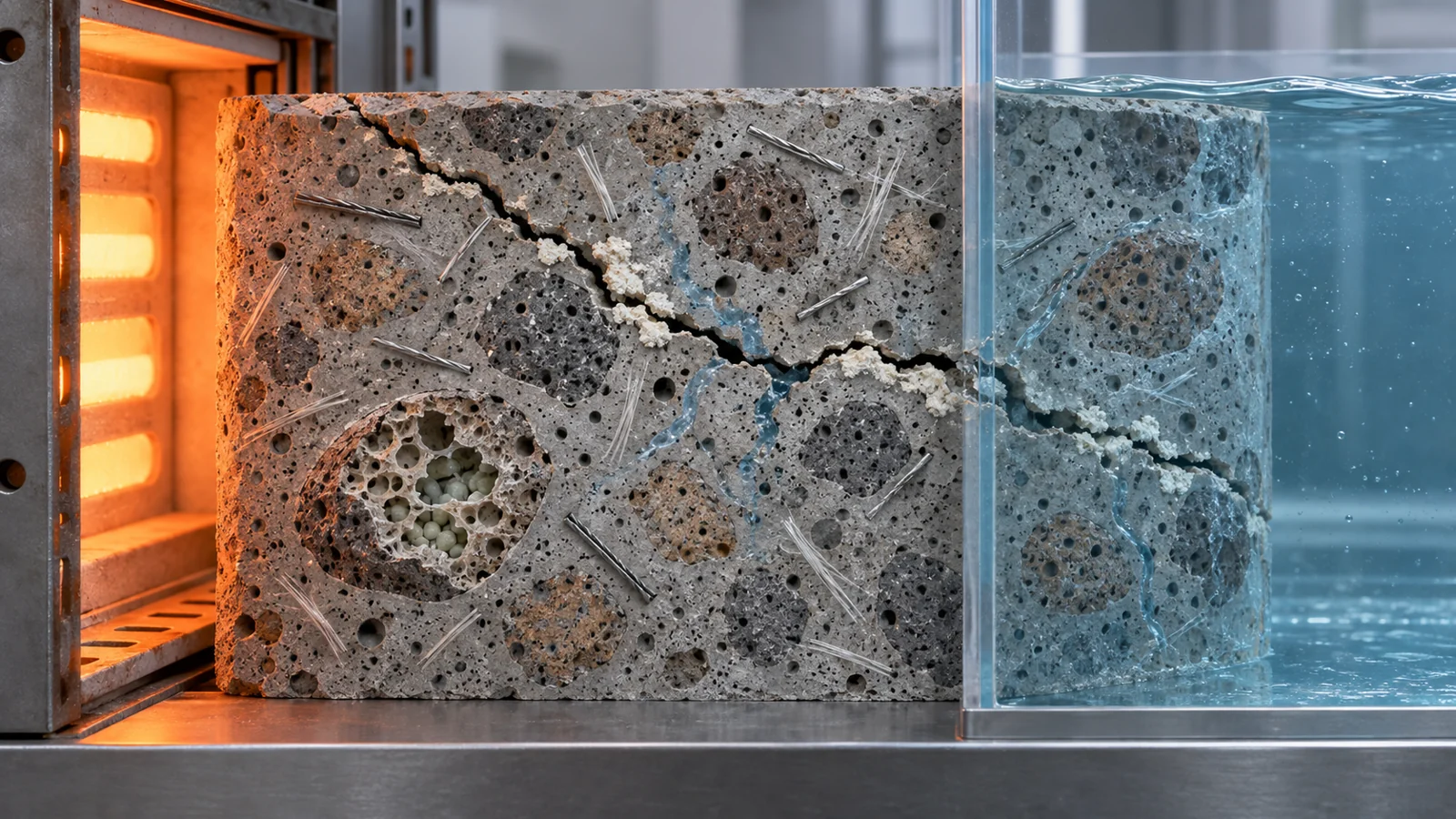
The study used fiber-reinforced lightweight concrete in both groups. The difference was inside the lightweight aggregate. In the experimental mix, the aggregate carried bacterial spores and a nutrient package. In the control mix, the aggregate did not contain the spores or nutrients.
The carrier was intended to protect the bacterial system inside the concrete until conditions allowed activity to resume. The preparation involved soaking the lightweight aggregate in a solution containing calcium lactate and yeast extract, drying it, repeating the nutrient treatment, and then immersing it in a bacterial spore solution before another drying period. The concrete also contained steel fiber at 0.75 percent by volume and polypropylene fiber at 0.09 percent by volume, so the comparison concerned two fiber-reinforced lightweight concretes rather than ordinary concrete versus a biological material.
That distinction matters. The experiment tested a bundled treatment: bacterial spores and their accompanying nutrients were added together. It did not separately measure what portion of any later change came from the bacteria, the nutrient package, the carrier, or ordinary concrete processes.
The furnace separated crushing from bending
The specimens were placed in a furnace that rose to 500 °C at 2 °C per minute. The target temperature was held for one hour, after which the concrete cooled naturally inside the furnace to room temperature.
The heat did not affect every property in the same way. Relative compressive strength after heating was 0.97 for the control group and 1.01 for the experimental group, values that remained close to the respective room-temperature benchmarks. That result says that resistance to crushing was not the main sign of damage in this test.
Bending told a different story. The residual flexural strength was 2.86 MPa for the control and 2.61 MPa for the experimental group. Relative to their room-temperature values, those represented 63.6 percent and 59.9 percent, respectively. Both groups therefore lost a substantial share of their bending resistance after the 500 °C exposure.
Stiffness also declined. The relative elastic modulus was 0.76 for the control and 0.71 for the experimental mix. A material can retain much of its compressive capacity while becoming less resistant to bending and less stiff. Those are different forms of performance, and they should not be combined into a single label such as recovered or damaged.
Water uptake improved, but the concrete was not back to baseline
The water-absorption sequence provides the clearest favorable result. Before heating, absorption was 3.3 percent in the control group and 3.2 percent in the experimental group. After exposure to high temperature, it rose to 10.3 percent and 10.9 percent, respectively.
After 28 days of water curing, absorption fell to 6.7 percent in the control and 5.6 percent in the experimental group. The bacteria-and-nutrient treatment therefore produced the lower post-curing value, a difference of 1.1 percentage points compared with the control.
But neither group returned to its preheating level. The lower value is evidence of partial improvement in resistance to water entry, not complete restoration of the original internal structure. The curing water also helped both mixes, consistent with further hydration of cement material that had not previously reacted and with deposits forming in smaller cracks and pores.
The location of the absorption specimens makes the favorable comparison more specific. The researchers cut the test pieces from the middle of the concrete cylinders after heating. They attributed the experimental group’s lower absorption to relatively greater bacterial survival in that interior region, where bacterial mineralization may have been more pronounced and the material became more compact. This is not the same as showing that every part of a heat-damaged concrete member would receive the same benefit.
Stiffness improved without a load-bearing win
The mechanical results after curing sharpen the distinction. After 28 days of self-healing in water, compressive strength was 34.91 MPa in the control group and 33.06 MPa in the experimental group. Flexural strength was 3.28 MPa and 2.90 MPa, respectively. On those two measures, the bacteria-containing concrete did not outperform the control.
The elastic modulus moved in the other direction. The control reached 21.32 GPa, while the experimental group reached 25.28 GPa. Relative to the post-heating values, the modulus recovery ratios were 1.08 for the control and 1.24 for the experimental group. The difference suggests a stiffness-recovery signal in the treated concrete even though the strength tests did not show a bacterial advantage.
This is why the lower absorption result should not be translated into a claim that the concrete regained its full load-bearing performance. Water movement, stiffness, crushing resistance and bending resistance describe related but separate parts of a concrete member’s condition. In this study, they did not recover in lockstep.
Minerals show filling, not a single cause
Microscopy showed healing precipitation along the cracks, while X-ray diffraction identified calcite in both groups. The experimental specimen also showed a prominent calcium carbonate peak. Calcite is compatible with the proposed bacterial mineralization process, but its presence does not identify a single producer. The paper also describes ordinary cement hydration as a contributor to crack filling, especially when water allows unhydrated cement particles to react.
The crack-width observations fit that mixed explanation. Crack widths decreased during water curing in both groups. The authors report that the reduction in the experimental group was not substantial and suggest that heat-related losses of viable bacteria may have limited mineralization; they also note that no additional nutrient source was supplied during water-tank curing.
That constraint is important because nutrients had been placed in the lightweight aggregate at the start of the experiment. Initial loading was not the same as a continuing supply during the 28-day curing period. If biological activity slowed after the available resources were used or after heat-related losses, deposits could still appear through ordinary hydration and other mineral-forming processes without demonstrating that bacteria caused all of the measured recovery.
The study also does not provide a separate bacterial-only comparison. Because the spores and nutrient package traveled together, the design cannot isolate their individual contributions. Nor do the reported mineral observations establish a numerical survival rate, a verified temperature profile through the cylinder, or a general advantage for structural strength after a real fire.
What this could change
If this kind of biological filling can be made reliable inside heat-damaged concrete, its most practical future value may be control of moisture pathways rather than an immediate replacement for structural assessment. Reducing water entry through internal cracks could help limit a route by which further deterioration begins, potentially lowering some maintenance demands for infrastructure owners.
That possibility depends on several conditions. The effect would need to persist beyond a controlled water-curing period, work across the relevant parts of a real component, and coexist with independently verified structural adequacy. A lower absorption value in heated laboratory cylinders is a promising repair signal, but it is not evidence that an occupied building is safe after a fire. The useful capability, if later established, would be targeted protection against continuing moisture ingress alongside—not instead of—decisions about the member’s actual load-bearing condition.
Key Sources
- Primary source: Application of Biomineralization Technology to Self-Healing of Fiber-Reinforced Lightweight Concrete after Exposure to High Temperatures.
DOI or Journal Page · Peer-Reviewed Paper · 2022-11-04