
Since the previous research note · Earlier expectation not tested
Track continuity
Since the previous research note: Pineapple fibres change how bacterial concrete handles load and water
Previous expectation: A bacterial concrete formulation might reduce maintenance if it retained useful performance in realistic service and gained durable crack-repair capability.
What this study adds: The current study reports the timing between spore germination, renewed urease activity, and deposition, together with potentially reversible environmental inhibition for Bacillus sphaericus LMG 22257. It adds a biological activation milestone without establishing a test of the earlier formulation's performance forecast.
What changed in this study
Concrete that can help seal its own cracks depends on more than keeping bacteria inside the material. The bacteria must become active at the right time, produce the activity linked with mineral deposition, and begin that deposition under conditions that may be harsh. A study published on June 17, 2026, examines that sequence in spores of Bacillus sphaericus LMG 22257.
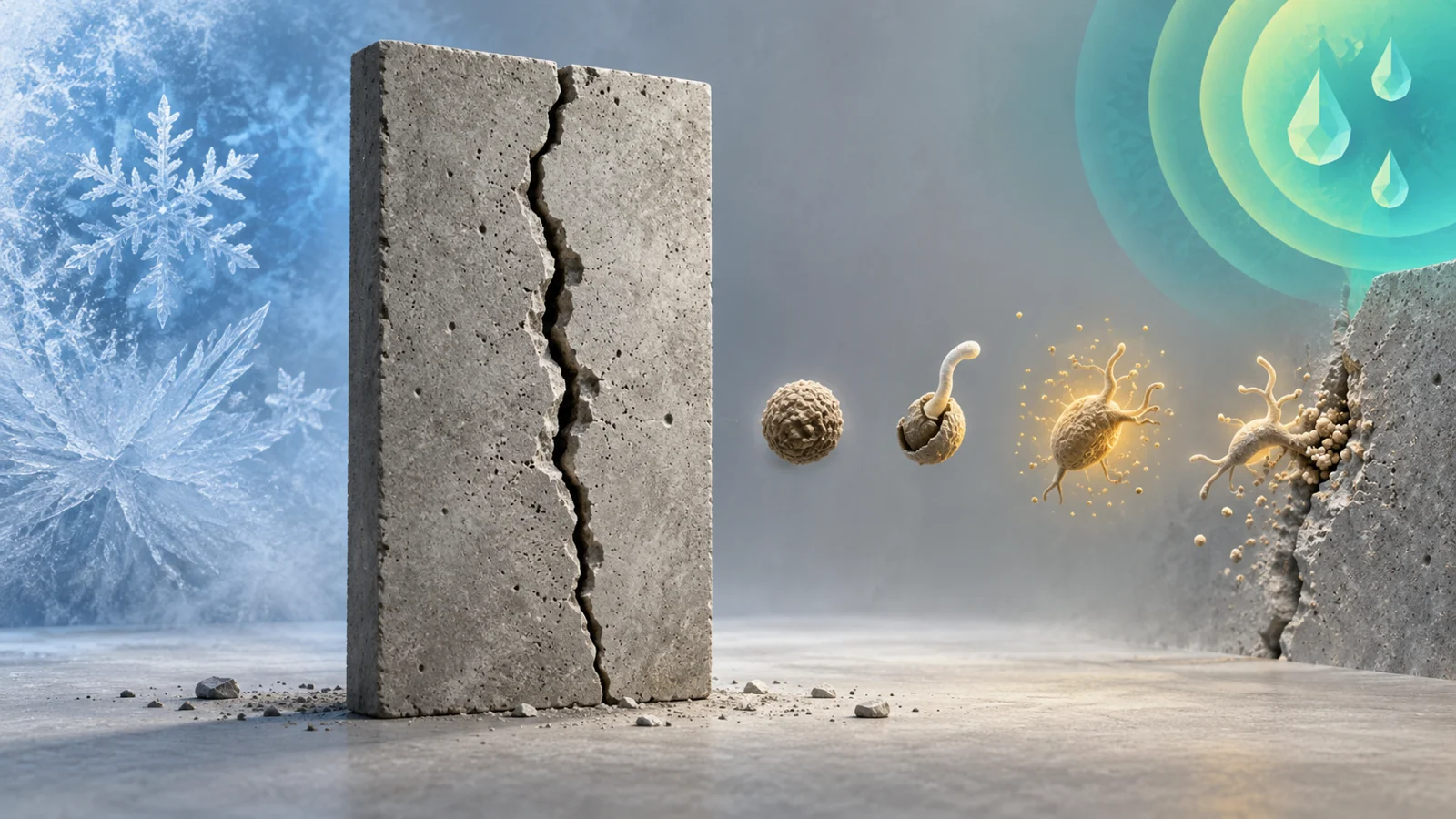
The central question is practical but easy to blur: when a dormant spore begins to wake, how long does it take for the biological activity associated with deposition to return? The study separates three stages—spore germination, renewed urease activity, and bio-deposition—and places them on a timeline rather than treating “activation” as one event.
Germination comes before the deposition-related activity
The spores did not regain urease activity at the same moment they germinated. The study reports a delay of approximately 5 to 24 hours between those events. In other words, germination marked an earlier transition, while the return of urease activity came later.
The next step followed closely. Renewed urease activity occurred almost simultaneously with bio-deposition. That timing makes the enzyme-related stage a useful marker for when the process is moving toward deposition, while also showing why the first signs of spore activation should not automatically be treated as the beginning of material repair.
This is a biological sequence, not a crack-sealing timetable. The reported measurements do not establish how quickly a crack would close, how wide a crack could be sealed, or whether the surrounding concrete would regain strength or water resistance. They locate the advance at the level of activation and deposition timing.
Harsh conditions could pause the process without ending it
The study also tested conditions that can suppress activity. High alkalinity at pH 12 and a low temperature of 10°C were associated with inhibition, but the effect was described as potentially reversible. When the conditions were adjusted to pH 9 or 28°C, the spores could regain activity and restart bio-deposition within 72 hours.
The two stressors matter for different reasons. High alkalinity represents a chemical environment that can interfere with biological activity, while low temperature represents a thermal condition that can slow or suppress it. The reported recovery after adjustment suggests that an inactive period under either condition need not be interpreted as permanent loss of activity for this strain and these tested conditions.
That recovery window should still be read narrowly. It does not show indefinite survival, repeated recovery through multiple environmental cycles, or reliable performance across every concrete environment. It shows that activity could return after the exposure conditions were moved into the reported ranges.
Urea changes the starting delay
Chemical conditions also influenced the earliest stage. Urea concentrations from 75 to 900 mM were reported to significantly accelerate spore germination. This result concerns the lag before germination, not a complete recipe for crack repair and not a demonstrated optimum for construction use.
The distinction matters because a shorter germination delay does not automatically shorten every later stage by the same amount. Germination still has to be followed by renewed urease activity, and that activity has to coincide with deposition under conditions that support the process. The study therefore points to chemical regulation as one way of influencing activation timing, while leaving the broader performance question open.
The reported concentration range also should not be converted into a field instruction. The available findings do not establish a monotonic dose response, an ideal urea concentration, compatibility with a particular concrete formulation, or the durability of any resulting repair.
A clearer activation milestone for self-healing concrete
For infrastructure owners, the potential value is predictability. If bacterial repair systems could begin their deposition-related activity more reliably after cracking, engineers might eventually be able to design concrete that seals damage with fewer unexpected delays. That could support more dependable maintenance planning and reduce the need for some repair interventions—but only if the biological timing observed here transfers to realistic cracks and produces durable, functionally useful sealing.
The supplied evidence does not establish whether this biological timing produces durable crack sealing, recovered strength, restored water resistance, or longer service life. It concerns one named strain under specified pH, temperature, and urea conditions, so the timing should not be generalized to other bacteria or all concrete settings.
What the work adds is a more precise biological milestone. Germination comes first, urease activity returns roughly 5 to 24 hours later, and deposition begins almost alongside that renewed activity. Inhibition at high alkalinity or low temperature may be reversible after conditions change, while urea can accelerate germination within the reported range. Those findings help define when the repair process may become active; they do not yet show that the concrete has completed a useful repair.
What this could change
Self-healing concrete could become more dependable if its bacterial activation stage can be controlled well enough to produce durable crack sealing in real structures. The reported timing and recovery behavior offer a basis for that possibility: a dormant biological system may be able to restart after unfavorable exposure, and its initial delay may be influenced by the chemical environment. The practical benefit for infrastructure users remains conditional on those responses surviving the complexity of actual cracks and translating into lasting material function.
Key Sources
- Primary source: Fundamental study on the germination, revival of urease activity, and bio-deposition behaviors of Bacillus sphaericus spores for microbial self-healing concrete.
DOI or Journal Page · Peer-Reviewed Paper · 2026-06-17