
Since the previous research note · Partly supported
Track continuity
Since the previous research note: When water helps bacterial concrete repair and when it acts too soon
Previous expectation: A bacterial reserve that survives production and later maintains crack sealing could reduce damaging ingress and disruptive infrastructure maintenance.
What this study adds: This review brings carrier design and distinct engineering outcomes into the account, including a cited specimen study linking bacterial crack closure with inhibited reinforcement corrosion. That supports one part of the earlier pathway through synthesized evidence rather than a new test of the combined forecast.
What changed in this study
Concrete is strong, durable and relatively inexpensive, which explains its central role in buildings, bridges, dams and roads. Its weakness often begins with something that looks minor: a crack. Once water, chlorides or other aggressive substances enter that opening, they can reach embedded steel reinforcement and accelerate deterioration. Repair may then require resin injection, sealants or patching, followed by more work when the repair no longer holds.
Bio-self-healing concrete approaches the problem differently. It embeds dormant bacteria in the concrete so that, when a crack admits water, the bacteria can become active and help deposit calcium carbonate inside the opening. The idea is appealing because the material could respond locally instead of waiting for a repair crew. But the bacteria are only one part of the system. The material that houses and protects them, the chemistry around them and the engineering measurement used to judge success all influence what “healing” actually means.
A small crack can open a large problem
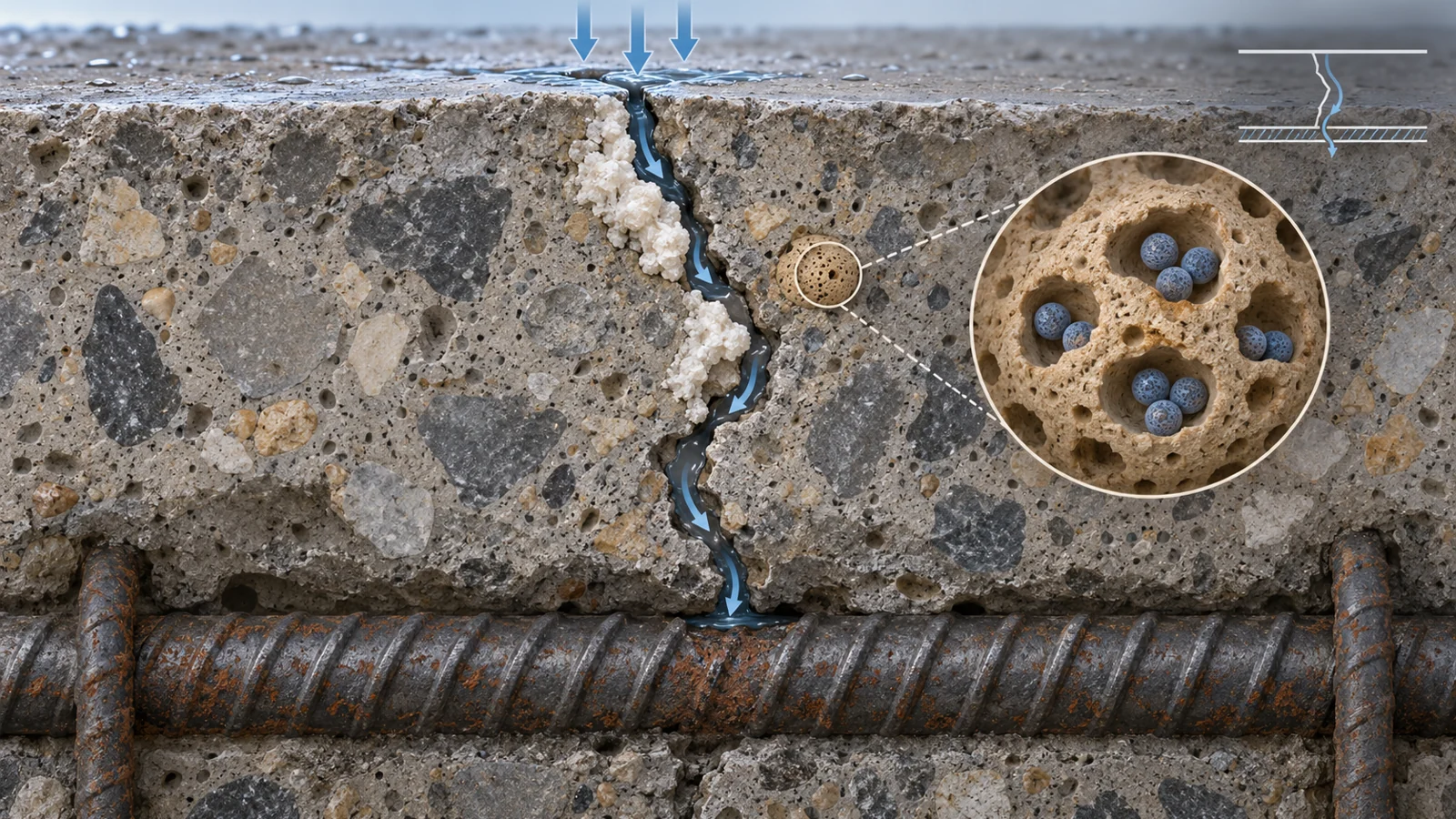
The visible gap is not the whole concern. A crack can become a pathway into the concrete, allowing moisture and aggressive agents to move toward reinforcement. Corrosion of that embedded steel can contribute to further deterioration, so a repair that limits ingress may matter even when it does not make the concrete look completely new.
The December 2024 review on bacteria-powered self-healing concrete brings several parts of this problem together: bacterial selection, the chemistry of mineral formation, protective carriers and the conditions that affect performance. It also gathers results reported for different bacteria, mixtures, crack sizes, exposure schedules and endpoints. Those studies help explain the technology’s promise, but their numerical results are not one common test of a single formulation.
A crack opens a chemical repair route
The process begins when water enters a crack and reaches dormant bacterial spores within the concrete matrix. Moisture can prompt the spores to germinate and become metabolically active. The bacteria then use available nutrients and produce carbonate-containing products. Calcium ions in the surrounding material can combine with carbonate to form calcium carbonate, or CaCO₃, which deposits as crystals and gradually fills part of the crack.
The review describes more than one way nutrients can support this process. Some formulations use calcium lactate or similar organic compounds. Another important route uses urea. In that pathway, the enzyme urease breaks urea down into products that ultimately shift the local chemistry toward carbonate formation. The carbonate then combines with calcium to produce the mineral deposit that seals the opening.
The sequence matters because the material is not repairing itself through a single instant reaction. Water must reach the bacteria. The bacteria must become active. Nutrients must be available. The relevant chemical reactions must proceed, and the resulting mineral must form in a position that limits the crack’s pathway. A closed-looking surface is therefore the endpoint of several linked conditions rather than a direct measure of bacterial presence.
Survival is not the same as useful activity
Spore formation gives bacteria an important advantage. Spores can remain dormant through dehydration, high temperature, pressure and chemical stress, then become active when water and nutrients return. That endurance helps explain why bacteria are considered for concrete, whose internal environment can be hostile.
Persistence, however, is not the same as rapid mineral production inside a finished structure. Concrete can reach pH values around 12 or 13, and the review summarizes evidence that such strongly alkaline conditions suppress bacterial growth and reduce urea-hydrolysis efficiency. Urease activity is described as stronger in a milder pH range, with 7.5–8.0 identified as ideal for the enzyme in the cited discussion. A bacterium may remain present as a spore while the chemistry needed for fast healing is limited.
Temperature also changes the timing. In one summarized comparison, spore germination and growth had a much longer lag at 10°C than at 28°C: up to 48 hours rather than about 6 hours. The review identifies 30–35°C as an optimal range for bacterial growth, urease activity and calcium carbonate production in the studies it discusses. These values do not establish a universal operating range for every concrete design. They show why a reserve of durable spores should not be treated as proof that a crack will quickly seal under every service condition.
Nutrient supply and crack geometry add further dependence. A narrow, accessible crack exposed to moisture presents a different opportunity from a larger or more complex opening. This is one reason the technology is better understood as a carefully designed material system than as bacteria simply mixed into cement.
The carrier changes the engineering bargain
A carrier is the material that houses and protects the bacteria inside the concrete. It may shield spores from high alkalinity, drying and mechanical stress, while also helping control how nutrients and moisture reach them. That protection can improve the biological conditions without automatically improving every property of the concrete mix.
Diatomaceous earth illustrates the tradeoff. Its porous particles can adsorb bacterial cells and create a more favorable local environment. The review summarizes tests in which bacteria immobilized on diatomaceous earth retained enzymatic activity and completely repaired cracks around 0.15–0.17 millimetres in a cement environment with pH 12.5. Yet the same material absorbs substantial water. If too much is used, it can dry the mortar paste and impair workability. A carrier therefore has to perform two jobs at once: protect the bacteria and remain compatible with mixing and placement.
The carrier can also change the relationship between biological activity and observed specimen performance. In a comparison involving polyurethane foam and silica gel, bacteria immobilized in silica gel showed higher activity when judged by the amount of calcium carbonate precipitated in the carriers. Specimens using polyurethane nevertheless showed better self-healing performance. Mineral production inside a carrier and crack repair in a concrete specimen are related, but they are not interchangeable measurements.
Other designs use microcapsules, porous aggregates, lightweight materials or ceramic particles. Microcapsules can isolate spores until cracking and moisture expose them to the conditions needed for activation. The review summarizes one microcapsule study in which microorganism-containing specimens had higher reported healing rates and a median healed width of 0.97 millimetres, alongside substantially lower permeability than bacteria-free specimens. Those figures belong to that study’s particular materials and test conditions; they are not a general capacity rating for all bacterial concrete.
A porous ceramsite approach provides a different kind of engineering result. The review reports that ureolytic bacteria immobilized in the particles completely healed cracks up to 450 micrometres wide within 120 days in reinforced-concrete specimens. Electrochemical measurements in that test setting indicated that the crack closure inhibited reinforcement corrosion. The result is important because it connects mineral deposition with a possible protective effect, while still remaining a result from one studied system rather than a guarantee for infrastructure in service.
A closed crack is only one engineering measurement
Crack width is the most visible endpoint. It asks how much of the opening can no longer be seen or measured at the surface. Permeability asks a different question: how readily can water or dissolved substances continue to pass through the repaired region? A specimen may show substantial visual closure while retaining pathways that matter for durability, or it may reduce transport without recovering all of its original appearance.
Reinforcement-corrosion measurements add another layer. Electrochemical indicators and corrosion-related tests examine whether the conditions around embedded steel have become less damaging. They do not simply repeat a crack-width measurement. In the ceramsite example, the reported inhibition of reinforcement corrosion gives the mineral deposit a significance beyond appearance, but it remains tied to the exposure and specimen design used in that study.
Resistance recovery, permeability, crack closure and electrochemical behavior should therefore be read as separate answers to separate engineering questions. They cannot be combined into one universal “healing score,” especially when the reviewed studies use different bacterial strains, carriers, crack dimensions, durations and environmental conditions. Nor does visible closure or reduced permeability alone establish full recovery of structural capacity.
This distinction changes how a promising result should be interpreted. The technology may help limit the route by which damaging substances enter concrete, which could support durability. That is a narrower and more defensible claim than saying that the original structural performance has been completely restored.
Autonomous sealing has to fit the repair job
Bacterial healing is designed around gradual, local action. A crack forms, moisture reaches the embedded system, bacterial activity produces mineral and the opening becomes less permeable over time. That operating pattern could be useful for limiting recurring ingress in places where small cracks are difficult to inspect or repair individually.
It is not the same operational need as an urgent structural repair. If a crack requires immediate intervention, waiting for spores to germinate and deposit enough mineral may not be appropriate. Larger or more complicated cracks may also remain only partly healed. In dry environments, limited moisture can reduce activation and subsequent mineral formation. These practical differences affect where the technology might fit and where conventional assessment or repair would still be necessary.
Cost is part of the same decision. Adding bacteria, nutrients and protective carriers increases production complexity and expense. A carrier that improves bacterial survival but harms workability may require a different formulation, processing step or dosage. Long-term environmental assessment is also needed, including consideration of bacteria and metabolic products in the surrounding environment. The review presents these questions as unresolved development issues rather than as settled evidence of either harm or benefit.
For infrastructure owners, repeatable material performance matters as much as an impressive laboratory result. Industry standards and regulatory development would help define acceptable carrier behavior, healing measurements, durability expectations and safety requirements. Genetic engineering and thermotolerant strains are discussed as possible ways to improve efficiency or heat resistance, but the prospect of a better engineered bacterium is not the same as an infrastructure-scale demonstration.
What this could change
Concrete components that seal small cracks soon after they form could help limit water and chloride ingress, protect embedded steel and reduce some disruptive maintenance for people who depend on bridges, roads and buildings. That benefit remains conditional: the mineral seal must persist in service, the bacterial reserve must remain usable, and the carrier must preserve the concrete’s required performance at a workable cost.
If those conditions are met, bio-self-healing concrete could shift part of infrastructure maintenance from repeated surface intervention toward materials that respond locally to early damage. The most useful future version would not promise that every crack disappears or that structural repair becomes unnecessary. It would provide a durable, measurable reduction in pathways that allow deterioration to spread, while fitting the practical demands of construction and long-term ownership.
Key Sources
- Primary source: Bacteria-powered self-healing concrete: Breakthroughs, challenges, and future prospects.
DOI or Journal Page · Review or Meta-Analysis · 2024-12-31