
Since the previous research note · Earlier expectation not tested
Track continuity
Since the previous research note: Bacterial mortar was loaded, kept moist and put to the test again
Previous expectation: Bacteria that remain functional in service and restrict water entry after small cracks develop could reduce external repair needs.
What this study adds: The July 7, 2022 synthesis broadens the engineering picture by connecting mineralization pathways, delivery methods, formulation-dependent performance, and proposed biological modifications. It does not directly test sustained in-service function or the maintenance benefit anticipated in the earlier milestone.
What changed in this study
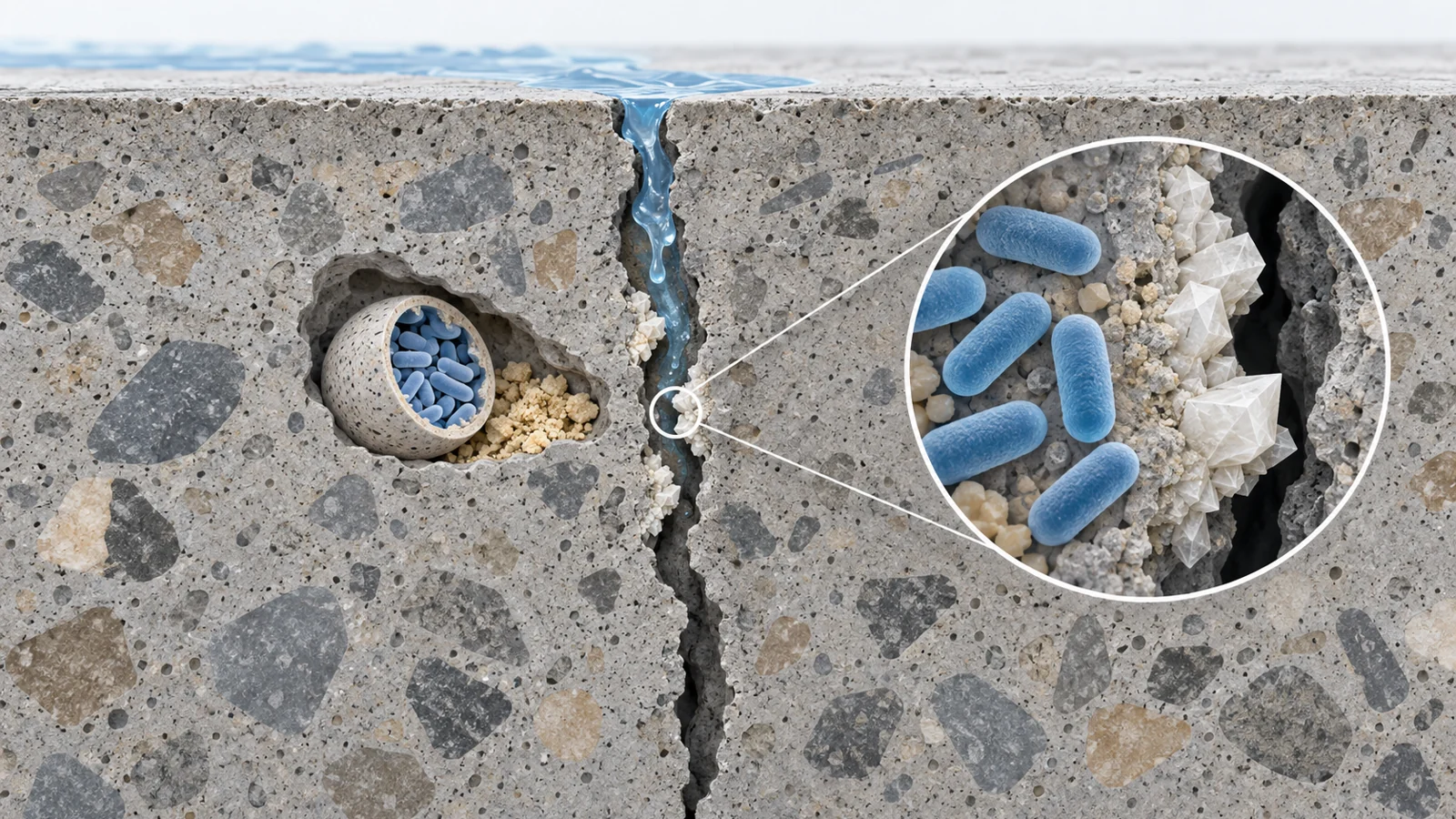
A small crack can create a route into concrete. Water and other substances entering through it can contribute to deterioration and corrosion of steel reinforcement. The practical appeal of bacterial concrete begins there. If microbes help deposit minerals inside narrow openings, they might restrict entry before damage creates a larger repair problem.
Getting that process to work requires more than adding bacteria to a concrete mix. The organisms need suitable chemical ingredients and conditions, while the material surrounding them must still perform its construction job. A protective carrier that helps bacteria function can also change the strength of the concrete.
Published on July 7, 2022, Bacterial Performance in Crack Healing and its Role in Creating Sustainable Construction brings these biological and material choices together. It synthesizes previously published work on mineral formation, delivery methods, concrete properties, and proposed biological modifications. It does not present a new experiment following bacterial repair through years of service. Its contribution is to explain how several parts of a potential repair system interact—and why different measurements answer different questions about its usefulness.
How bacteria help a mineral seal form
The material filling a crack is calcium carbonate, often identified as calcite. Bacteria help create the conditions for that mineral to precipitate from available ingredients. Their activity depends on water, nutrients, calcium sources, and a chemical environment that supports the chosen process. The organisms themselves are distinct from the mineral they help produce.
The synthesis describes three pathways. In ureolysis, the enzyme urease breaks down urea, producing ammonia and helping establish conditions for carbonate precipitation. Other bacteria metabolize organic compounds in reactions that support calcium carbonate formation. A third route involves nitrate reduction. These approaches have different chemical requirements; supplying a bacterial strain without its supporting ingredients does not establish a working repair mechanism.
Calcium lactate provides a concrete example of the metabolic route. In the process described by the paper, bacteria use calcium lactate together with oxygen and moisture, producing calcium carbonate among the reaction products. Oxygen availability therefore matters for this particular route, even when the necessary bacteria and calcium-containing ingredient are already present.
Bacterial surfaces also have a role. Negatively charged groups on cell walls can attract calcium ions and provide sites where mineral formation begins. The amount of available calcium, the pH, dissolved inorganic carbon, and the availability of these starting sites all affect precipitation. A crack offers space for deposits to accumulate, but the chemistry determines whether those deposits form.
The paper also discusses hydrogels as reservoirs that retain water near bacteria and healing ingredients. This helps explain why a bacterial concrete formulation includes more than a biological additive. Water availability, nutrient supply, mineral precursors, and the way these ingredients reach a crack are all part of the design.
Protecting microbes changes the concrete around them
Direct incorporation puts bacteria and healing ingredients into the mix without a separate protective enclosure. The synthesis also describes encapsulation, protective carriers such as expanded clay, and embedded vascular networks intended to deliver agents when cracking opens the network. Each approach changes where the ingredients reside and how they become available.
Protection addresses a difficult biological setting. The paper describes concrete environments with pH values reaching about 13, restricted oxygen, and other stresses. Capsules and carriers can shelter spores, while hydrogels can retain moisture and provide mechanical protection. Yet those additions also become part of the construction material. The synthesis reports that some encapsulation or carrier approaches reduce compressive strength or disrupt the uniformity of the mix. Keeping the biological component viable and keeping the surrounding concrete strong are connected design decisions.
The comparisons do not establish a universally superior delivery method. Different cited studies use different organisms, carriers, mixtures, and test conditions. A favorable result for direct incorporation in one mortar cannot by itself settle how a protected formulation would perform in another concrete.
Adding more bacteria is likewise not a straightforward improvement. The paper reports that concentrations above an effective level can reduce compressive strength, and discusses competition for nutrients as an explanation. Bacterial loading must work with the available resources and the rest of the formulation. The useful quantity is the one that supports the intended material behavior under the tested conditions, rather than the largest number of cells that can be added.
A mineral deposit and a stronger specimen answer different questions
The synthesis draws together several kinds of evidence that are easy to collapse into a single claim of “healing.” They measure different things.
Scanning electron microscopy can reveal the shape and location of deposits. X-ray diffraction helps identify calcite. Together, these observations support an account of mineral formation, but identifying a mineral does not establish how much structural function a cracked specimen has recovered.
Visible crack closure provides another piece of information: an opening has become partly or fully occupied by material at the observed location. The paper cites examples involving crack widths from 0.15 to 1 millimeter and healing periods ranging approximately from three to fourteen weeks. These are results from different studies, rather than a single tested range within which every bacterial formulation works. They describe small openings and processes taking weeks, not immediate repair of major structural damage.
Strength tests ask how a specimen responds to loading. Compressive strength concerns resistance to being squeezed; tensile and flexural tests address pulling and bending behavior. A bacterial specimen that is stronger than a conventional comparison specimen has shown a difference in material performance. That comparison alone does not measure strength regained after a crack developed.
For example, the synthesis attributes increases of 35.15% in compressive strength, 24.32% in average tensile strength, and 17.24% in average flexural strength to a cited study. These figures belong to that reported comparison. They are not pooled estimates for bacterial concrete as a material class. The paper itself describes performance changing with bacterial species, concentration, incorporation method, and curing duration.
Water absorption and permeability measurements address a separate practical concern: how readily fluid or dissolved substances can enter or move through the material. Mineral deposits that reduce connected void space can help explain lower water entry even without demonstrating restored load-bearing capacity. Conversely, a strength increase cannot substitute for a measurement of water entry through a repaired crack.
The synthesis reports lower water absorption and chloride permeability in cited studies, along with reduced strength loss during some acid-exposure tests. The exposure and outcome matter. Losing less strength in a particular acid test is evidence about that test, while lower water absorption is evidence about uptake. Neither can automatically be translated into a number of extra years of structural service.
These distinctions give the results their engineering meaning. Mineral identification establishes what formed, observations of closure show where an opening filled, mechanical tests measure load response, and fluid-entry tests examine a route by which deterioration can begin. A useful repair system needs an appropriate combination of these properties.
Can the biological component keep doing its job?
The unresolved duration of useful bacterial activity is a central reason the paper turns to biological modification. Dormant spores may persist inside a formulation, but a long-lived repair function requires them to remain capable of responding when suitable conditions arise. The synthesis does not establish dependable repeated healing across a structure’s service life.
The proposed modifications target different parts of that problem. One line of work concerns hosts that tolerate alkaline or otherwise harsh conditions. Another concerns proteins associated with mineral-related processes. The paper describes cited experiments involving a bioremediase-like protein associated with silica release from silicate materials, including work in modified Escherichia coli and transfer into spore-forming Bacillus subtilis. The reported mortar-property improvements help motivate combining a useful biological activity with a more suitable host.
Other cited work concerns extracellular polymers, substances produced outside bacterial cells that can influence the local environment for mineral formation. The synthesis also describes fluorescent labeling used to observe microbial mineralization in model systems. Improving a mineral-forming process and making that process easier to observe are different research contributions; fluorescent tracking is not itself evidence of better crack repair.
These examples support research directions, with observations in mortar or other model systems. They do not demonstrate that an engineered formulation can remain effective for decades inside a working structure. The paper also acknowledges environmental-release considerations for modified organisms, adding another constraint to any eventual application.
The numerical account needs care as well. The abstract’s wording about acid resistance is ambiguous, and the cost section contains conflicting statements about production and repair costs. Those passages do not support a dependable resistance multiplier or a quantified financial advantage. Its publication date identifies this contribution in time; it does not establish a defined cutoff for the literature it covers.
What this could change
If a formulation can sustain mineral deposition after small cracks develop, restrict damaging ingress, and retain suitable structural properties under service conditions, infrastructure owners could gain components that need fewer external crack-repair interventions. The immediate benefit would be less work to seal accessible openings and address the deterioration that can follow them. That could reduce maintenance demands where repeated access and repair are difficult.
A longer useful life could also delay replacement. Keeping concrete components in service would potentially reduce demand for replacement material and the cement production associated with it. This is the causal route from bacterial mineral formation to a possible construction-sector environmental benefit.
The balance would depend on whether avoided repair and replacement outweigh the added inputs needed to produce, protect, and supply the bacteria. The July 2022 synthesis makes those possibilities understandable, but does not measure lifecycle savings or net emissions reductions for a deployed system. The practical opportunity is concrete whose response to small cracks reduces the amount of later intervention its owner must provide.
Key Sources
- Primary source: Bacterial Performance in Crack Healing and its Role in Creating Sustainable Construction.
DOI or Journal Page · Peer-Reviewed Paper · 2022-07-07