
Since the previous research note · Earlier expectation not tested
Track continuity
Since the previous research note: How crack pathways shape concrete that can seal its own cracks
Previous expectation: Concrete designed to distribute mineral-forming ingredients more evenly might sustain useful crack sealing and reduce localized repairs if modeled advantages persist in service.
What this study adds: This source presents a conceptual proposal using Bacillus subtilis spores and nutrients, with performance estimates adapted from existing literature because laboratory access was unavailable. It does not establish a test of the earlier transport-based forecast.
What changed in this study
Concrete is strong, but cracks can open a route to costly maintenance and repair. A study published on May 9, 2025, proposes a biological way to address some of that damage from within the material itself. Its idea is usually described as self-healing concrete: concrete intended to repair its own cracks through a mineral-forming process involving bacteria.
The contribution is a conceptual prototype, not a completed laboratory demonstration. The authors describe a proposed mix containing bacterial spores and nutrients, then use findings from existing literature to estimate possible healing efficiency, compressive strength retention and environmental benefits. The proposal is therefore useful for explaining how this type of material might work and where it could matter, while leaving its actual durability to be established.
A repair system built into the mix
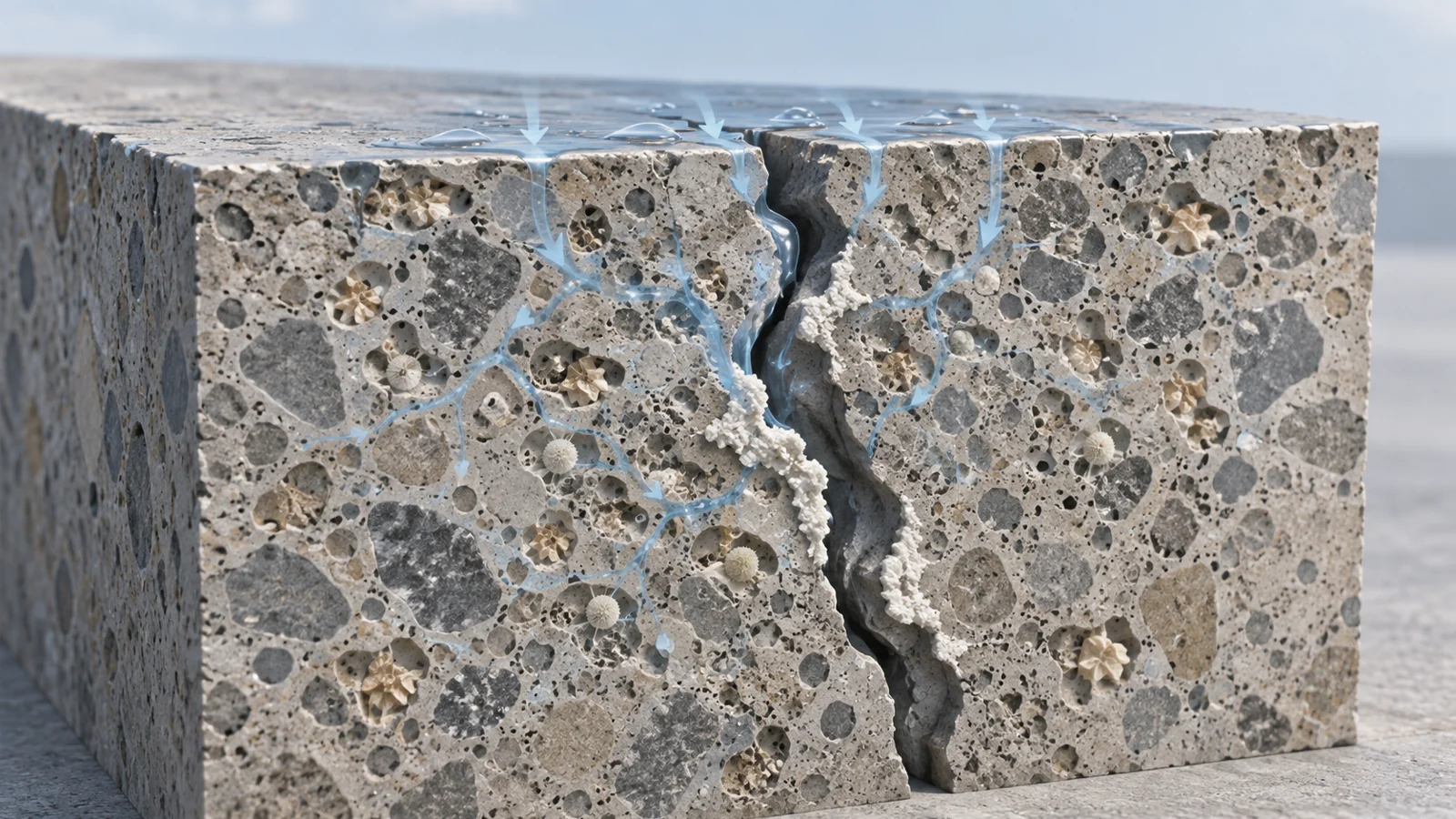
The proposed sequence begins before a crack forms. Bacillus subtilis spores and nutrients would be incorporated into the concrete mix, distributing the ingredients through the material. Spores are dormant forms that can remain inactive until conditions become suitable for biological activity.
When a crack allows water and oxygen to reach the relevant parts of the material, the bacteria are intended to become active. Their activity is linked to microbial-induced calcium carbonate precipitation, or MICP. In ordinary language, the process is meant to produce calcium carbonate, a mineral that can accumulate in the opening and help fill it.
Exposure is central to the proposal. The bacteria are not described as repairing every crack continuously or independently of their surroundings. Water and oxygen are identified as the conditions that enable the intended sequence: embedded spores and nutrients, exposure through a crack, bacterial activity and mineral formation in the damaged area.
That sequence explains the attraction of the approach. A repair ingredient could travel with the concrete rather than being applied only after damage is found. It also shows why a conceptual design cannot be judged only by whether mineral formation is chemically plausible. The material would need to retain the relevant ingredients, respond under service exposure and produce repair that is useful for the structure in question.
What the estimates are trying to answer
The study separates several possible outcomes that are easy to blend together. Healing efficiency concerns how effectively the proposed process might fill or seal a crack. Compressive strength retention concerns how much of the concrete’s mechanical performance might remain after the material has been affected. Environmental benefits concern the possible consequences of extending service life or reducing conventional repair demand.
Those are different questions. Mineral deposition inside a crack would not, by itself, show that the concrete has regained the load-bearing capacity required of a structure. Nor would a possible reduction in repair materials automatically establish a particular environmental saving.
The authors studied and adapted results from existing literature to estimate these outcomes for the proposed concrete. The abstract also explains that laboratory access was unavailable and that a conceptual prototype was developed to demonstrate feasibility and application. Its references to simulated crack formation and controlled conditions belong to the described experimental design; they should not be read here as completed laboratory observations of this particular mix.
The estimates may help organize future testing, but the available account does not establish how the underlying studies were selected, how comparable their materials and conditions were, or how the estimates were calculated. The abstract does not report numerical healing rates, crack-width limits, strength gains, service-life extensions or environmental savings for this proposed mix. The practical question remains whether the proposed process would work durably in concrete exposed to the varied conditions of real infrastructure.
From material idea to maintenance prospect
The most immediate application described is not a futuristic building that never needs repair. It is a possible reduction in some localized repair work. If mineral formation could repeatedly address relevant cracking without compromising structural performance, owners might have fewer occasions to send crews, equipment and conventional repair materials to difficult sites.
That possibility is especially significant for remote or infrastructure-critical settings, where access can be expensive, delayed or disruptive. Roads, water-related structures and other essential assets can impose a maintenance burden even when an individual crack appears limited. A concrete mix that could handle some damage internally might give operators another way to manage that burden.
The benefit remains conditional on several practical requirements: the spores and nutrients would need to remain usable, the necessary exposure conditions would need to occur, the mineral deposit would need to provide meaningful sealing, and the repaired material would still need to perform the role demanded of the structure. The proposal identifies an appealing route toward lower-intervention maintenance, but it does not yet show that route working in service.
What this could change
A durable version of this approach could allow infrastructure owners to treat some cracking as an internal maintenance function rather than an immediate site visit. That could make repair planning less dependent on reaching every damaged location quickly and could reduce demand for some conventional repair materials, benefiting the people who rely on remote or infrastructure-critical structures.
Whether that capability becomes practical depends on proving that the proposed bacterial activity and mineral formation remain reliable under service exposure while preserving the performance the concrete must provide. The conceptual prototype marks out a possible direction; it does not yet establish a longer-lasting structure or restored structural safety.
Key Sources
- Primary source: Bacterial Healing Concrete
DOI or Journal Page · Preprint · 2025-05-09