
Since the previous research note · Partly supported
Track continuity
Since the previous research note: How bacteria embedded in concrete are proposed to seal cracks
Previous expectation: Reliable bacterial mineral formation could let concrete handle some cracking internally and reduce repair visits while preserving its performance in service.
What this study adds: This preprint reports strength recovery in cracked specimens and mitigation of sulfate damage, providing experimental support for parts of that expectation. It does not establish reduced repair visits, repeated autonomous healing, or reliable performance throughout a structure's service life.
What changed in this study
Concrete can fail in two connected but different ways. Cracks create openings that can weaken a material, while sulfate attack exposes it to chemical damage from sulfate salts. A concrete mixture that seals a crack may not regain all of its load-bearing performance. A mixture that performs well in freshwater may also respond differently when sulfate exposure continues over time.
A preprint published on June 17, 2025, examines both questions in concrete containing bacteria. The study tests whether bacterial activity can support crack healing while also helping concrete withstand sulfate exposure. Its results are useful because they place mechanical recovery and chemical durability in the same experiment, but they measure those outcomes in different ways.
Cracks and chemical attack are separate tests
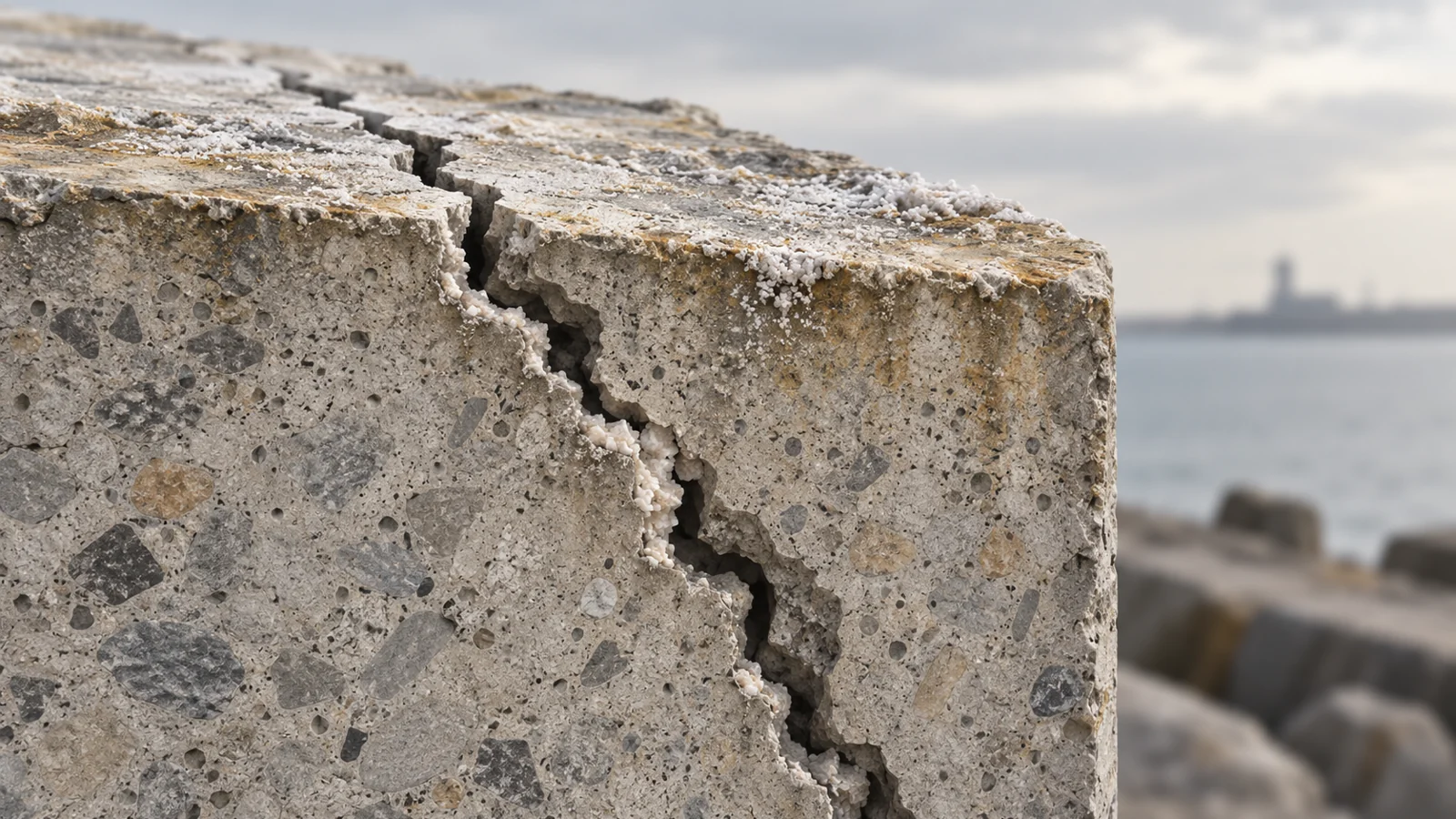
The proposed connection is microbially induced calcium carbonate precipitation, often abbreviated as MICP. In the study’s interpretation, bacterial activity helps form calcium carbonate that can deposit in cracks and contribute to their sealing. That mechanism could link a visible change in the crack to a change in the concrete’s mechanical response.
The researchers compared Bacillus megaterium, abbreviated BM, with Bacillus sphaericus, abbreviated BS. Bacterial suspensions were added at 1% or 2.5% of cement weight. The concrete also included either silica fume or fly ash at 10% of cement weight. Specimens were cured in freshwater or in sulfate solutions at 2%, 5%, or 10% concentrations.
The testing combined compressive strength, flexural strength, and microstructural examination using scanning electron microscopy, energy-dispersive spectroscopy, and X-ray diffraction. That combination matters because compression, bending, and crack appearance are not interchangeable measurements. Each can illuminate a different part of the engineering problem.
Freshwater strength gains and crack recovery are different outcomes
The abstract identifies the 2.5% bacterial addition as the best-performing level in the reported comparison, with BM outperforming BS. For freshwater-cured samples, the reported increases reached up to 41.3% in compressive strength and up to 52.3% in flexural strength.
Compressive strength describes how well concrete withstands a pushing load. Flexural strength concerns resistance to bending. The two percentages therefore answer different questions, and neither should be read as a percentage of cracks sealed. They are maximum reported changes in separate mechanical measurements under the stated freshwater condition.
The study also reports that cracked specimens treated with BM recovered up to 93.1% of their original compressive strength. Here, the denominator is the specimen’s own original compressive strength. The figure does not mean that 93.1% of cracks closed, that every mechanical property returned to its starting value, or that a structure regained its original safety.
The percentage results also need to remain attached to the conditions the abstract gives. The freshwater strength maxima should not automatically be carried over to sulfate curing, and the 93.1% recovery figure should not be treated as a universal result for every bacterial mixture or exposure level.
Sulfate exposure changed the result over time
Sulfate curing produced a more complicated timeline than a single strength ranking. The abstract reports an early strength increase of 1.97% at seven days, followed by an 8.5% loss at 120 days. The direction of the result therefore changed with elapsed exposure.
An early increase cannot settle whether concrete will remain durable during longer chemical exposure. Early-age behavior may look favorable while later exposure reveals deterioration. In this study, bacterial inclusion was associated with mitigation of sulfate damage, and the authors connect that effect to calcium carbonate precipitation and crack sealing. The result is encouraging as a specimen-scale finding, but the seven-day and 120-day values should be read as different points in the exposure story rather than as competing versions of the same conclusion.
This timing also helps separate chemical resistance from freshwater performance. A high strength value measured in freshwater says something about that curing environment. It does not by itself show how the same concrete will behave when sulfate salts continue to act on it.
What the recovery figure can tell us
A recovery value and a crack-sealing observation describe related but distinct outcomes. Crack sealing concerns the opening or visible pathway. Compressive recovery concerns how a specimen responds to a pushing load after it has been cracked and treated. A specimen can show evidence of mineral formation and recover part of its compressive response without demonstrating that all cracks closed or that bending performance returned to its original level.
The full preprint narrows several of those interpretation questions. For silica-fume mixes, cracked-and-reloaded specimens containing 2.5% Bacillus megaterium reached 92.10% of the corresponding uncracked strength at 56 days and 93.14% at 120 days in freshwater, compared with 57.33% and 63.70% for the bacteria-free control. Under 2% sulfate, the BM mix reached 91.89% and 92.78%, while the 2.5% Bacillus sphaericus mix reached 89.28% and 90.75%. These are mix-, exposure-, and time-specific recovery ratios, not a universal healing percentage, and they still do not establish whole-structure service-life performance.
For the same reason, the supplied evidence does not establish repeated autonomous healing throughout a real structure. It does not establish how bacterial mineral formation would persist over a service life, how the material would respond to repeated damage, or whether visible sealing would consistently preserve the structural functions that owners need. The preprint is best understood as an experimental demonstration that chemical exposure, bacterial treatment, and mechanical recovery can be studied together.
What this could change
If bacterial mineral formation remains effective during sulfate exposure and repeated cracking while required mechanical performance is preserved, concrete infrastructure owners could eventually face fewer repair interventions and use less replacement material. That could matter especially for structures exposed to sulfate-rich environments, where repair access and recurring material use add to the practical burden.
The June 2025 result supports that possibility by linking BM treatment with partial recovery of original compressive strength and reported mitigation of sulfate damage in concrete specimens. Turning that possibility into a dependable service-life benefit would require the effect to remain repeatable beyond the tested specimens and to cover the kinds of damage that infrastructure experiences in use.
Key Sources
- Primary source: Bio-Mitigation of Sulfate Attack and Enhancement of Crack Self-Healing in Sustainable Concrete Using Bacillus megaterium and Sphaericus Bacteria
DOI or Journal Page · Preprint · 2025-06-17