
Since the previous research note · Earlier expectation not tested
Track continuity
Since the previous research note: How conditions can pause and restart bacteria in self-healing concrete
Previous expectation: Controlling bacterial activation could make self-healing concrete more dependable if restarting activity translates into lasting crack sealing in real structures.
What this study adds: The current source adds controlled mortar-strength and selected chemical-exposure results for Bacillus albus W39, including a reversal in the preferred bacterial concentration as calcium availability changes. It does not establish that the earlier activation-and-recovery behavior produces lasting crack repair.
What changed in this study
A study published on June 23, 2026, tested whether a bacterium that produces calcium carbonate could improve cement mortar. The surprising result was not simply that bacterial incorporation helped under some conditions. The preferred bacterial concentration changed when the amount of calcium changed.
The work used controlled laboratory mortar mixtures, with compressive strength measured during curing through 90 days. It also examined selected chemical exposures, mineral formation and thermal behavior. Those measurements make this a useful progress report on formulation-dependent material performance, while leaving a narrower question for future work: whether such a material can reliably repair cracks after real structures are damaged.
The experiment began with a search for a useful strain
The researchers collected 50 bacterial isolates from alkaline soils in Wadi El-Natrun, Egypt, and screened them for calcium-carbonate production. Isolate W39 produced the most among the leading candidates, with a reported yield of 0.453 grams of CaCO₃ per 100 milliliters of culture. Sixteen-S ribosomal RNA sequencing identified W39 as Bacillus albus, and the strain was recorded under accession number PQ288981.
The screening result mattered because the study was looking for a microorganism that could remain useful in an alkaline cement environment while producing a mineral that can occupy spaces in the mortar. Further characterization found that W39 is spore-forming. That feature may help a Bacillus strain persist through unfavorable conditions, but it is a biological property, not proof that cells will remain active for years inside a finished structure.
Calcite formation linked the cells to the cement matrix
The paper describes microbially induced calcium carbonate precipitation, or MICP, as a process in which ureolytic bacteria break down urea, raise the local pH and help calcium carbonate precipitate as calcite. Calcite is a crystalline form of calcium carbonate. In this setting, urea supplies the chemical route that supports carbonate formation, while calcium chloride supplies calcium ions for the mineral.
The researchers first optimized the culture conditions before adding the bacteria to mortar. The best reported precipitation conditions were pH 8, 25 millimoles per liter of calcium chloride, 20 grams per liter of urea, 30 °C and seven days of incubation. The resulting material was identified as nanoscale, high-purity calcite using several techniques, including electron microscopy, infrared spectroscopy, X-ray diffraction and surface-area analysis.
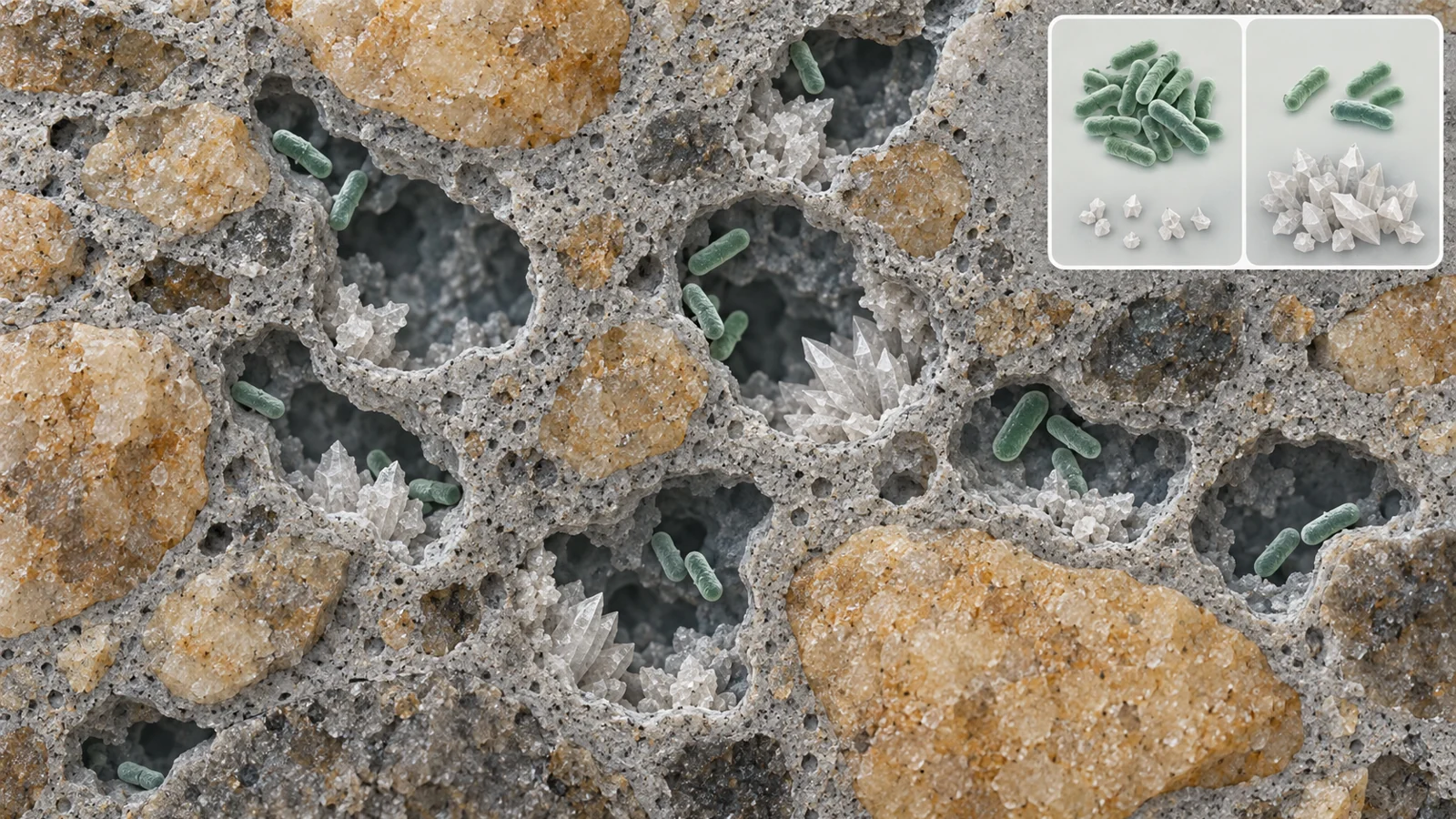
Inside the mortar, scanning electron microscopy showed more calcium-carbonate deposits filling pore spaces in bacterial mixtures than in corresponding controls. X-ray diffraction and thermal analysis also indicated additional calcite and C–S–H, a cement hydration product. The study connects those changes with a less porous, denser matrix. That is the main material pathway observed here: mineral deposits and hydration products altered the internal structure of the mortar.
The dose only made sense alongside calcium
Bacterial concentration was set using OD₆₀₀, an optical-density reading used to control the concentration of a culture. It is not a direct cell count. The researchers tested viable Bacillus albus cells at OD₆₀₀ values of 0.5, 1.0 and 1.5 while varying calcium chloride from 25 to 100 millimoles per liter.
At 25 millimoles per liter of calcium chloride, the highest tested bacterial concentration, OD₆₀₀ 1.5, gave the strongest reported improvement. At higher calcium concentrations of 50 and 100 millimoles per liter, OD₆₀₀ 0.5 was more effective than the higher bacterial doses. In those mixtures, increasing the bacterial concentration could slightly reduce compressive strength relative to the control. The authors discuss excessive biomass, calcium-related stress, reduced urease activity or rapid, poorly bonded mineral accumulation as possible explanations. These are proposed interpretations rather than separately demonstrated causes.
The pattern is important because it rules out a simple recipe in which more mineral-producing bacteria automatically produce stronger mortar. The useful amount of bacteria depended on the surrounding chemical balance. Calcium was not just an ingredient added alongside the cells; it changed which bacterial concentration performed best.
The strength comparison had a defined clock
Compressive strength was measured after 1, 3, 7, 28 and 90 days of curing. For the mixture containing OD₆₀₀ 1.5 and 25 millimoles per liter of calcium chloride, the study reports a 102.05% increase at 90 days compared with its corresponding bacteria-free control. The same mixture also showed higher relative strength at the earlier measurement points.
That percentage is a matched comparison within this experiment. It is not an absolute load-bearing specification, and it does not show that this formulation is stronger than every other bacterial strain or mortar design. The tests used sets of three cylindrical specimens, so the reported result is best read as evidence that the selected formulation changed performance under the study’s curing conditions, not as a construction standard.
The result also illustrates why the bacterial dose cannot be separated from the calcium level. At low calcium availability, the study’s strongest outcome came with the highest tested bacterial concentration. With more calcium present, the lower concentration became the better-performing choice. A formulation that ignores that interaction could add biological material while producing less useful mineral organization inside the mortar.
Chemical exposure followed the material after curing
The durability experiments used a separate set of specimens containing bacteria at OD₆₀₀ 0.5. After casting and demolding, the mortars cured for 28 days in solutions containing 20 grams per liter of urea and either 25, 50 or 100 millimoles per liter of calcium chloride. The samples were then dried at 105 °C for 24 hours before immersion in either 5% magnesium sulphate or 5% magnesium chloride for as long as 60 days. The exposure solutions were refreshed weekly.
Measured total sulphate and total chloride contents increased as immersion continued, showing that aggressive ions still entered the material over time. The bacterial mortars nevertheless accumulated less of these ions than their corresponding controls. After two months in magnesium sulphate, for example, the total sulphate content in the bacterial mortar prepared with 25 millimoles per liter of calcium chloride was reported as 25.71% lower than in its control.
This test speaks to penetration through a controlled pore system. The lower ion contents are consistent with the mineral deposits and matrix changes observed elsewhere in the study, but they are not a direct measure of crack closure or repeated autonomous healing. The specimens followed a defined curing, drying and immersion sequence that cannot by itself reproduce the changing moisture, loading and chemistry of a working structure.
Heating the sample was not the same as testing a building
The study’s thermal claim also needs a precise reading. The researchers heated samples from room temperature to 1000 °C at 10 °C per minute under nitrogen while tracking thermal behavior and mass change. This was a thermal-analysis experiment on the material’s phases, not a fire-resistance test on a loaded structural element.
Between roughly 600 and 950 °C, the measured endothermic features were associated with the decarbonation of amorphous and crystalline calcium carbonate. In the bacterial mortars, those decomposition peaks shifted to higher temperatures than in the controls. The authors interpret the shift as evidence of a greater quantity and crystallinity of biogenic calcium carbonate.
The result tells us something about how the mineral phase behaved during programmed heating. It does not provide a fire-resistance rating, show that a wall or beam would retain its structural capacity at 1000 °C, or establish how the complete mortar system would perform during a real fire.
A promising laboratory candidate still has to survive service conditions
The central evidence separates two claims that are easy to blend together. The study demonstrates changes in mortar strength, pore-related measurements, mineral phases and selected chemical exposures during controlled laboratory tests. It does not yet turn those changes into dependable repair after cracks arise in service.
A spore-forming Bacillus strain may have a way to endure periods that are unfavorable for active growth, and W39 produced its best mineral yield near pH 8 in the culture experiments. Neither observation establishes years of viability inside mortar or reliable reactivation whenever a crack appears. For a self-healing system to work outside the laboratory, cells and the surrounding chemistry would also need suitable access to water and the reagents that support precipitation. Those conditions may vary across a structure and across seasons.
The authors identify several unresolved practical questions: long-term field validation, broader durability testing such as freeze–thaw and additional chemical exposures, scalability, cost-effectiveness and ecological effects of incorporating microbes. Those questions determine whether a carefully tuned mortar mixture can become a practical material rather than remain a controlled demonstration.
The phrase self-healing bio-mortar is therefore most secure here as a description of the intended technology and research direction. The measured advance is more specific: an indigenous Bacillus albus strain changed the mineral structure and strength behavior of mortar, and the best bacterial concentration depended on calcium availability.
What this could change
A cement-based material that could limit deterioration and reduce the need for disruptive repairs would matter to infrastructure owners and to the people who rely on bridges, buildings, roads and other concrete structures. Less frequent intervention could mean fewer closures, less difficult access work and longer periods of dependable service.
That future depends on more than producing calcite in a laboratory vessel. The calcium-dependent dose response would need to remain useful in realistic materials and environments, the cells would need to stay viable and accessible to the chemistry that activates mineral formation, and the resulting formulation would need to be scalable, affordable and environmentally acceptable. From the June 2026 publication perspective, Bacillus albus W39 is a candidate for that capability, with its strongest case still resting on whether the laboratory gains survive real service conditions.
Key Sources
- Primary source: Microbially induced calcite precipitation by a novel alkaliphilic Bacillus albus strain for sustainable self-healing bio-mortar with enhanced mechanical performance and durability.
DOI or Journal Page · Peer-Reviewed Paper · 2026-06-23