
Since the previous research note · Earlier expectation not tested
Track continuity
Since the previous research note: What bacterial capsules achieved inside cracked mortar
Previous expectation: Internal bacterial mineral formation might help maintainers repair small cracks in hard-to-access concrete, provided the capsule system survives construction and delivers durable protection in service.
What this study adds: The December 2023 study examines a different carrier system and measures steel–concrete bond after damage and treatment, with the highest relative bond-strength ratio in specimens receiving chemical immersion and warm incubation. It adds a mechanical endpoint without testing the earlier capsule-based maintenance forecast.
What changed in this study
A concrete crack matters for more than appearance. In a reinforced structure, damage can affect the transfer of force between the concrete and the steel bar inside it. The practical question is whether repaired concrete can still grip that bar well enough to carry load and limit relative movement.
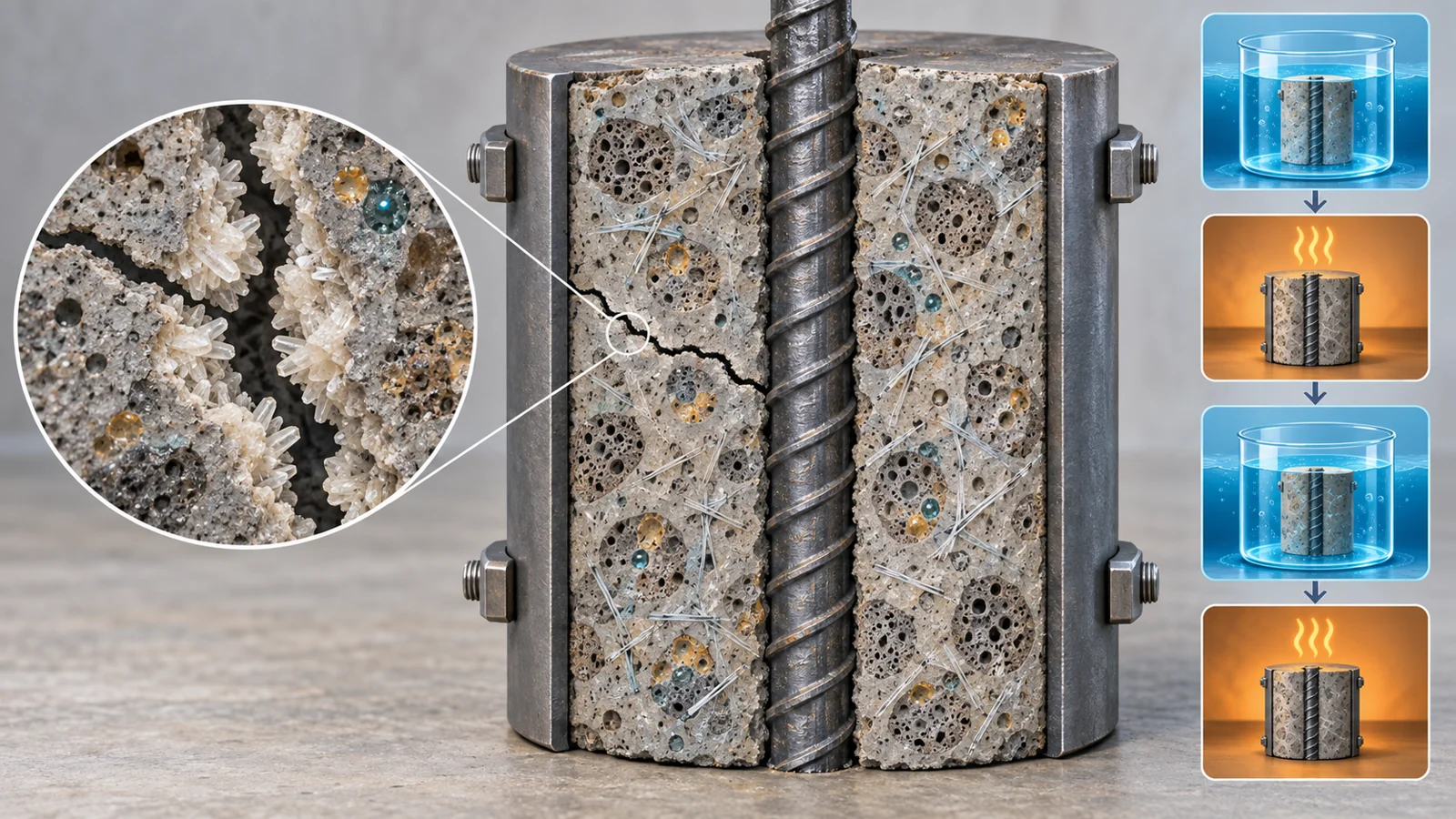
A laboratory study published on 30 December 2023 tested that question in damaged fiber-reinforced lightweight aggregate concrete. The researchers first damaged specimens through compression and steel-bar pull-out tests. They then gave different groups a 28-day treatment period before testing them again. The strongest result came from specimens containing bacterial spores and nutrient-loaded lightweight aggregate that also received repeated chemical immersion and warm incubation. Their relative bond-strength ratio was 17.9% higher than the control group’s.
That percentage is useful, but only after its denominator is made clear. It describes a comparison between two recovery ratios in a particular pull-out setup. It does not mean the concrete regained 17.9% of its original strength, or that the material returned to an undamaged state.
The repair question was mechanical
The concrete tested here used artificial lightweight aggregate made from shale. The lower strength of those particles can affect how the surrounding concrete transfers force to reinforcing steel. Bond stress is the shear stress along the steel–concrete interface, and bond slip describes the relative movement that occurs as load is transferred.
The study therefore measured more than whether cracks looked filled. It measured compressive strength and the bond between a concrete block and an embedded steel bar. In the pull-out test, the bar was pulled while instruments tracked movement at the loaded and free ends. The first pull-out test stopped when slip reached 5 millimeters, limiting further damage before the treatment stage.
The specimens were deliberately confined. Each pull-out block had a 19.1-millimeter bar embedded along its central axis, transverse stirrups, and a concrete cover of about 6.5 centimeters. All specimens showed pull-out failure rather than a different structural failure mode. That makes the experiment a focused test of steel–concrete load transfer, not a complete simulation of an entire beam, column, bridge deck, or building component.
Several ingredients, several jobs
The concrete mixture contained two kinds of fibers: short micro-steel fibers and polypropylene fibers. These were dispersed through the concrete to form part of the material’s reinforcement system. They were not the same as the central reinforcing bar used in the pull-out test.
The lightweight aggregate had a different role in the experimental group. Before mixing, the particles were loaded first with a nutrient solution containing calcium lactate and yeast extract. They were dried, treated again, and then immersed in a suspension containing spores of Sporosarcina pasteurii before another drying stage. The porous particles served as carriers intended to place both biological ingredients and nutrients inside the concrete mixture.
The control concrete used lightweight aggregate without the bacterial spores and nutrient loading. Both experimental groups used the loaded aggregate. This arrangement allowed the study to compare ordinary incubation with a more active treatment schedule, while also changing the material composition between the control and bacterial specimens.
The distinction matters because the bacteria were not added as a free-floating ingredient after the concrete had been damaged. Their spores were incorporated through the lightweight particles, alongside the nutrients intended to support the repair process. The reinforcing fibers, meanwhile, belonged to the concrete mix itself and should not be confused with the biological carrier or the bar whose bond was measured.
Damage came before treatment
The researchers prepared cylindrical specimens for compression testing and cube-shaped specimens for pull-out testing. After casting, the concrete was cured through the study’s initial 28-day process. Each group then underwent its first mechanical test, creating the damaged condition used for the treatment comparison.
The control specimens were placed in a 40 °C incubator during the 28-day self-healing period. Experimental group I followed the same incubation schedule, but its lightweight aggregate carried bacterial spores and nutrients. Experimental group II used the same biological carrier and added a repeated chemical exposure: two days immersed in a solution containing urea and calcium acetate, followed by two days in a 40 °C incubator. That four-day cycle continued until the treatment period was complete.
After 28 days, the specimens underwent secondary compression and pull-out tests. The study prepared three specimens for each test and used their average values. Surface cracks were observed, and samples were examined with field-emission scanning electron microscopy, elemental analysis, and X-ray diffraction. Each method addressed a different part of the question: visible change, microscopic structure, elemental composition, and crystalline material.
The protocol creates a meaningful comparison, but it also defines what can be attributed to what. Group II differed from the control in bacterial loading, nutrient loading, solution immersion, and the alternating curing environment. The treatment was designed as a combined package rather than as a clean test of bacteria alone.
The percentage has a specific denominator
The clearest result concerns the secondary pull-out test. After treatment, the three groups had these bond-strength results:
| Group | Secondary bond strength | Secondary-to-original bond-strength ratio |
|---|---|---|
| Control | 18.84 MPa | 0.67 |
| Experimental group I | 20.82 MPa | 0.73 |
| Experimental group II | 22.25 MPa | 0.79 |
The ratio compares the secondary bond strength with the original 28-day bond strength for that group. A ratio of 0.67 means the secondary result was 67% of the group’s original measured bond strength; 0.79 means 79%. None of these values represents a return above the original test condition.
The reported 17.9% improvement is the relative difference between group II’s ratio of 0.79 and the control ratio of 0.67. In other words, the calculation is based on 0.79 compared with 0.67. It is not 17.9 percentage points, and it is not a measurement of the fraction of strength regained from an independently measured condition immediately after damage.
Compression tells a different story. The secondary-to-original compression-strength ratios were 0.31 for the control, 0.32 for group I, and 0.34 for group II. Group II again ranked highest, but the values show that the post-treatment compression endpoint recovered to a much lower proportion of the original result than the bond endpoint did. The treatment ranking was similar across the two tests; the scale of the remaining damage was not.
This is why the bond result is best read as evidence of improved performance within the study’s treatment and test design. It is not evidence that all damaged mechanical functions recover equally, nor that a filled surface crack has become equivalent to intact concrete.
Mineral deposits supplied a second line of evidence
The visible crack observations helped show when the treatment began to produce a recognizable deposit. In the control and experimental group I, crack healing on the observed surfaces was not obvious as the treatment period progressed. In group II, calcium carbonate crystals began appearing in surface cracks from the seventh day. The deposits became denser and more extensive as the curing period continued.
Microscopy added a closer view. The researchers observed bacterial endospores near the surface and in the center of the specimens. After 28 days, the group II samples showed prominent clusters of polygonal calcium carbonate crystals around the relevant regions, unlike the comparable appearance in the control and group I samples. The study interprets this pattern as microbial carbonate precipitation associated with the bacterial treatment.
Elemental analysis supplied a chemical check on the deposits. In the filled crack region of group II, calcium, carbon, and oxygen occurred together in a pattern consistent with calcium carbonate. X-ray diffraction provided a separate crystallographic comparison and supported the identification of calcium carbonate in the experimental material.
These observations strengthen the connection between the treatment and the mineral found at the crack. They do not, by themselves, measure how much of the bond-strength difference came from bacterial activity, chemical exposure, nutrient loading, or the warm incubation schedule. Identifying the deposit and explaining the entire mechanical improvement are related questions, but they are not the same question.
Why the result needs a narrow reading
The control and group II comparison changes several variables at once. Group II has the bacterial carrier and nutrient loading, but it also spends part of each cycle in urea–calcium acetate solution. The control remains in the incubator. Even group I, which shares the incubator schedule with the control, differs in its loaded aggregate and biological ingredients. The three-arm design can show that the combined group II treatment performed best in this experiment; it cannot isolate every contribution to that ranking.
The pull-out geometry also concentrates the conclusion. Thick cover and transverse stirrups provided substantial confinement, and all of the specimens failed by pulling the bar out of the surrounding concrete. That is a useful mechanical setting for measuring interface behavior, but service structures experience different dimensions, restraint, crack patterns, loading histories, moisture conditions, and exposure cycles.
Compression cracks were another source of variation. Their size and location were difficult to control, so the surface observations focused on cracks that could be seen. The study’s three-specimen averages provide a direct experimental comparison, while the uncontrolled crack geometry limits how broadly the compression results can be generalized.
The treatment therefore offers a specific result rather than a universal repair claim. It improved the measured relative bond outcome under the study’s combined biological, chemical, and curing conditions. The experiment does not establish long-term field durability, repeated healing, corrosion protection, component-level structural safety, or an extension of service life. It also does not justify quantified environmental benefits, cost savings, or replacement of conventional repair methods.
What this could change
A repair process that helps damaged lightweight reinforced-concrete components retain useful load transfer between steel and concrete could give infrastructure owners another option when removing and replacing a component is difficult. The practical value would be greatest where the repair ingredients can reach the damaged material and where the recovered bond remains reliable under real service exposure and repeated loading.
That capability remains conditional. The present study shows a promising laboratory treatment package in a confined pull-out geometry, not a field-ready maintenance system. To become one, the biological carrier, nutrients, chemical exposure, and curing requirements would all need to be delivered consistently, while the resulting bond recovery would need to remain durable beyond the tested 28-day period and under the stresses that infrastructure actually experiences.
Key Sources
- Primary source: The Evaluation of the Effectiveness of Biomineralization Technology in Improving the Strength of Damaged Fiber-Reinforced LWAC.
DOI or Journal Page · Peer-Reviewed Paper · 2023-12-30