
Since the previous research note · Partly supported
Track continuity
Since the previous research note: How bacteria might seal a concrete crack and what that repairs
Previous expectation: Bacterial mineral formation might help infrastructure owners slow water-driven deterioration through protection built into concrete, provided the material remains functional and structurally suitable.
What this study adds: This laboratory study reports improved mechanical response alongside reduced electrical charge passage and capillary water uptake in concrete containing Bacillus subtilis solution. Those findings support parts of the earlier practical expectation but do not establish persistent self-repair or reduced maintenance.
What changed in this study
Concrete can be strong and still be vulnerable. Cracks created by shrinkage, temperature changes or loading can give water and aggressive dissolved substances a route into the material, where they may threaten long-term durability. That is why peak compressive strength alone is an incomplete answer to the question of whether a concrete mixture can withstand damage.
A research article published on March 16, 2026, tested whether adding Bacillus subtilis changed both the strength of concrete and the way damage developed through it. The broader idea is often called self-healing concrete, meaning concrete intended to seal its own cracks. In this experiment, however, the focus was narrower and more measurable: how bacterial-solution mixtures behaved under load, how much electrical charge passed through hardened specimens, how quickly they absorbed water, and whether calcite could be identified in the material.
The durability question starts with damage
The study compared a conventional control mixture with concrete containing 5% or 10% Bacillus subtilis solution. Those percentages refer to the mass of mixing water replaced by the bacterial solution. Every mixture kept the same 0.50 water-to-cement ratio, so the comparison was built around changing the liquid source rather than simply adding an unspecified extra volume.
The bacterial system also used calcium lactate at 1% of cement weight as a nutrient. The paper describes Bacillus subtilis as non-ureolytic, so the proposed pathway does not rely on urea hydrolysis. Instead, bacterial metabolism of the calcium-lactate-based nutrient is described as contributing carbonate ions that can react with calcium and form calcium carbonate within the cement matrix.
This design matters because it places the intervention inside the concrete from the moment of mixing. It does not test a surface coating, an injected repair, an encapsulated treatment or a finished bridge. The results belong to this particular directly mixed formulation and its laboratory curing and loading conditions.
Stronger did not mean simply harder
At 56 days, compressive strength rose from 22.3 megapascals in the control to 28.8 megapascals with 5% bacterial solution and 32.2 megapascals with 10%. The progression was also visible at earlier ages. At 14 days, the reported values were 9.0, 13.5 and 18.2 megapascals for the control, 5% and 10% mixtures respectively. These results show a dose-associated strength increase within the tested programme, but strength was only one part of the story.
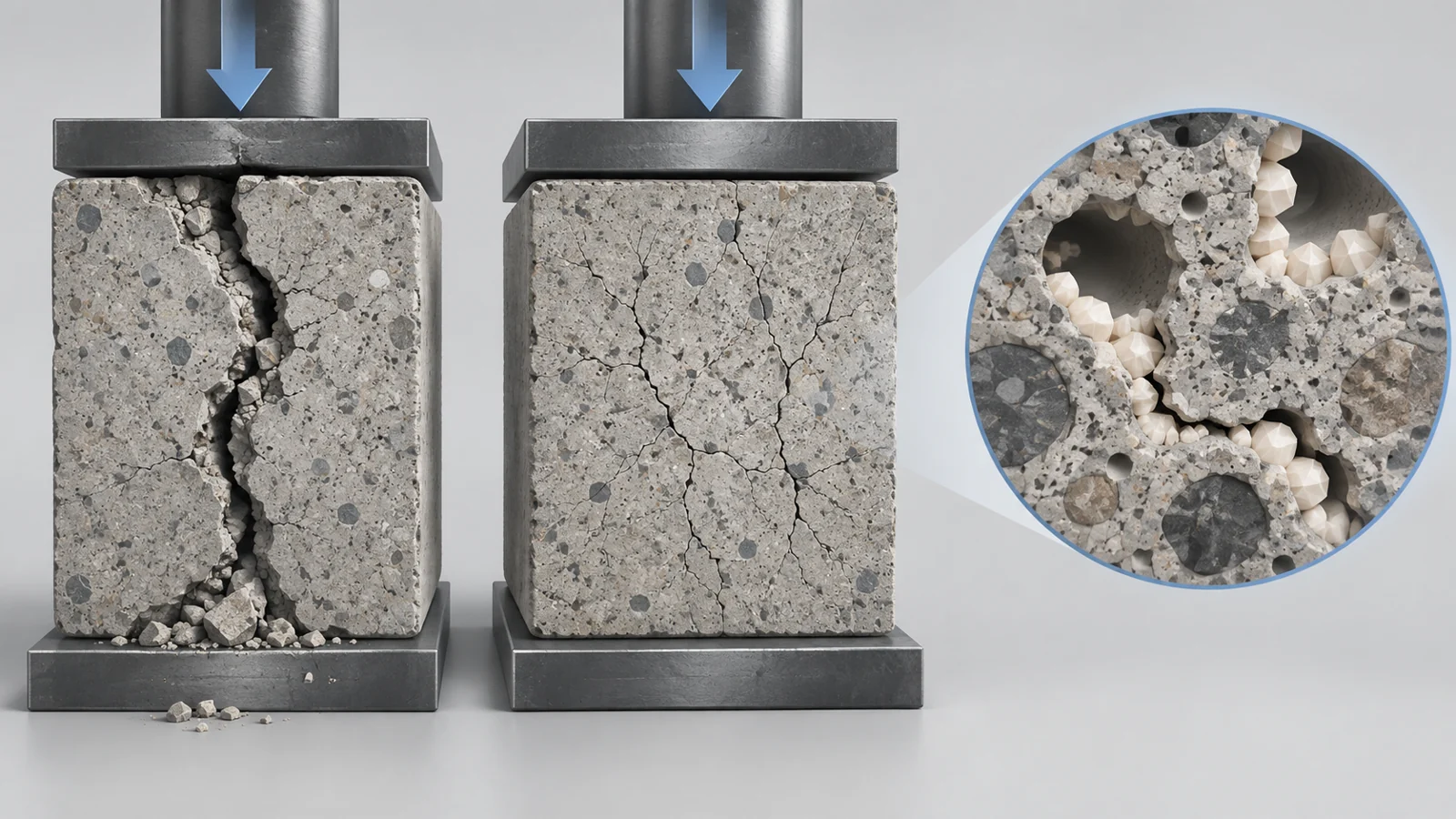
The stress-strain results suggested a change in how the specimens carried load as failure approached. The bacterial mixtures reached higher peak stresses, with approximately 28.75 megapascals for the 5% mixture and 32.2 megapascals for the 10% mixture. Their post-peak curves also descended more gradually than the control’s curve, and their peak strains were somewhat higher. In practical terms, the material did not appear to lose its load-carrying response as abruptly once the maximum stress had been reached.
The observed crack patterns followed the same broad direction. The control developed earlier, more localized vertical cracking. The bacterial specimens showed later crack formation and more distributed, finer cracks rather than one dominant fracture opening rapidly. That pattern indicates a greater capacity for stress redistribution in these tests. It is different from saying that the concrete became flexible or that a damaged structure repaired itself.
Flexural testing made the post-cracking difference more visible. Flexural strength increased from 2.93 megapascals in the control to 3.35 megapascals with 5% bacterial solution and 3.65 megapascals with 10%. The energy absorbed after cracking rose from 2.054 kilonewton-millimetres in the control to 3.35 kilonewton-millimetres in the 10% mixture. The flexural toughness index increased from 0.56 to 0.84. These measures describe how much load and deformation the specimens could accommodate after a crack had begun, not merely how high the initial peak was.
Two transport tests measured two different things
The durability results came from separate experiments. The chloride-related test was a rapid electrical-charge test. Hardened disks were exposed to different solutions on opposite sides while a voltage was applied for six hours. The reported charge passing through the 10% bacterial mixture was 1650 coulombs, a 57.1% reduction relative to the control. The 5% mixture recorded 2700 coulombs, a 29.9% reduction.
Coulombs in this test are a measure of electrical charge transferred under the specified conditions. They are not a direct count of chloride ions entering a wall, nor do they translate by themselves into a percentage reduction in reinforcement corrosion or years of service life. The 10% result was classified in the paper as low chloride-ion penetrability under the test’s interpretation.
The capillary experiment measured water uptake through an exposed bottom surface. The control absorbed roughly 2.8 millimetres by the later point shown in the test, with a sorptivity coefficient of about 0.28 millimetres per square-root minute. The 5% mixture absorbed around 1.8 millimetres, while the 10% mixture reached approximately 1.2 millimetres. The paper reports this as roughly a 50–60% reduction in sorptivity for the 10% formulation.
The preparation was not the same as the chloride test. Specimens were conditioned for six days in bacterial solution or lime-saturated water, then air-dried for ten days before one-directional water uptake was measured. Those details are important because the two tests answer different questions under different protocols. The electrical assay describes charge passage across a disk under an applied voltage. Sorptivity describes early capillary absorption. These results do not establish how transport changes while concrete is being mechanically loaded and cracking.
Where calcite fits and where the evidence stops
X-ray diffraction identified crystalline calcite in the 10% bacterial mixture after 56 days of curing. The reported calcite reflections are consistent with calcium carbonate being present in the hardened material, and the paper connects that finding with microbial-induced calcium carbonate precipitation. Calcite can also fit the observed picture of a denser matrix, refined pores and smaller or less connected openings.
The mineral result is meaningful, but it does not answer every causal question. Detecting calcite does not quantify how much of it came from bacterial activity, where all of it was distributed, or how much of the strength and transport changes should be assigned specifically to mineral formation rather than hydration, particle packing, pore refinement or changes in the interfacial transition zone. The measurements also do not establish that reduced crack connectivity caused the lower electrical-charge passage or water uptake.
The strongest interpretation is therefore a linked laboratory observation rather than a complete chain of proof. The formulations showed different mechanical behavior. The transport assays also showed lower measured passage or uptake. Calcite was identified in the higher-dose mixture. The authors propose that pore refinement and a less abruptly localized damage pattern work together to restrict connected routes through the concrete. That explanation is plausible within the reported results, but they do not establish the proposed causal link under sustained loading.
The study also does not establish long-term bacterial viability, repeated autonomous healing, or restoration of a previously damaged structure’s original load capacity. The 5% and 10% comparison cannot identify a universal best dose for other concrete designs, climates or construction practices. A laboratory reduction in charge or water uptake is not an equivalent reduction in maintenance frequency, corrosion risk or service-life loss.
The fresh mix still had a handling tradeoff
The hardened-specimen results came with a change in fresh-concrete workability. The control had a slump of 78 millimetres. Replacing part of the mixing water with bacterial solution reduced slump to 72 millimetres at 5% and 67 millimetres at 10%.
The paper attributes the modest decrease to bacterial cells and organic nutrients in the suspension, which may increase the viscosity of the mixing liquid and affect cement-particle dispersion. Within the tested formulation, the authors considered all three mixtures workable for ordinary placement and compaction. That conclusion belongs to these materials and laboratory conditions; it does not remove the need to check handling when the water-replacement level, aggregate system, placement method or environmental conditions change.
This tradeoff also helps keep the result in perspective. A material that carries load more gradually and absorbs less water may offer a useful durability direction, but it still has to be mixed, placed and compacted consistently. The practical value depends on whether the altered fresh behavior can be managed without losing the hardened performance observed in the specimens.
What this could change
Concrete for salt-exposed infrastructure could eventually be designed to tolerate developing damage more gradually while slowing some of the routes by which water and dissolved substances move inward. For owners and users, that combination could mean fewer disruptive repairs and longer intervals before deterioration becomes an urgent maintenance problem.
That benefit remains conditional on the laboratory behavior persisting under realistic loading and environmental exposure, and on the bacterial formulation remaining practical to produce and place. The March 2026 study makes the prospect more concrete by connecting strength, post-cracking response and transport-related measurements in one formulation. It does not yet turn those measurements into a promise of saltproof concrete or proven long-term self-repair.
Key Sources
- Primary source: Influence of Bacillus subtilis -Instigated Calcite Precipitation on Damage Progression and Ionic Transport.
DOI or Journal Page · Peer-Reviewed Paper · 2026-03-16