
Since the previous research note · Earlier expectation not tested
Track continuity
Since the previous research note: Bacteria that survive cement chemistry filled narrow mortar cracks
Previous expectation: Matching bacteria to cement chemistry might enable locally tailored crack-sealing ingredients if laboratory performance survives longer exposure and construction-scale use.
What this study adds: This preprint presents a Bacillus subtilis concrete concept and performance claims, but its declaration of no laboratory access conflicts with its experimental narrative. The supplied evidence establishes no test of the earlier screening principle or its predicted transfer to local materials and larger mixes.
What changed in this study
Concrete is strong under compression but vulnerable to cracks. Even a narrow opening can let water and harmful chemicals reach deeper into a structure, where reinforcement may corrode and damage can spread. Repairing that opening early could therefore matter long before a bridge, tunnel, or building shows obvious structural distress.
A preprint dated March 13, 2026, called Bacterial Healing Concrete, proposes a way to make some of that maintenance happen inside the material. Its idea is to mix bacterial spores and nutrients into concrete so that a later crack can become the site of mineral deposition. The abstract presents this as a conceptual prototype and says that its performance estimates were adapted from existing literature because laboratory access was unavailable. Later sections use the language of completed experiments, so the proposal needs to be read as both a material concept and a case study in how performance claims are established.
A crack can be small and still matter
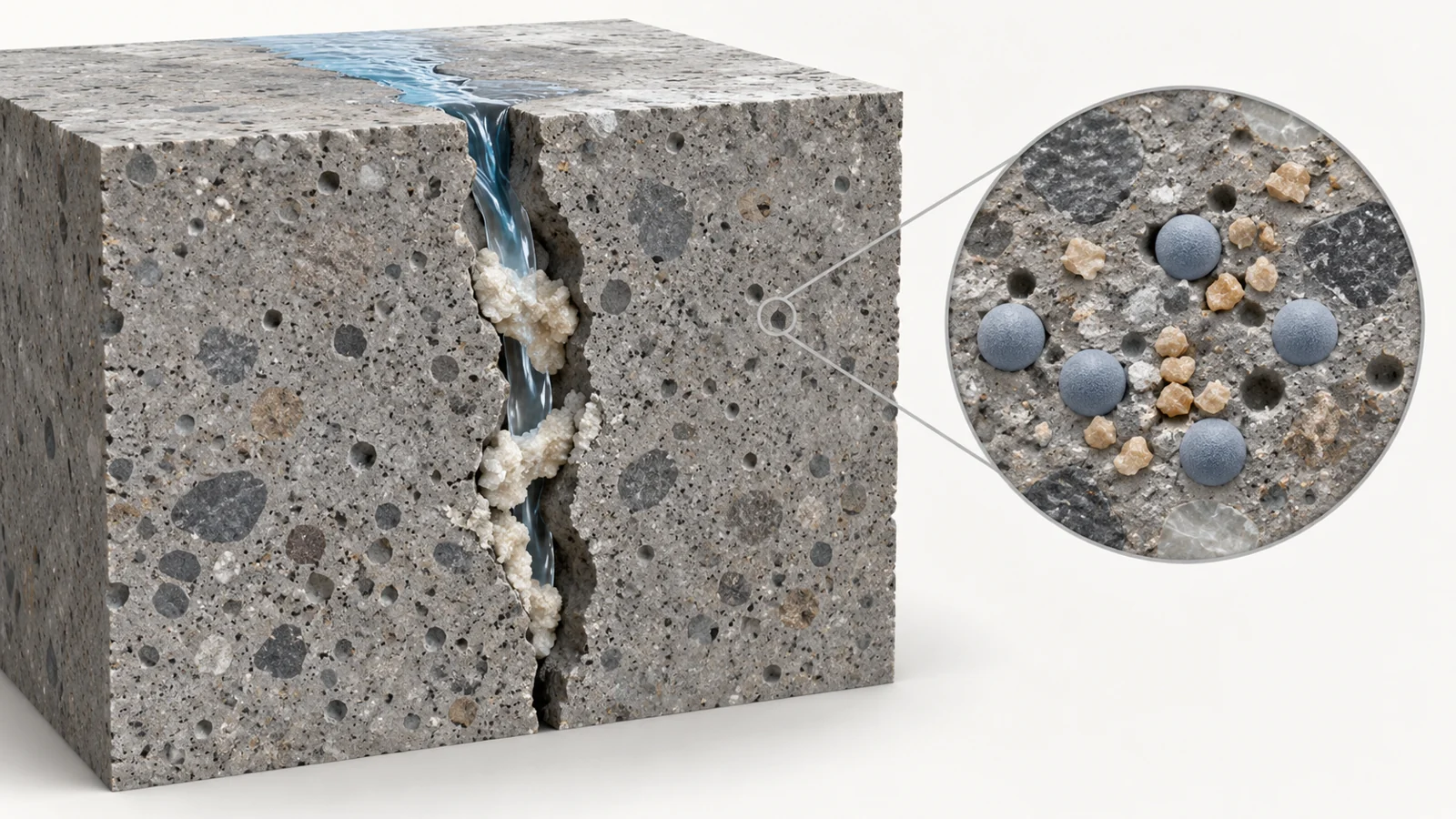
The proposed benefit is not that bacteria would rebuild an entire damaged structure. It is that a mineral deposit could partly occupy a crack and reduce the route available for water to enter. Less water movement could slow one pathway by which concrete deteriorates, potentially postponing more difficult external repairs.
That practical distinction matters. Narrowing a visible opening is a geometric observation. Reducing water permeability describes how readily water passes through the material. Recovering compressive strength concerns how the concrete responds to load. Improvements in one of these measures do not automatically establish improvement in the others, and none alone demonstrates restored structural safety.
The preprint places Bacillus subtilis spores and a nutrient supply inside the concrete mix. In its proposed sequence, a crack gives water access to the dormant spores. Water, oxygen, and nutrients then support bacterial activity, and the bacteria produce calcium carbonate, a mineral that can accumulate in the opening. The intended result is a biological seal formed where the crack creates access to the ingredients already embedded in the material.
The mechanism is therefore conditional rather than continuously active. The spores are not described as filling every crack on demand. They need the environmental access and biological activity identified by the paper, and the mineral deposit must remain attached and useful after it forms.
One paper tells two different stories about its evidence
The abstract explicitly says that the work developed a conceptual prototype without laboratory access and adapted estimates from existing literature. That framing would make the numerical results projections or literature-informed expectations rather than measurements from a newly completed experimental program.
Elsewhere, however, the paper describes prepared bacterial and control samples, 28-day curing, crack induction and healing tests, extraction of bacteria for colony counts, and statistical analysis using analysis of variance. Its discussion also refers to laboratory-scale experiments and presents numerical outcomes in the language of observed performance.
These accounts are not reconciled in the text considered here. It is therefore not clear which procedures were actually performed or which figures, if any, came from new measurements rather than adapted estimates. The paper describes an experimental-looking system, but its abstract places the central performance claims inside a conceptual and literature-informed approach. That unresolved provenance changes how confidently the reported percentages can be interpreted.
Three measurements answer different engineering questions
The preprint claims up to a 70% reduction in crack width after 14 days. This figure, if it reflects a measured change, describes how much narrower the opening became under the paper’s stated conditions. It does not show that the concrete regained its original load-bearing capacity or that the crack could be repaired repeatedly.
The paper also states that permeability fell by 50%, reaching 0.10 × 10⁻¹⁴ m²/s after healing. Permeability is relevant because water infiltration can carry the deterioration process farther into concrete. A tighter route for water could be valuable even when a crack remains visible, but a lower permeability figure is not the same as a structural safety assessment.
A third claim is a 7% increase in compressive strength compared with a control concrete. This addresses resistance to a particular loading test, not the complete condition of a cracked bridge deck, wall, dam, or foundation. The paper also discusses initially lower compressive strength in the bacterial concrete; the relationship between that initial disadvantage and the later claimed increase remains unclear.
The three percentages should remain separate. They cannot be combined into a general healing score, and they do not provide a service-life estimate. A crack can narrow without restoring the surrounding structure, water entry can decrease without proving adequate load performance, and a change in compressive strength can occur without showing durable sealing under repeated environmental exposure.
The seal depends on its surroundings
Moisture is central to the proposed operation. A crack that receives water offers the trigger described in the abstract, while a persistently dry opening may not support the same bacterial activity. Oxygen and nutrients are also part of the stated conditions. The surrounding concrete must allow those conditions to reach viable spores without weakening the material more than the repair could justify.
The paper says that bacteria remained viable and active for at least 14 days during the healing process. That is relevant to the proposed short-term response, but it is not evidence of persistence for the much longer period during which a real structure might develop another crack. Future usefulness would depend on whether spores remain capable of activity over much longer periods, including under the temperature fluctuations and variable moisture availability identified among the paper’s limitations.
Durability also depends on the mineral seal itself. Filling part of a crack is only useful if the deposit stays in place and continues to limit damaging ingress. The preprint identifies temperature fluctuations, moisture availability, ultraviolet exposure, long-term performance, and production scale as unresolved practical concerns. It also notes that incorporating and culturing bacteria would need to become workable for construction use.
The most plausible early application would therefore be a concrete element in which small cracks are difficult or expensive to reach, and where slowing water entry could buy time before conventional intervention. Infrastructure owners and maintenance crews could benefit if the material preserved acceptable strength while reducing the frequency of external repairs. That outcome remains conditional on bacterial function lasting long enough, mineral sealing surviving real exposure, and the mix performing reliably when produced at construction scale.
What this could change
Concrete that can seal some early cracks internally could give infrastructure owners another way to slow deterioration before workers need to reach the damaged area. Bridges, underground structures, dams, and other difficult-to-access assets might become easier to maintain if a biological mineral deposit reduced damaging water ingress without compromising the surrounding material.
That capability would require more than a narrower crack in a conceptual system. The proposed spores would need to remain functional, the calcium carbonate seal would need to endure environmental stress, and the concrete would need acceptable structural performance in full-scale construction. If those conditions hold, bacterial concrete could shift part of repair work from repeated external patching toward passive protection built into the material itself. The March 13 preprint outlines that possibility, but its conflicting account of how the performance figures were obtained leaves the practical promise unconfirmed.
Key Sources
- Primary source: Bacterial Healing Concrete
DOI or Journal Page · Preprint · 2026-03-13