
Since the previous research note · Earlier expectation not tested
Track continuity
Since the previous research note: Choosing and feeding one bacterium for possible concrete microcrack repair
Previous expectation: A prepared bacterium might eventually help concrete seal small cracks and reduce local patching if its activity persists inside the material and produces durable sealing.
What this study adds: This study examines a different bacterium, Bacillus pasteurii, and shows retained mineral-making capacity after aging with an expanded-perlite carrier in simulated cement environments. It adds evidence about preserving a repair ingredient, without testing the earlier strain-and-nutrient combination or establishing its predicted maintenance benefit.
What changed in this study
Concrete’s biological repair problem begins before a crack appears. A bacterium placed inside a cement-based material must remain useful through long periods of alkaline exposure, drying and temperature variation, then still produce enough mineral to help seal damage when that damage eventually occurs.
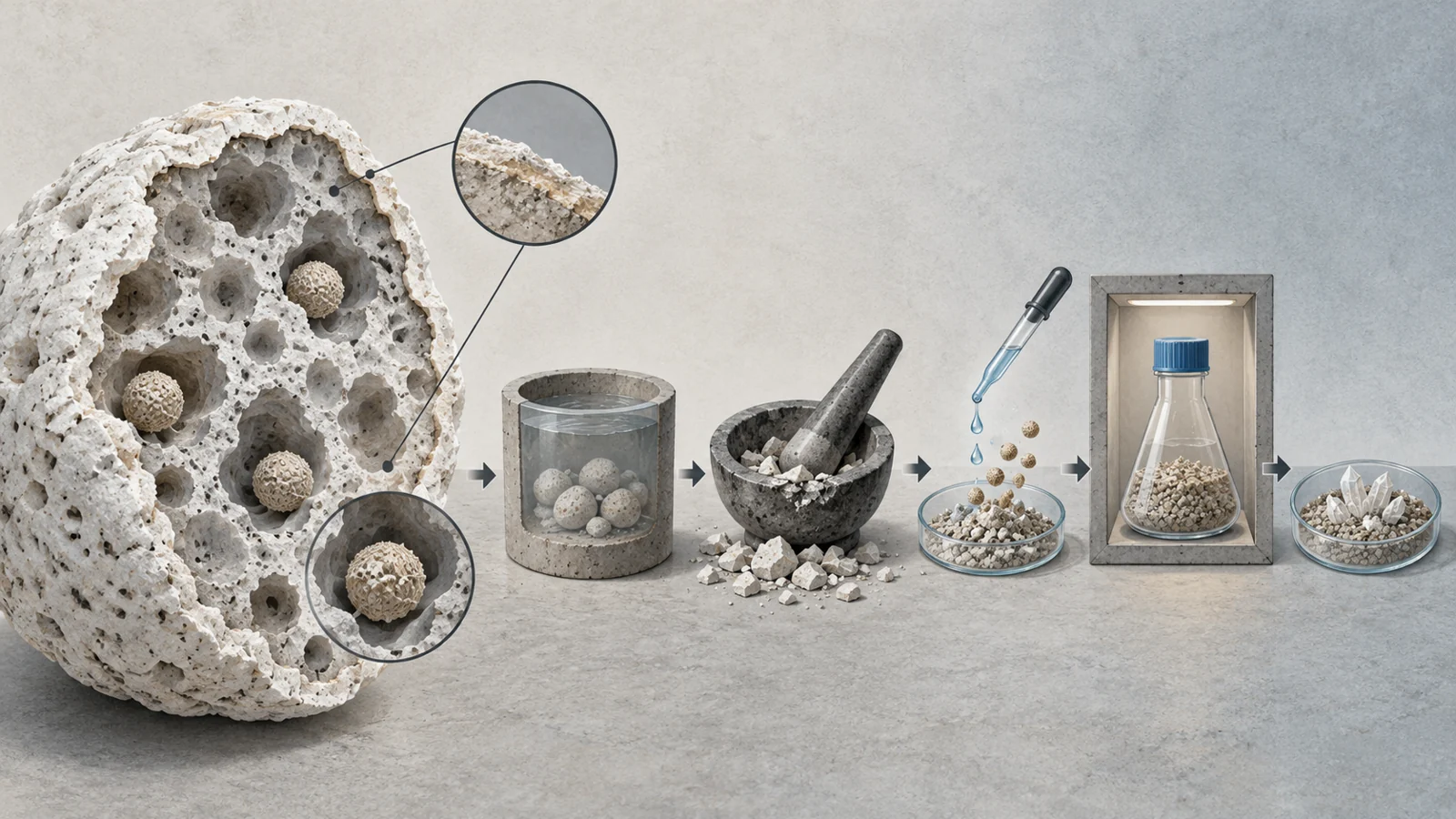
A study published January 16, 2026, tested one way to protect that biological ingredient. It used spores of the urease-producing bacterium Bacillus pasteurii and placed them in expanded perlite, a lightweight porous mineral often used as a concrete additive. The laboratory work found that the carrier preserved mineral-making capacity across several aging conditions. It also showed why the result is an encouraging materials finding rather than a demonstration that a bridge, wall or slab can repair itself.
Concrete repair has a waiting problem
Microbially induced carbonate precipitation is a proposed route to biological concrete repair. In simple terms, bacteria help drive reactions that form carbonate-containing mineral deposits. Those deposits may eventually fill small voids or cracks, but the biological component has to survive inside a difficult environment first.
Concrete is highly alkaline, relatively dry after hydration, and subject to mechanical stress during mixing and service. Its low tensile strength and brittleness also make it prone to microcracks. Once formed, those openings can allow water, oxygen, carbon dioxide, chlorides and other agents to move farther into the material. The attraction of a self-healing approach is therefore not just the ability to produce mineral once. It is the possibility of retaining a repair ingredient until the structure needs it.
The study focused on that waiting period in simulated cement environments. The supplied evidence does not establish that the measured mineral production sealed a particular crack width, restored permeability or recovered load-bearing capacity. Its central question was narrower and foundational: how much biological function remains after the spores and their carrier have aged under controlled exposure conditions?
Perlite changes the biological setup
Bacillus pasteurii is a Gram-positive, urease-producing bacterium that can form spores. Its alkaline tolerance and spore formation make it suitable for experiments that simulate cementitious conditions. Urease breaks down urea into ammonium and carbonate ions. The resulting change in solution conductivity provides an indirect way to follow urease activity.
Expanded perlite adds a physical shelter. Its porous structure offers attachment sites and can retain water around the immobilized material. That internal moisture may help spores become active during a later assay, while the mineral itself helps separate the biological material from the surrounding alkaline environment.
The particles were also treated with a two-layer coating system. A layer described as a “sugar coating” and an outer protective layer were intended to keep microorganisms and nutrients from being lost during mixing, reduce perlite’s water uptake, prevent premature contact between cells and nutrients, and improve resistance to mixing stresses. The design rationale also included carrier fracture when a crack begins, potentially releasing the contents. The supplied evidence describes that release as an intended engineering function; it does not establish crack-triggered release in a concrete structure.
The aging test measured a sequence, not a crack
The researchers used different measurements for different parts of the biological process. Bacterial concentration was estimated from optical density at 600 nanometers. Within the tested concentration range, cloudier suspensions corresponded to higher estimated concentrations. The concentration experiment used three tubes at each age stage and three independent replicates, with analysis of variance used for significance testing.
Urease activity was assessed separately through conductivity. A bacterial suspension was mixed with urea solution, and the change in conductivity over five minutes was used as an indicator of how quickly urea hydrolysis was occurring. This is a functional measurement of enzyme-related activity, not a direct count of living spores.
Mineral production followed another sequence. For immobilized samples, the expanded perlite was crushed after its aging period, nutrients were added, and the material was incubated at 30°C. The resulting material was dried and weighed to determine recovered precipitate. The mineral mass therefore shows what the aged preparation could produce under the prescribed nutrient-fed assay conditions. It should not be read as proof that the carrier was continuously producing the same amount of mineral while it sat in the simulated cement solution.
The tests varied pH, temperature and moisture in separate experimental series. Some schedules extended to 180 or 270 days, depending on the measurement. This design made it possible to see how individual stresses altered retained function, while leaving the combined effect of those stresses unresolved.
Protection preserved output, with a temperature tradeoff
The pH comparison showed a sharp difference between free and immobilized spores. Non-immobilized spores initially produced more mineral during the first week than they did later: average precipitation was 4.8 grams at pH 8, 5.49 grams at pH 10 and 4.37 grams at pH 12. By 90 days, the non-immobilized results had fallen below 0.5 grams.
The immobilized series followed a steadier path. It retained 4.77 grams at 180 days, and a separate summary of the immobilized pH results put average precipitation near 5.60 grams across the tested pH and aging conditions. The best average in that comparison occurred around pH 10, at approximately 5.88 grams. Because the free-spore and immobilized observations come from different ages, the values should not be converted into a single matched effect ratio. Their significance lies in the contrasting aging patterns.
Temperature added an important qualification. Free spores produced their strongest early mineral output at 30°C, with an initial average of 4.39 grams, compared with 2.95 grams at 0°C and 3.44 grams at 10°C. Their output then declined substantially with age. At 90 days, the 0°C condition retained 1.44 grams, while the 10°C condition retained 0.87 grams. The cooler condition therefore performed less impressively at the beginning but better over the longer interval.
Immobilization made mineral production more stable across the tested temperatures. It improved output under the cooler, less favorable conditions, while moderately reducing output at 30°C, where free spores had their strongest early performance. The carrier’s advantage was therefore not a universal increase. It shifted the balance toward steadier retained function rather than the highest first-stage yield.
Moisture mattered most at the dry extreme
The moisture experiment used expanded perlite’s saturated moisture content as its reference point. A value of 100% meant saturation of the carrier; 20% or 40% described partial saturation, not ambient relative humidity and not a universal water specification for finished concrete.
Across the 20% to 100% range, recovered mineral production stayed near 7.91 grams in the reported comparison. In the longer low-moisture series, the 20% and 40% groups maintained approximately 7.29 and 7.58 grams, respectively. Complete drying behaved differently. The 0% group was initially stable, then declined rapidly after seven days and fell below one gram by day 28.
These measurements point to a practical exposure dependency. The carrier did not need to remain fully saturated in the tested setup to support later activity, but complete desiccation was strongly damaging. As in the other mineralization tests, the aged material was later placed in a nutrient-fed assay. The moisture results therefore describe how storage conditions affected subsequent measured capacity, not uninterrupted mineral production inside an intact concrete element.
The carrier still has to belong inside concrete
A material that protects bacteria can create new problems for the host material. Expanded perlite’s porosity helps it hold water and biological material, but it can also absorb mixing water. That may contribute to microbial detachment or reduce the water available for cement hydration. At higher amounts, the same effects can weaken the concrete matrix and impair the interface between perlite particles and the surrounding material.
The coating system was proposed partly to address those practical concerns by reducing water absorption, retaining the biological contents and improving compatibility with conventional mixing. Yet the laboratory aging results and the concrete engineering problem remain separate questions. Preserving mineral-making capacity is useful only if the carrier can be incorporated without unacceptable penalties to strength, bonding or hydration.
The study also varied pH, temperature and moisture separately rather than reproducing their combined behavior in one exposure. Real cementitious environments can present several stresses at once. The authors identify those interactions as a subject for future work, so a strong result under one controlled condition should not be treated as a complete prediction of service life.
What this could change
The possible payoff is a longer-lived repair ingredient embedded within concrete: something that could retain biological activity during the quiet years before small cracks appear, then contribute to mineral sealing when the surrounding conditions allow it. For infrastructure owners and maintenance crews, that capability could eventually reduce some localized patching work and extend the useful life of selected concrete components.
That outcome remains conditional. Carrier-protected spores would need to produce durable sealing in actual concrete under combined alkaline, thermal, moisture and mechanical exposures, while the perlite and coating caused no unacceptable material penalties. This study supplies an important piece of that path by showing that a porous mineral carrier can preserve later measured mineral-making capacity after laboratory aging. It does not yet show autonomous crack-triggered repair, years of field service or fewer maintenance interventions.
Key Sources
- Primary source: Expanded perlite immobilization enhances long-term survival and mineralization activity of microbial spores in cementitious environments.
DOI or Journal Page · Peer-Reviewed Paper · 2026-01-16