
Since the previous research note · Earlier expectation not tested
Track continuity
Since the previous research note: How concrete can store and release a mineral-making repair system
Previous expectation: Dependable internal microcrack sealing could reduce difficult maintenance work if repair activity survives real exposure without weakening concrete.
What this study adds: The current source identifies a candidate bacterial strain and preliminary nutrient conditions, reporting enhanced germination and urea hydrolysis alongside inhibition from excessive calcium. These findings address preparation of the biological component; they do not establish the earlier forecast’s infrastructure benefit.
What changed in this study
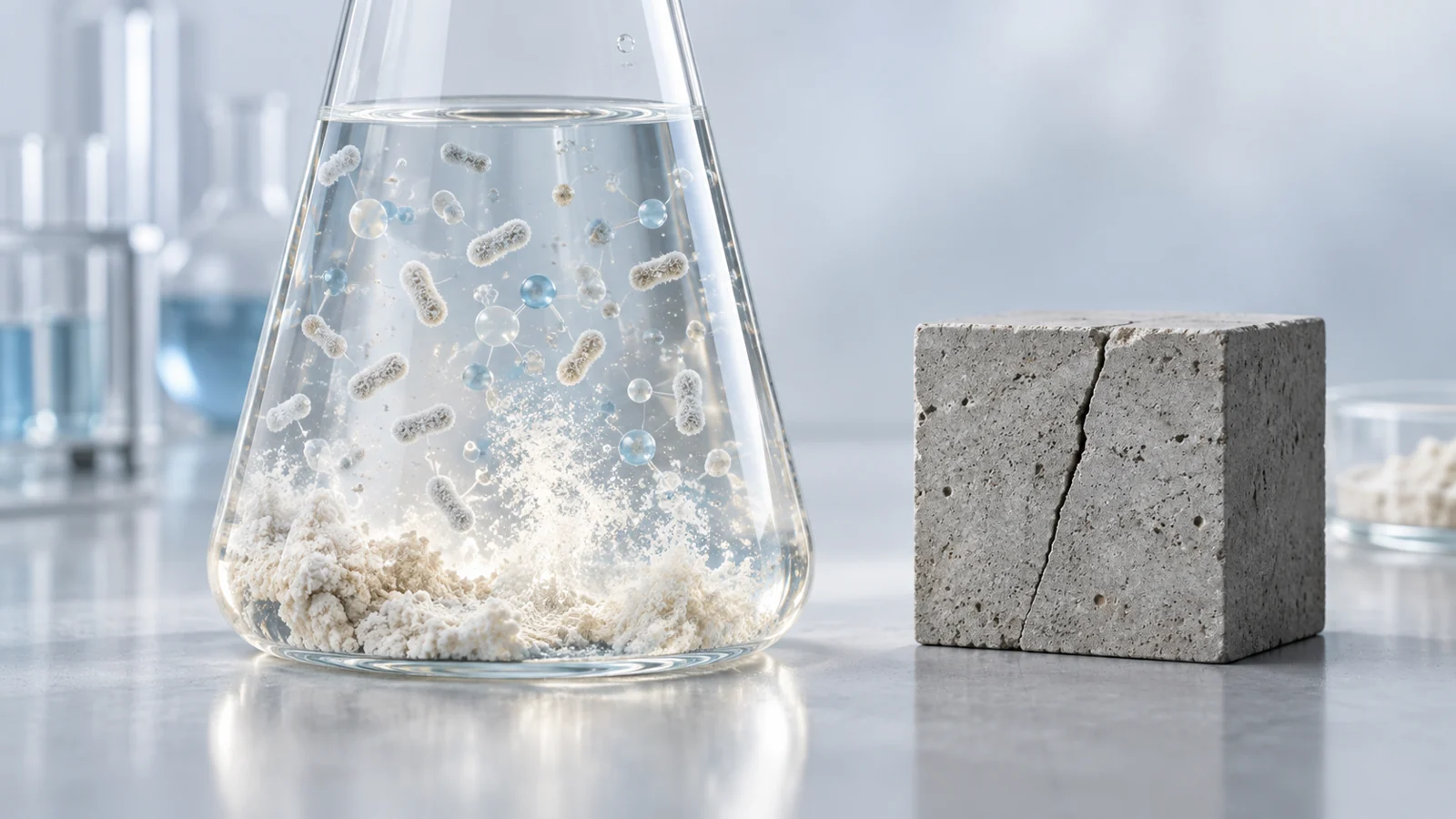
Concrete designed to seal some of its own small cracks depends on more than finding a mineral-producing microbe. The organism must also remain active under conditions that support the chemistry needed for calcium carbonate formation. A study published in January 2026 examined that preparation stage by screening soil bacteria and then adjusting nutrients around one selected strain.
A candidate emerged from 155 soil isolates
The researchers began with 155 soil isolates. Morphological and biochemical tests narrowed this group to Lysinibacillus pakistanensis, which they selected for further optimisation as a possible contributor to self-healing concrete.
The next question was not simply whether the bacterium could produce calcium carbonate. It was how its surrounding nutrients affected the biological activity linked to that process. The investigation included yeast extract, nutrient broth, glucose, L-alanine and inosine. Urea decomposition and calcium carbonate precipitation served as the measured responses.
This narrowing process matters because it separates two stages that are easy to blend together. First, a strain is identified as promising within a screening programme. Then, its growth or activity conditions are explored. The study focuses on the second stage for L. pakistanensis, offering a preliminary nutrient direction rather than a finished concrete treatment.
The food around the bacterium changed its response
Urease is the enzyme that breaks down urea, and the study tracked that breakdown as one response to nutrient changes. That breakdown is part of the biological process associated with calcium carbonate precipitation, so stronger urease activity can make the organism more useful for investigating mineral formation.
The nutrient results were not uniformly positive. L-alanine and inosine enhanced spore germination and urea hydrolysis, indicating that these additions helped more spores become active and supported the measured breakdown of urea. Excessive calcium, by contrast, inhibited activity under the tested conditions.
The practical lesson is a balancing problem. Calcium is relevant to the mineral-forming environment, but more calcium was not automatically better for the bacterium. The abstract does not establish an exact formulation, a calcium-inhibition threshold, or the size and reproducibility of each nutrient effect. It does show why the biological preparation cannot be treated as a single fixed ingredient whose performance is independent of its surroundings.
Two measurements describe different parts of the process
The study reports that L. pakistanensis hydrolysed 100% of the urea within 72 hours. In plain terms, all of the measured urea had undergone the reported breakdown by that point. This is a biochemical result: it describes urea hydrolysis, not the time required to close a concrete crack and not the duration associated with the largest mineral yield.
The other headline number is calcium carbonate production of up to 0.43 grams per 100 millilitres. This is a measured amount of precipitated mineral in the reported culture volume. It is not interchangeable with the percentage of urea hydrolysed, and the two figures should not be read as one combined performance score.
The researchers used scanning electron microscopy, energy-dispersive spectroscopy and Fourier-transform infrared spectroscopy to characterise the precipitate. Those tools add information about the material produced in the laboratory. They do not, on their own, establish how that material would behave inside a concrete microcrack.
The evidence stops before demonstrated concrete repair
The strain selection and nutrient response are useful preparation findings for a proposed repair system. They identify a bacterium that performed strongly in the reported screening and show that its spore germination and urea hydrolysis responded differently to particular nutrients and to excessive calcium.
The supplied abstract does not provide crack-healing percentages, a maximum repairable crack width, restored concrete strength or reduced permeability. It also does not establish whether the precipitate would remain effective through the physical and chemical conditions of real concrete, or whether the activity would be durable enough for service use. Those are separate questions from breaking down urea and producing a measured quantity of calcium carbonate.
Selection in this study should therefore be read as a promising candidate decision within the tested screening, not proof that the bacterium is superior to every other organism or to enzyme- and capsule-based approaches. Manufacturing suitability, cost savings and whole-system environmental benefits also remain open. The result advances the biological preparation of a possible repair material; it does not yet demonstrate that infrastructure has been repaired.
What this could change
A bacterium that can be prepared to germinate and produce calcium carbonate under suitable conditions could eventually become one component of concrete able to seal some small internal cracks. If that activity survives inside the material and creates useful, durable sealing, infrastructure owners and maintenance crews might need fewer local patching interventions for certain types of damage. The benefit would come from extending repair capability into the concrete itself, but it depends on turning this laboratory strain-and-nutrient combination into a reliable, long-lasting working system.
Key Sources
- Primary source: Enhancing urease for calcium carbonate precipitation in Lysinibacillus Pakistanensis through nutrient optimisation for self-healing concrete applications.
DOI or Journal Page · Peer-Reviewed Paper · 2026-01-01