
Since the previous research note · Earlier expectation not tested
Track continuity
Since the previous research note: When a sealed concrete crack meets a new load
Previous expectation: Built-in bacterial crack sealing could reduce water entry and maintenance disruption once durability under real exposure and repeated loading, affordability and environmental tradeoffs were demonstrated.
What this study adds: The November 2025 review compares microbial, enzyme, capsule and composite approaches, making protection, release, environmental requirements and fabrication tradeoffs more explicit. It does not itself test the earlier forecast's repeated-loading or infrastructure-maintenance outcomes.
What changed in this study
Concrete is usually repaired from the outside. Someone finds a crack, reaches it with a sealant or grout, and tries to stop water and further damage from getting in. That approach becomes harder when cracks are hidden inside a member, appear in places that are difficult to access, or recur after the repair crew has gone.
A review published on November 1, 2025, examines a different idea: concrete that carries materials capable of making their own mineral repair. Its focus is biomineralized self-healing concrete, in which microorganisms or enzymes help produce calcium carbonate, the same broad mineral family found in limestone. The precipitated material can fill parts of a crack or pore. The review compares microbial systems, extracted enzymes, protective capsules and composite carriers, making the engineering choices behind the promise easier to see.
The comparison is important because self-healing concrete is not one finished material. It is a collection of delivery systems and chemical routes. A crack may close visibly while the surrounding concrete remains mechanically compromised. A repair may work in a small specimen but depend on light, nutrients, oxygen, a carefully timed capsule rupture or a carrier that is expensive to manufacture. The useful question is therefore not simply whether a crack can be filled, but how the repair capacity is stored, activated and evaluated.
Repair begins with a mineral made in place
Calcium carbonate is the solid product that gives many of these approaches their visible repair effect. In a microbial route, bacteria or fungi help create the chemical conditions for calcium and carbonate ions to meet and precipitate inside a crack. The new mineral can occupy the open space and form deposits along the crack surfaces.
One bacterial example described in the review starts with the crack itself. Water and oxygen entering through the opening can activate bacteria present in the concrete. The bacteria convert calcium lactate into calcium carbonate crystals and carbon dioxide. The crystals can fill internal parts of the crack, while nearby concrete particles react with the carbon dioxide to generate more calcium carbonate that settles toward the surface.
Another widely studied route uses urea hydrolysis. Bacterial cells and the polymers around them can attract calcium ions, while the reactions surrounding urea breakdown create carbonate species and raise the local pH. Calcium carbonate then forms on or near the biological material. The cells and their extracellular polymers also provide nucleation sites, places where the mineral can begin to grow.
The living system is doing more than supplying a chemical ingredient. Its survival, concentration and location influence where precipitation starts and how much mineral forms. The review describes work with bacteria, fungi and mixed biological communities, with results varying by organism and concentration. Filamentous fungi can provide branching structures that offer many nucleation sites and physical support for mineral deposits, while bacterial systems are often valued for their controllable precipitation chemistry.
An enzyme route separates the mineral-making chemistry from microbial growth. In enzyme-induced calcium carbonate precipitation, urease extracted from plants catalyzes the breakdown of urea. The resulting chemical sequence produces carbonate ions, which react with calcium ions to form calcium carbonate in and around cement-based material. The enzyme itself can be biodegradable, and the route can act quickly in the early repair of small cracks.
That distinction changes the design problem. A microbial system must preserve useful biological activity within an alkaline, physically constrained material. An enzyme system needs the enzyme and reactants to reach the right place and remain chemically useful long enough to precipitate mineral. Both aim at the same broad solid product, but they do not carry the same biological requirements or environmental tradeoffs.
A repair system needs a way to wait
Putting a healing ingredient into concrete is not enough. It must remain available after mixing and hardening, then respond when damage creates a path for activation. Microcapsules offer one way to separate those two moments.
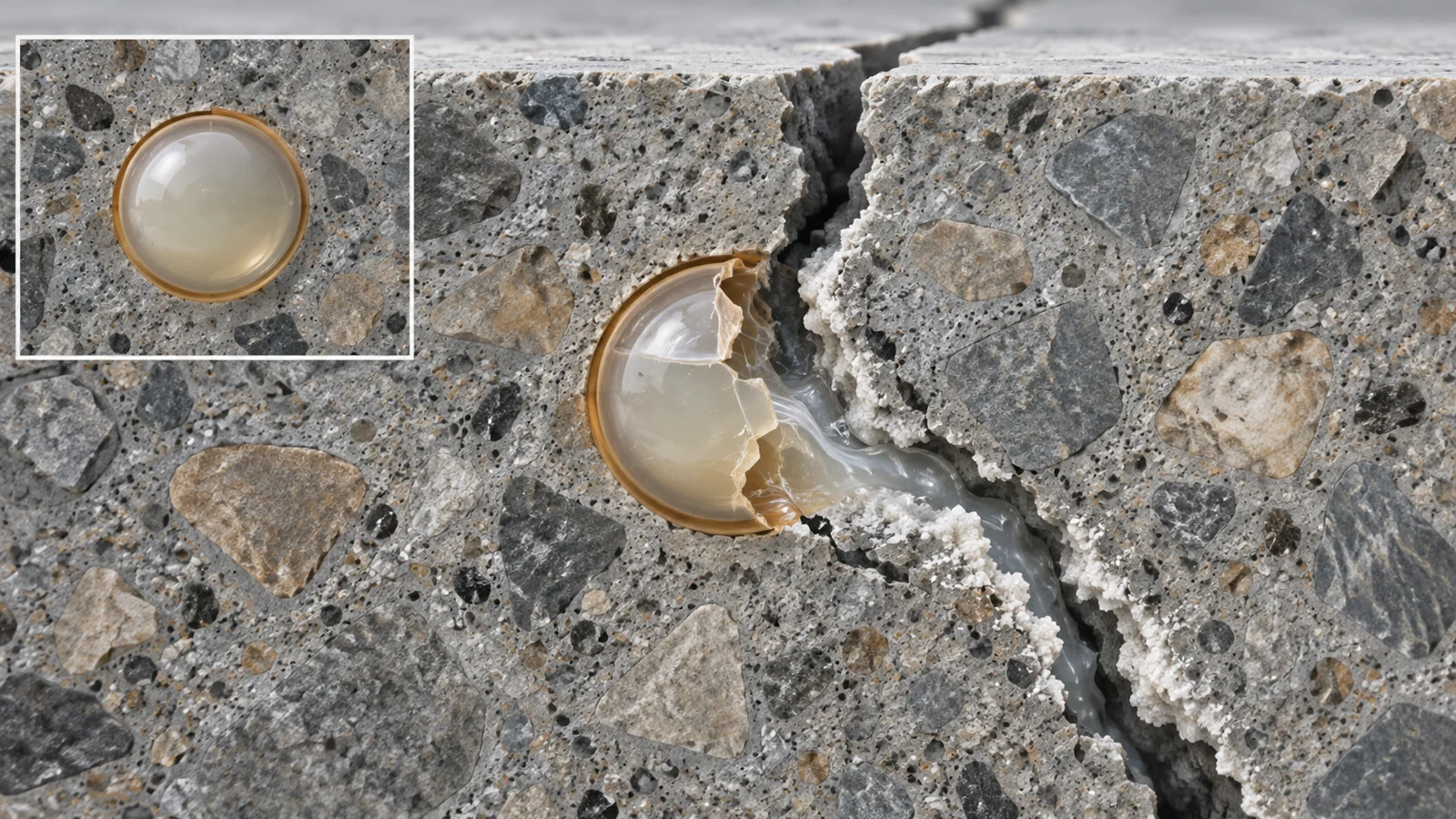
A capsule places a healing agent inside a protective shell dispersed through the cementitious matrix. As a crack moves through the material, it can rupture capsules in its path. The contents are released into the crack volume, where they can react or activate locally. The appeal is easy to understand: the repair agent is present before damage, but its main response begins when damage reaches it.
The shell has to meet two opposing demands. It must survive incorporation into concrete and remain stable during the material’s service, yet it must be fragile enough to break when a crack arrives. A shell that fails too early can waste the healing agent. One that remains intact after cracking cannot deliver it where it is needed. Once a capsule releases its contents, the same location may also have limited capacity for another response, especially when the damage is wider or returns along the same path.
Microcapsule systems introduce material questions of their own. Adding many capsules can change the concrete’s fluidity, castability and final mechanical properties. As capsule materials degrade, they may leave micropores that weaken durability. Large-scale production is still costly for some biopolymer shells, including examples the review compares with more conventional chemical materials. The capsule therefore cannot be judged only by how much crack filling it enables; it also has to preserve the host material.
Carriers provide another form of protection. Hydrogels, lightweight aggregates and polyvinyl alcohol fibers can shelter microorganisms from the high pressure, heat, alkaline conditions and limited oxygen found in concrete. They may also release nutrients when a crack forms. The porous interface between an inorganic component and the cement matrix can create a small protected space for microbial spores and their food sources.
Composite systems try to make the biological and inorganic parts reinforce one another. Inorganic particles can offer surfaces for mineral growth, while microbial activity helps bind or anchor those particles through calcium carbonate formation. This may improve the balance between strength and toughness, but complex carriers add fabrication steps and cost. Their long-term behavior also has to remain predictable inside a structure that is exposed to moisture, loading and changing environmental conditions.
A sealed crack is not the same as a restored structure
The review’s examples show why several measurements must stay separate. Crack closure describes how much of an opening is filled or sealed. Strength increase describes how a material compares with another condition. Strength recovery describes how much of a previously damaged material regains its earlier capacity. None of those numbers can stand in for all the others.
Consider a fungal example involving Fusarium oxysporum and Trichoderma longibrachiatum. The review says the organisms completely sealed cracks up to 1.34 millimeters and restored 58.75 percent of compressive strength. Those are meaningful results, but they do not mean that the concrete returned to its original load-bearing condition. Complete visible sealing and partial mechanical recovery are different outcomes.
The bacterial results make the same point in another way. In one set of comparisons, a concentration of 10⁷ cells per milliliter produced higher crack-healing efficiency, while 10⁵ cells per milliliter produced the best improvement in compressive strength. The concentration associated with better mineral filling was therefore not the same as the concentration associated with the strongest mechanical result.
A single performance score would hide this difference. A mineral deposit can block a path for water without restoring the continuity, toughness or load transfer of the surrounding concrete. Conversely, a change in strength may occur without complete closure of every visible opening. Testing has to state whether it measured width reduction, water resistance, compressive or tensile behavior, recovery after damage, or another endpoint.
The distinction also matters when comparing organisms, enzymes and capsules. A system that performs well in one small specimen under one curing condition may be optimized for a particular endpoint rather than for broad structural protection. The review presents these results as a diverse research field, not as evidence that one formulation has already combined the widest repairable crack, fastest action, greatest strength improvement and repeatable service-life performance.
Light and chemistry set different environmental terms
Not every biological route can operate under the same conditions. Photosynthetic approaches using microalgae depend on light. In the reaction described by the review, photosynthesis uses water and removes carbon dioxide from bicarbonate-containing solution, producing carbonate compounds and a local rise in pH. In the presence of calcium ions, those conditions can promote calcium carbonate formation.
That mechanism gives microalgae an attractive connection to natural light, but it also limits where and how the system can function. The review describes microalgae repair as largely confined to laboratory research, with open questions around efficiency, light dependence and long-term stability. A material inside a dark or deeply embedded part of a structure would not automatically have the same operating conditions as a surface specimen exposed to light.
Urease-based repair has a different environmental profile. Urea hydrolysis can produce ammonia and ammonium ions as part of the chemistry, and the review highlights potential concerns about nitrogen pollution. It also notes carbon dioxide generated during remediation. A process that helps form carbonate in one local reaction cannot, by itself, establish the environmental balance of the complete concrete system, including the ingredients, manufacturing, transport, carrier or capsule production and eventual degradation.
Calling a method biological or mineral-based does not settle whether it is environmentally preferable. The relevant question is how the full material behaves, what it consumes and releases, and whether the repair lasts long enough to justify its added complexity. Those comparisons require consistent boundaries and measurements rather than a benefit inferred from one reaction step.
The laboratory result still has to become a building material
The largest gap identified by the review is not a lack of imaginative mechanisms. It is the distance between promising small specimens and reliable infrastructure. Many tests use small material volumes, while the field lacks standardized criteria for comparing self-healing effectiveness. Different studies can vary in organisms, substrates, crack preparation, healing conditions, observation times and performance endpoints.
That variation makes an impressive percentage difficult to interpret outside its original setup. It also complicates decisions about dosage, capsule shell, carrier architecture and the amount of repair material that can be added without harming workability or strength. Manufacturers need a repeatable formulation process. Infrastructure owners need to know how the material behaves when embedded at scale, exposed to real moisture and temperature conditions, and subjected to the loads that produce damage.
Long-term biological survival remains especially important. The review’s outlook leaves open whether microorganisms can remain viable throughout a building’s service life. The broad possibility of continuing repair should therefore not be read as proof that an embedded population will stay active for the whole life of a structure. A system may work after a controlled curing period and still require a different design to remain effective years later.
The same caution applies to repeat damage. Microcapsules may release their contents once, and a microbial system may depend on nutrients or protected spaces that are gradually depleted. The review does not itself test dependable protection in components exposed to repeated loading. That question belongs to a different stage of validation than comparing how mineral deposits form in a specimen.
For deployment, the standard is more demanding than a best-case healing percentage. Engineers need comparable tests for closure and mechanical recovery, evidence about the host concrete after carriers or capsules age, credible manufacturing costs and specifications that can be followed consistently. Until those pieces are connected, self-healing concrete remains a promising set of repair strategies rather than a general replacement for conventional maintenance.
What this could change
Concrete that can seal some small cracks from within could eventually reduce the need for crews to reach and patch difficult locations. For building and infrastructure owners, that could help limit pathways for water ingress and make maintenance less disruptive for the people who use the structure. The practical route to that benefit depends on the delivery choice: a microbial system must protect useful activity, an enzyme system must bring its chemistry to the crack, and a capsule system must release its contents without compromising the concrete around it.
That future remains conditional. The repair must survive real exposure, provide more than a convincing surface closure, and be manufactured affordably without weakening the material that carries it. The November 2025 review clarifies the design tradeoffs that must be solved before a self-healing system can become dependable infrastructure protection. It does not yet turn those tradeoffs into a field-wide maintenance saving or a proven whole-system environmental advantage.
Key Sources
- Primary source: Progress in Self-Repair Technology for Concrete Cracks via Biomineralization.
DOI or Journal Page · Review or Meta-Analysis · 2025-11-01