
Since the previous research note · Partly supported
Track continuity
Since the previous research note: Tracing concrete crack repair back to the bacteria
Previous expectation: Built-in bacterial repair could reduce disruptive concrete maintenance if the bacteria remain functional and healing proves durable under service conditions.
What this study adds: The current study supplies laboratory observations of crack closure and behavior after renewed loading, including reinforced-beam results relevant to a useful repair capability. Residual cracks during the second loading sequence and the stated need for field validation leave the service-life conditions unresolved.
What changed in this study
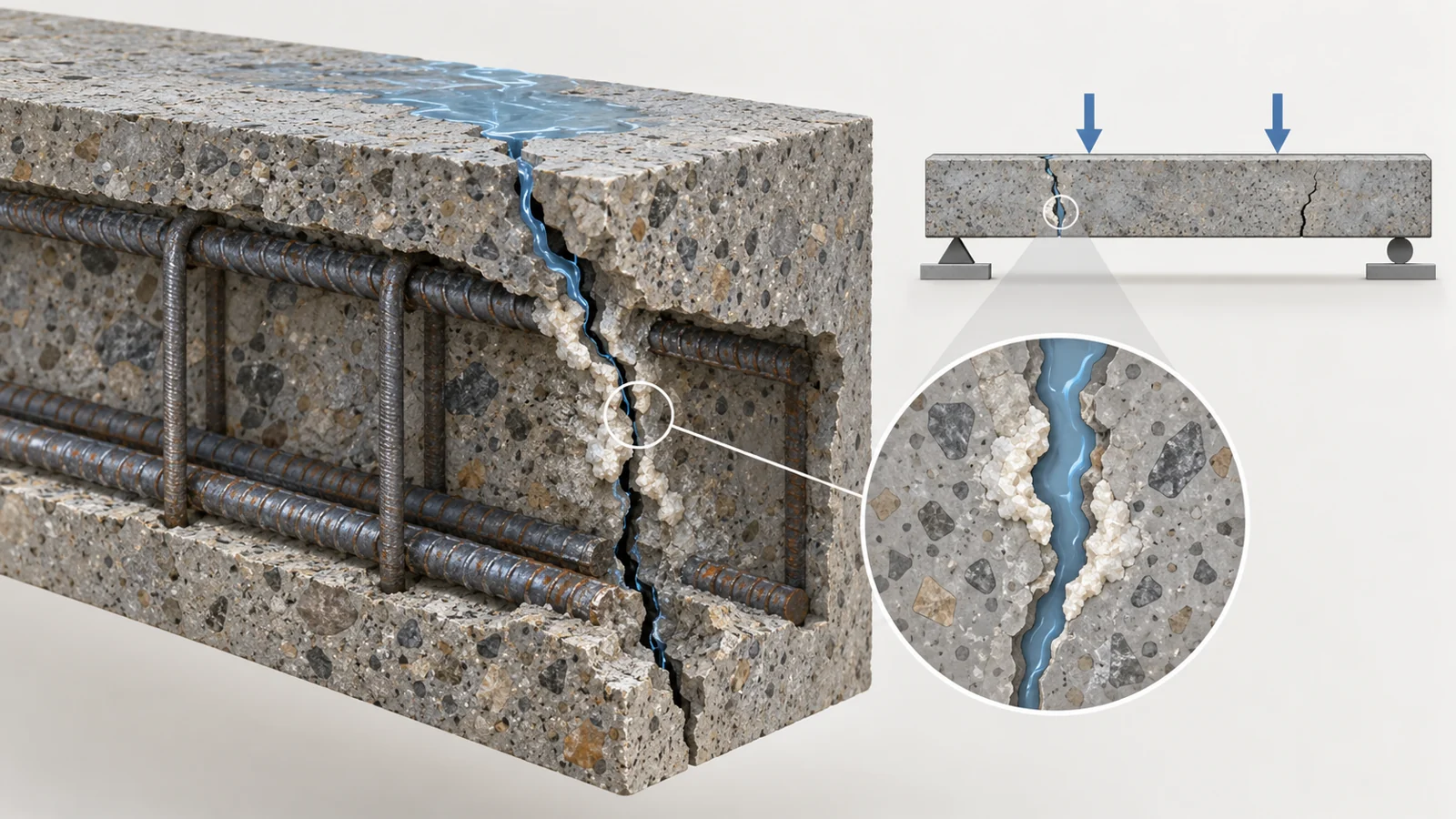
Concrete cracks are more than surface blemishes. They can provide routes for water and chemicals to enter the material, weakening the concrete matrix and increasing the risk of corrosion around steel reinforcement. A material that can seal its own cracks could therefore reduce some disruptive repair work—but only if the sealed region remains useful when the structure is loaded again.
A research article published on September 30, 2025, tested that question in laboratory concrete made with Bacillus subtilis. The experiments included ordinary specimens, reinforced beams, crack-width measurements, microscopy and renewed loading. The paper reports closure of cracks up to about 1 millimeter under selected conditions. The more important result for infrastructure is what happened after the first healing period, when the specimens were asked to carry load again.
A crack is a route for water and chemicals
The proposed material places bacteria and a nutrient called calcium lactate inside the concrete mixture. The bacteria can be added in powder or liquid form; the study used 100 grams per cubic meter during the dry-mix stage. When a crack forms and water enters, the previously inactive bacteria can become active and promote calcium carbonate deposition. The mineral can accumulate along the crack and narrow the path through which water would otherwise travel.
Microscopy gave the researchers a way to inspect that explanation rather than relying only on the visible disappearance of a crack. Scanning electron microscopy showed deposits inside the porous matrix, while elemental analysis found calcium, carbon and oxygen in proportions consistent with calcium carbonate. The images also showed calcite-like crystals. Together, these observations support a mineral-deposition account of the closure process, although they do not isolate bacterial activity from every other contribution that may affect a crack.
Strength changed with the mixture and the clock
The study compared four material combinations: bacterial and ordinary concrete, each made with either river sand or manufactured sand. That design matters because “bacterial concrete” is not one uniform material. The aggregate, the property being measured and the age of the specimen all influenced the comparison.
At seven days, manufactured-sand bacterial concrete had a lower reported compressive strength than its ordinary counterpart, 11.19 versus 12.61 newtons per square millimeter. With river sand, the two results were nearly identical, 10.24 versus 10.25. By 14 days, the bacterial mixtures were higher in compression for both aggregates: 27.59 versus 24.49 for river sand and 32.66 versus 30.26 for manufactured sand.
The pattern changed again at 28 days. Manufactured-sand bacterial concrete measured 34.27 newtons per square millimeter, slightly below the ordinary mixture at 34.92, while the river-sand bacterial mixture was marginally above its control, 32.13 versus 31.73. These measurements argue against a simple claim that adding bacteria always makes concrete stronger. They point instead to an age- and mixture-dependent effect.
The split-tensile results followed a different pattern. Manufactured-sand bacterial concrete was higher than its matched control at seven days, 5.06 versus 4.51 newtons per square millimeter, and at 14 days, 5.41 versus 4.82. At 28 days, the values were 5.90 and 4.86. Calcium carbonate deposition may have improved bonding and resistance to crack opening in this test, even though the compression results did not move in the same direction at every age.
Healing had two clocks
One clock measured how old the concrete was before it was cracked. The other measured how much time passed after cracking while the specimens were allowed to heal. Mixing those clocks together would make the results look more uniform than they were.
The reported initial cracks included widths of 1.0, 0.6 and 0.5 millimeters. Closure progressed substantially during the first seven days and was described as almost complete by 21 days in the relevant specimen series. Detailed results also describe complete closure by 14 days for specimens that had been cured for seven or 14 days before testing, while a specimen cured for 28 days retained a small residual crack of 0.15 millimeters at that point.
The beam results add another layer. Beams cured for seven days required 21 days for full closure. The detailed passage reports complete closure in 14 days for beams cured for 14 days, while beams cured for 28 days required 21 days. Elsewhere, the paper summarizes complete closure within 21 days for beams cured for 14 and 28 days. Rather than turning these differing summaries into a universal deadline, the useful reading is that healing depended on the prior curing condition, the specimen and the elapsed healing period.
Renewed loading produced a less complete picture. After the initial healing stage, the specimens were loaded again. During this second sequence, residual crack widths of roughly 0.08 to 0.10 millimeters were recorded at 21 days in the relevant tests, and a larger initial crack in one 14-day specimen appeared to slow recovery. Partial re-closure was still observed later, but the second loading sequence was less efficient than the first.
Reloading moved the test closer to real structures
The reinforced-beam program used simply supported M20, M25 and M30 beams under two-point loading. This arrangement created a bending region where the researchers could follow crack initiation, growth and subsequent healing. It was a more structural test than examining a small crack in an isolated cube because beams develop flexural cracks while carrying a load.
The bacterial beams showed higher reported flexural strength at first crack than the control beams. For example, the M20 group measured 4.2 versus 3.5 megapascals after 14 days of curing and 4.8 versus 4.0 after 28 days. The M25 and M30 groups showed similar advantages in the reported first-crack measurements.
Those numbers describe resistance to the first visible crack. They are not the same as a measurement of how much original structural capacity was recovered after healing. In the renewed-loading observations, new cracks formed at locations different from the original cracks. That suggests the previously damaged regions could withstand additional loading without immediately reopening in the same place, but it does not by itself establish complete recovery of the original capacity, long-term fatigue resistance or unlimited healing cycles.
The result is useful precisely because it separates two questions. A mixture may resist the first crack more strongly, and a healed region may behave differently from an untouched region, but neither observation alone proves that an operating beam can repeatedly repair itself under changing service loads.
What the modeling adds
The paper reports boundary conditions associated with a Random Forest algorithm and Kuhn–Tucker conditions in Table 10. In the discussion, the authors invoke both methods to support their account of healing after renewed loading.
The experimental evidence remains the anchor. The reported material identifies the methods and presents boundary-condition calculations, but it is not enough to treat the study as independent validation of a general-purpose predictor for every concrete mixture or environment. The model-based claims warrant separate verification; the results discussed here rest on the reported strength tests, crack-width measurements, microscopy and beam observations.
The field still changes the question
A laboratory crack is created, wetted and observed under controlled conditions. Infrastructure experiences more variation: moisture may come and go, temperatures change, contaminants enter, and loads are repeated over long periods. The bacteria must remain viable and active in that setting, and calcium carbonate deposition must be consistent enough to matter beyond a carefully prepared specimen.
Scale introduces a separate problem. A mix that performs well in a controlled batch still has to be produced with reasonably uniform bacterial content and nutrient distribution. The cost of the bacterial additive and calcium lactate could affect whether the approach competes with conventional maintenance. Its environmental case also needs life-cycle assessment, including the footprint of cultivating the bacteria and producing the added materials.
The authors identify field-scale testing, long-term environmental exposure and better control of bacterial survival as necessary next steps. Those tests would need to connect crack closure with the outcomes owners actually care about: reliable sealing, safe load-bearing behavior, manageable maintenance and a credible service-life benefit. The present study establishes a laboratory milestone, not a completed infrastructure solution.
What this could change
Concrete owners could eventually use built-in crack sealing to limit some water entry and reduce hands-on patching and disruption around beams, slabs and other bending-loaded components. The benefit would be greatest where a localized crack can be sealed before it accelerates deterioration, allowing maintenance crews to intervene less often and users to experience fewer closures.
That future depends on more than a crack becoming difficult to see. Bacterial activity would need to survive real exposure, the healed zone would need to behave reliably under repeated loading, production would need to be affordable and consistent, and life-cycle accounting would need to show that the added biology and nutrients deliver a worthwhile environmental tradeoff. If those conditions hold up in field testing, self-healing concrete could shift some infrastructure maintenance from repeated visible repair toward protection built into the material itself.
Key Sources
- Primary source: Advancing sustainable concrete with bacterial self-healing technology and Kuhn-Tucker condition.
DOI or Journal Page · Peer-Reviewed Paper · 2025-09-30