
Since the previous research note · Partly supported
Track continuity
Since the previous research note: What bacterial concrete reveals about water uptake and recovery after cracking
Previous expectation: Bacterial concrete could reduce recurring repairs if its healing function survives real exposure and delivers useful protection after cracking.
What this study adds: The current preprint reports healing after specimens underwent two years of seasonal exposure, followed by induced cracking and 28 days of curing. That bears on the persistence condition and adds microbial recovery and transfer procedures, without directly testing the earlier study's forecast of water protection, maintenance savings, or environmental and economic benefits.
What changed in this study
A crack that appears to close in concrete is easy to see. The harder question is what caused the change. Did the added bacteria drive the mineral deposit, or did some other feature of the mixture produce the same appearance?
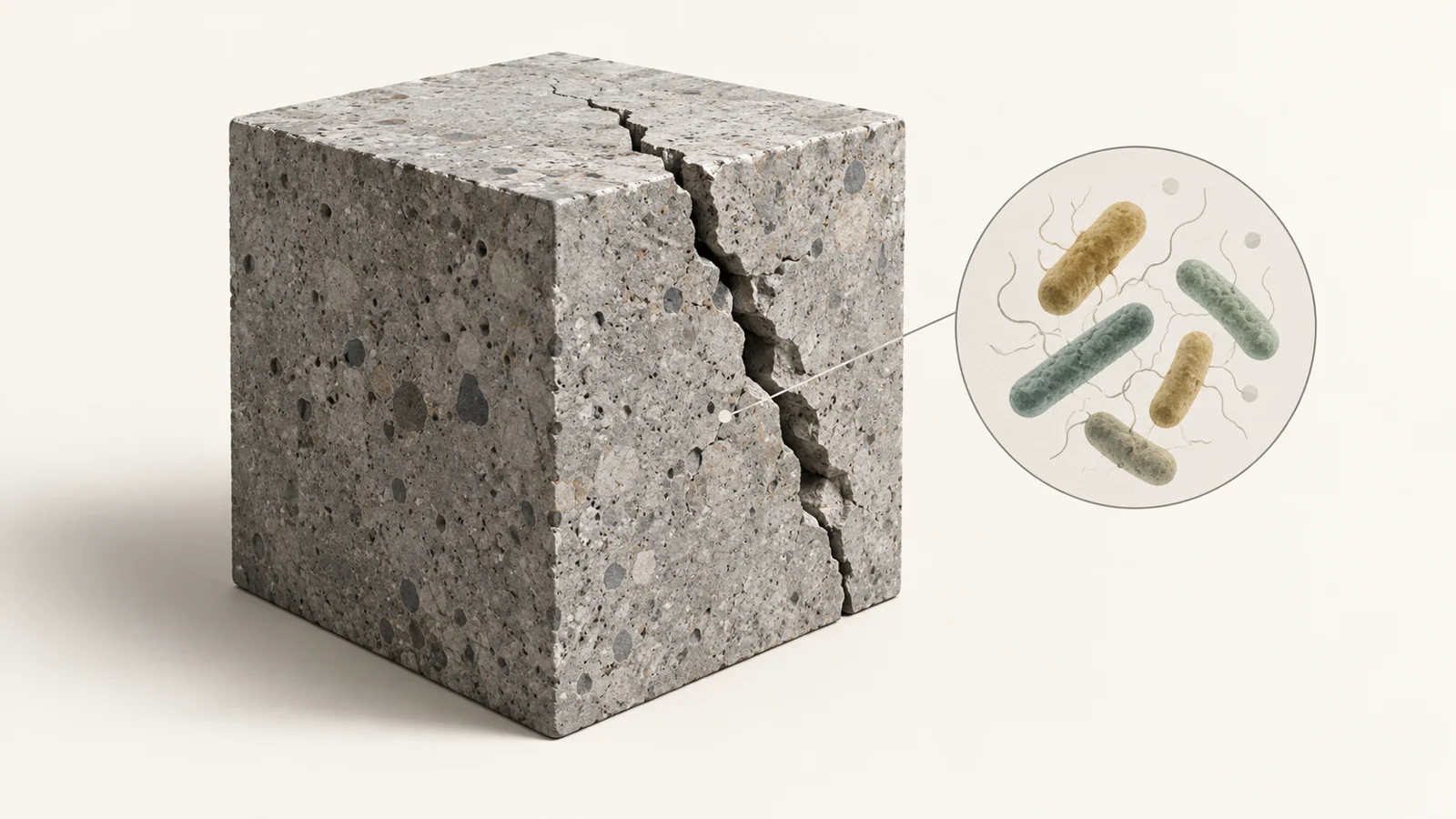
A September 8, 2025 preprint, Application of Koch’s postulates in self-healing concrete, takes that question into the material itself. The researchers compare ordinary concrete with a bacterial mix, recover microbes from the specimens, and use a culture from the healing material in a fresh mix. The aim is to connect a named organism with an observed effect rather than treating a filled crack as proof on its own.
A visible change needs a biological trail
The study concerns self-compacting concrete, a mix that can be vulnerable to shrinkage cracking because it contains a high amount of fines. The bacterial version was prepared with Bacillus subtilis at a stated concentration of 1.3 × 10^8 cells per millilitre. Conventional and bacterial mixes used the same stated water-binder ratio of 0.33, giving the comparison a shared mix-design condition.
Concrete specimens were cast as 100-millimetre cubes. The researchers then looked at two different outcomes. One was how the cubes performed under compression after 28 days of curing. The other was whether a deliberately induced crack later showed signs of healing. Keeping those outcomes separate matters: a stronger cube is not necessarily a cube that regains strength after damage, and a mineral-filled crack is not automatically evidence that the added organism caused the filling.
The reported results point in different directions at once. Bacterial concrete had 7% greater 28-day compressive strength than conventional concrete. In the crack-healing observations, conventional specimens did not heal in the reported comparison, while bacterial specimens developed precipitation in the cracks. The abstract also reports healing of a 1.2 mm crack. That number is an attributed result from this experiment, not a general maximum crack width for every bacterial-concrete formulation or exposure condition.
The postulates become a tracing experiment
Koch’s postulates were originally developed as a way to link a microorganism to a disease. Here, the researchers adapt that logic to a materials question: can the organism associated with a healing specimen be recovered, separated, and used to produce the same kind of effect in a new concrete body?
The first stage starts with samples from two places: the bacterial concrete that showed healing and the conventional concrete used as the comparison. Microbes from both samples were cultivated with a spread-plate method. Common bacteria were removed from consideration, while the suspected organism from the healing sample was grown separately using streak plates. The reported colony morphology was identified as Bacillus subtilis 168, described in the paper as a domestic, non-probiotic strain.
The second stage moves from observation toward attribution. A liquid culture made from the recovered organism was introduced into a fresh concrete mix. After 28 days of curing, the new cubes were cracked and cured for another 28 days; the researchers report that the cracks healed. They also report similar colony patterns when comparing streak plates from the second stage with the mother culture. The transfer therefore produced a reported healing outcome, extending the evidence beyond the original specimens. Similar colony patterns do not establish genetic strain identity, and the reported sequence should not be treated as complete causal proof.
The study also examined the material deposited in the cracks. Microstructural testing reported calcium carbonate precipitation formed through microbial-induced calcium carbonate precipitation, or MICP. That result helps describe what filled the crack. It does not, by itself, identify which part of the experimental system was responsible; the culture-and-transfer sequence is the study’s effort to address that separate question.
Ageing came before the second crack
The timing of the experiment gives the result a different meaning from a healing observation made immediately after mixing. After an initial 28-day curing period, specimens were exposed to seasonal conditions for two years. The aged cubes were then cracked and placed into another 28-day curing period before the researchers assessed healing.
The bacterial mix showed healing after that sequence. This matters because a material intended for infrastructure has to remain useful after time passes, not only while it is newly prepared. The observation is consistent with a bacterial capacity that can still be expressed after prolonged seasonal exposure and later cracking.
It does not show that the bacteria were continuously active throughout the two years, or that healing proceeded without the subsequent 28-day curing period. The result is narrower and more useful than either extreme: after ageing under the reported conditions, the bacterial specimens still showed healing when they were cracked and given another period of curing.
Three engineering questions remain separate
A filled crack answers a visual question: is material now occupying part of the opening? Compressive testing answers a loading question: how does the cube resist a force at the stated test stage? Protection from damaging water entry is a transport question about how fluids move through the material. Those questions can be related in a real structure, but one measurement cannot stand in for all three.
The 7% strength difference therefore should not be read as a 7% recovery after cracking. Nor does the crack-filling observation demonstrate restored structural capacity, repeated healing cycles, or water-tightness. The evidence described here also does not establish infrastructure-scale maintenance savings. Those are additional performance questions that would need their own measurements under relevant service conditions.
The same caution applies to mechanism. The strength difference may be useful for comparing the two mixes, but it does not by itself identify the biological cause of that difference. The microbial recovery work gives the paper a more specific attribution strategy, while the strength and visual observations answer their own narrower questions.
What this could change
Concrete that retains a biological capacity to seal some later-forming cracks could eventually help infrastructure owners reduce localized repairs, along with some of the disruption those repairs create for users. That prospect depends on dependable microbial activity under service exposure and on crack filling providing useful protection against deterioration, not merely an attractive change at the surface.
The preprint’s contribution is the attempt to follow the organism through the material and through time. If that connection can be made dependable across practical conditions, bacterial concrete might become a way to preserve some repair capacity inside a structure rather than relying only on intervention after every small crack. The September 2025 result is an early step toward that possibility, not a demonstration that the wider maintenance case has already been proved.
Key Sources
- Primary source: Application of Koch's postulates in self-healing concrete
DOI or Journal Page · Preprint · 2025-09-08