
Since the previous research note · Partly supported
Track continuity
Since the previous research note: From dormant bacterial spores to mineral bridges in cracked concrete
Previous expectation: Bacterial mineral repair could reduce water entry and some recurring crack repairs if bacterial function could be sustained within usable concrete.
What this study adds: This source reports lower water absorption and capillary uptake in bacterial concrete mixtures, alongside post-cracking strength recovery. Those observations support the water-entry part of the expectation without testing the earlier capsule activation, placement or lifetime-survival conditions.
What changed in this study
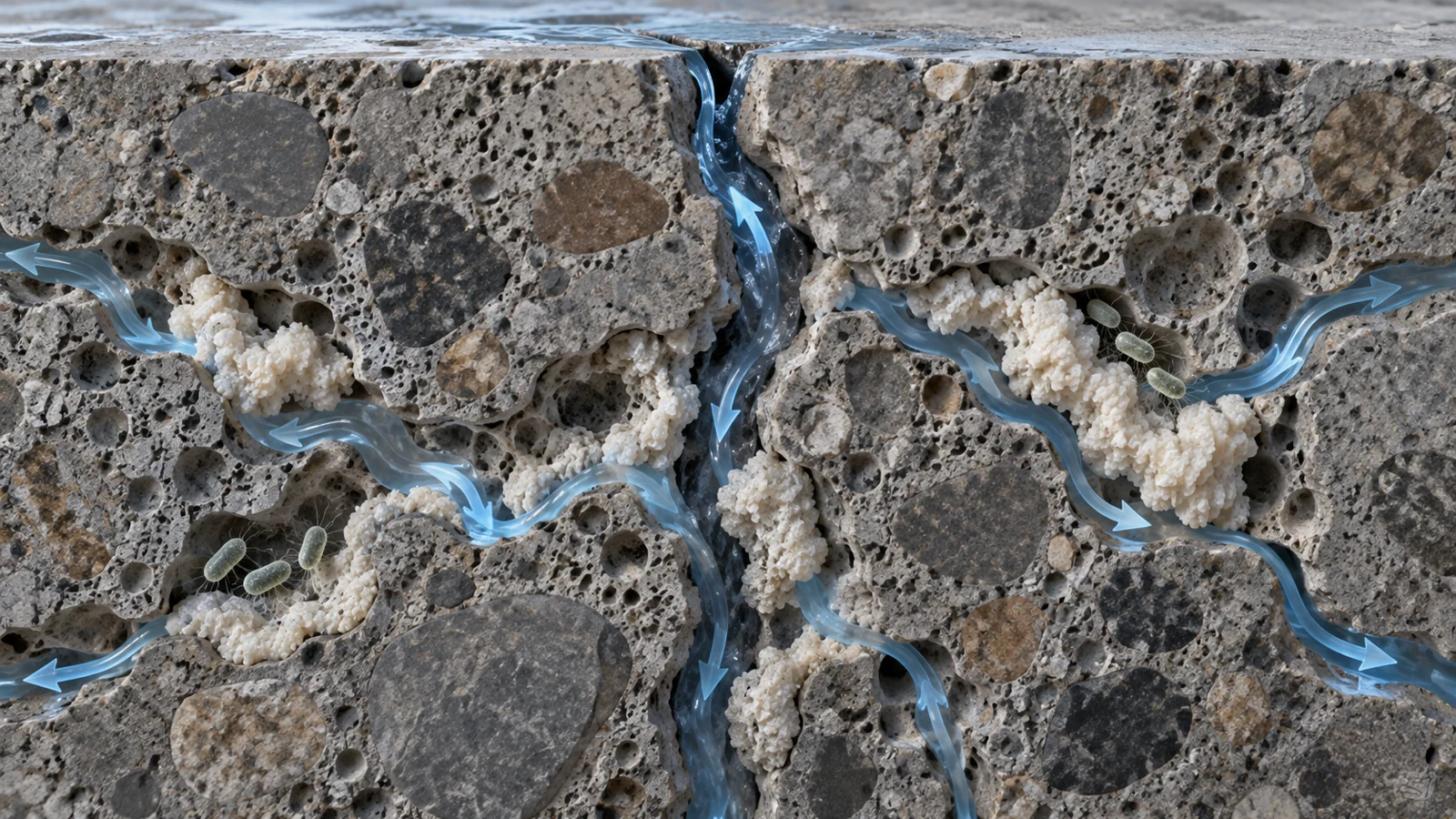
A crack in concrete is not only a visible line. It can become a route for water to move into the material, carrying the conditions that gradually weaken it. That makes self-healing concrete an appealing idea: instead of treating every small crack from the outside, could the material narrow some of its own internal pathways?
A research article published on August 14, 2025, examined that question in laboratory concrete specimens containing five bacterial species at concentrations ranging from 10⁴ to 10⁶ cells per milliliter. The mixtures were compared with conventional concrete using measurements of water absorption, capillary uptake, strength, sulphate resistance, acid-related strength loss and elemental composition. The results point to two different possibilities. Bacterial mixtures admitted less water in the reported tests, and some specimens regained strength after cracking. The distance between those observations and a concrete structure that needs fewer repairs is where the more important questions begin.
The repair chemistry is mineral, not magical
The proposed mechanism is microbial-induced calcium carbonate precipitation, or MICP. In one described pathway, bacteria break down urea, producing carbonate-related compounds that interact with calcium already present in the concrete matrix. Calcium carbonate can then precipitate in small cracks and pores. Deposits of that mineral may narrow some routes through which water enters, making the surrounding matrix harder for fluids to cross.
The study did not treat all five organisms as identical. Bacillus subtilis is widely studied in this area because of its urease activity and ability to form endospores. Pseudomonas stutzeri has been associated with calcite formation through denitrification, a different metabolic route. Escherichia coli was included partly because its genetics are well characterized and could make it useful as a biological chassis in future research. The other strains were selected for properties such as possible urease production, biofilm formation or environmental resilience. Those distinctions matter because a result from a bacterial mixture is not automatically a result that every species would reproduce in the same way.
The mineral interpretation also has a defined boundary. The paper uses energy-dispersive X-ray analysis to identify changes in elemental composition consistent with calcium carbonate formation. Higher calcium and carbon signals, alongside lower oxygen and silicon signals in the discussed mixture, were interpreted as evidence of a more refined pore structure. But EDAX cannot distinguish one calcium carbonate polymorph from another, and it cannot verify crystallinity. It supports the elemental basis of the explanation without providing a complete picture of the mineral deposits.
Water entry is where the measurements are clearest
Saturated water absorption and sorptivity answer related but different questions. Saturated absorption asks how much water a specimen takes up under a procedure designed to bring it close to saturation. Sorptivity describes the rate at which water is drawn into the material through capillary action. A mixture can therefore show improvement in both total uptake and the speed of early ingress, but the measurements should not be treated as interchangeable.
The reported absorption comparison is concrete. At 28 days, the conventional control mix recorded 2.96% saturated water absorption, while the mixture designated M7 recorded 1.62%. At 90 days, the corresponding figures were 2.42% and 1.32%. Both the control and bacterial mixtures changed across the measured ages, so the result is not a comparison between a fixed control and a timeless bacterial advantage. It is a set of matched-age observations in which the M7 designation is more reliable than any species label attached to it across the paper.
The capillary measurements point in the same direction. The control sorptivity was reported as 5.53 × 10⁻⁵ m/s¹/² at 28 days and 4.84 × 10⁻⁵ m/s¹/² at 90 days. The M7 mixture was reported at 3.50 × 10⁻⁵ and 3.06 × 10⁻⁵ m/s¹/² at those ages. Other bacterial mixtures also showed lower values at higher cell concentrations. In plain terms, the tested bacterial concretes tended to take up less water and draw it in more slowly than the control under these laboratory procedures. That is meaningful evidence for restricting water entry in specimens, but it is not the same as a measured waterproofing guarantee for a building or bridge.
Strength recovery follows a different clock
Water resistance and post-cracking recovery should be kept separate. The first asks how the material behaves before or during fluid exposure. The second asks what happens after damage has already changed the specimen.
In the strength section, the control mix reached 24.03 MPa at 28 days. The mixture designated M16 reached 28.85 MPa at 28 days, and its reported healed strength was 31.45 MPa at 40 days. These numbers show that the bacterial mixture had a higher reported strength at the first comparison point and a higher reported value after healing. They do not, by themselves, provide a healing percentage. The 28-day and 40-day values are different-age measurements, and ongoing curing can contribute to changes in strength alongside any crack-sealing activity.
The study also examined how sulphate exposure affected material loss. For the mix labeled M7, the reported weight-loss values across the listed measurement points were 2.84%, 2.56% and 2.48% before healing, falling to 1.99%, 1.80% and 1.74% after healing. This gives the reader another view of the experiment’s logic: the authors were not relying on compressive strength alone, but were asking whether the material retained more of itself after an aggressive exposure. The result supports the paper’s interpretation of improved resistance in the tested specimens, while leaving repeated repair over an entire structure’s life as a separate engineering question.
The mix labels matter as much as the mix results
A careful reading also reveals why bacterial species should not be ranked from these extracts alone. The slump section assigns M2–M4 to Bacillus subtilis and M5–M7 to Bacillus licheniformis. The strength section, however, identifies M14–M16 as the Bacillus subtilis group. Because the mix-to-species assignments do not remain consistent between sections, the safest language is to report the results by their mix designations and preserve the direction of the measurements without declaring one organism the clear winner.
The rapid chloride permeability test creates a second traceability problem. The control readings are printed as 2,074, 1,855 and 1,727 km/s at 28, 56 and 90 days. The paper interprets bacterial concrete as showing reduced chloride ion penetration, with some higher-concentration mixtures performing better than the control. Yet the printed unit makes the magnitude difficult to interpret, and it does not authorize replacing the unit with a corrected one or converting the values into a diffusion coefficient. The direction of the reported comparison can be retained; a precise transport ranking cannot.
These issues do not make every mix-level measurement unusable. They change what can responsibly be concluded from it. A reader can follow the reported absorption, sorptivity, strength and sulphate trends while recognizing that species-level attribution requires a more stable mapping between labels, mixtures and measurements.
A specimen is not yet an infrastructure system
Concrete used in infrastructure must function through changing conditions, not only through the controlled ages used in a laboratory comparison. The paper identifies bacterial survival during freeze–thaw cycles, carbonation exposure and prolonged drying as unresolved development pressures. Bacteria also need a workable nutrient supply if mineral formation is expected to continue. Protective carriers and delivery systems may help preserve biological function, but they add design and manufacturing requirements of their own.
The economics are similarly conditional. The paper discusses bacterial cultures and nutrients as costs that can exceed conventional concrete additives by 20% to 30%. That figure is part of the paper’s background discussion, not a cost test performed by the specimen experiment. A sustainable material would need to balance the resources used to grow, protect and feed the bacteria against the repairs, replacement material and disruption that might eventually be avoided.
For that reason, the environmental case cannot be inferred simply from adding a biological component. Life-cycle assessment would need to account for material production, bacterial cultivation, nutrient supply, incorporation into concrete, maintenance and end-of-life handling. Cost–benefit analysis would need to compare those inputs with a demonstrated reduction in repair work. The current results make those evaluations worth pursuing; they do not complete them.
The practical test is sustained function
The strongest near-term interpretation is narrower than the phrase self-healing concrete can suggest. In these specimens, bacterial mixtures were associated with lower water absorption and capillary uptake at matched ages, while selected strength measurements showed recovery after cracking. The paper’s own measurements therefore connect bacterial mineral formation with two useful material behaviors: restricting some fluid movement and restoring some measured mechanical performance after damage.
The harder test is whether those behaviors persist when the concrete is exposed repeatedly, when nutrients become less available, and when bacteria must remain useful in a material that is drying, aging and carrying loads. The supplied comparisons do not establish repeated autonomous repair throughout a structure’s service life or a measured extension of that service life. They show a laboratory step toward that goal, with the biological and economic operating conditions still attached.
What this could change
Concrete that blocks more damaging water entry and regains some strength after a small crack could eventually reduce recurring repair interventions for infrastructure owners. Fewer treatments or localized repairs could mean less traffic disruption, fewer work zones and lower demand for replacement material. Those benefits remain conditional on bacterial function surviving real exposure conditions, on the mineral deposits forming where they are useful, and on the full system producing a credible environmental and economic balance.
The August 14, 2025 study moves the conversation forward by comparing those two practical capabilities in the same family of specimens. It supports the idea that bacterial concrete can do more than contain an interesting biological ingredient. It also shows why the next step is not simply to name the best bacterium, but to establish which mixture remains traceable, active and worthwhile when concrete has to keep working outside the laboratory.
Key Sources
- Primary source: Bacterial concrete: the future of self-healing and sustainable infrastructure.
DOI or Journal Page · Peer-Reviewed Paper · 2025-08-14