
Since the previous research note · Earlier expectation not tested
Track continuity
Since the previous research note: The protective shell around concrete’s repair bacteria faces fire
Previous expectation: Bacteria protected during a fire might later seal water-entry paths if they survive, reactivate and function within structurally adequate concrete.
What this study adds: This study examines activation chemistry, assisted repair, mineral bridging and mortar properties in laboratory preparations. It does not test biological repair following the representative fire exposure on which the previous expectation depended.
What changed in this study
Cracks are more than visible flaws in concrete. They can become routes for water and aggressive substances to reach deeper into a structure, accelerating deterioration around reinforcement and within the material itself. Microbial self-healing concrete approaches that problem by placing dormant bacterial spores inside a cement-based material and relying on later mineral formation to obstruct some of those routes.
The difficult part is the sequence between those two states. A spore must become active under conditions that support germination. The resulting cells must remain physiologically useful. Mineral deposits must form where they can help narrow a crack or pore pathway. And the mortar must still be practical to mix and place before it hardens.
A research article published August 7, 2025, investigated several parts of that chain using Bacillus pasteurii, a bacterium used in microbial mineralization research. The experiments examined germination conditions, assisted repair in prepared rock fractures, mortar behavior, pore structure and microscope images. They offer a more detailed picture of how the process might work in a laboratory setup, while leaving the question of durable repair inside an operating structure open.
The experiment followed more than one repair setup
The study did not use a single test that moved continuously from a dry capsule inside ordinary concrete to autonomous crack sealing. Its preparations separated the biological and material questions.
In one line of work, concrete mortar containing dried microcapsules was prepared with different capsule dosages and particle sizes. The mortar was placed into precut rock fractures, and the samples were later subjected to controlled fracture preparation and repair observation. This arrangement allowed the researchers to examine how a capsule-containing mortar behaved in a fractured material.
A separate repair test began by grinding spore-containing microcapsules into a suspension. The suspension was placed in a germination medium, cultivated for 24 hours, and then injected into a rock sample. The sample was sealed with plastic film, and its nutrient solution was replaced regularly. The reported nutrient mixture included urea, yeast extract and calcium chloride at a stated pH, followed by a two-week curing period.
That assistance matters when interpreting the result. The bacteria in this preparation were given a germination medium, cultivation time, moisture and replenished nutrients. The test therefore shows what Bacillus pasteurii can do when a repair system supplies favorable conditions. It is not the same as showing that spores embedded in an unattended structure will later receive comparable access to nutrients and reactivate on their own.
Within the described repair conditions, the combination identified as producing the best repair effect used 2 grams of microcapsules per liter, pH 8 and 1 gram of inosine per liter. At 0, 7, 14 and 28 days, the crack development was observed, and the authors associated the repair effect with germinated spores mineralizing in the prepared sample.
Waking a spore is not the same as supporting a cell
The germination experiments make an important formulation distinction. A dormant spore and an active vegetative cell do not necessarily need the same chemical environment.
The researchers used optical absorbance at 490 nanometers as an indirect indicator of early germination. As a germination agent enters the spore core, the spore membrane becomes more permeable and the measured absorbance can fall. In the reported comparisons, inosine concentrations between 0.5 and 2 grams per liter were tested alongside different pH conditions. The authors describe the favorable germination range for inosine as approximately 0.5 to 1 gram per liter.
Higher inosine did not simply produce a better result. In the compared conditions, the germination rate fell when the concentration reached the higher tested range. The study also reports that a high pH could inhibit germination or alter the chemical environment around inosine. Lower pH was more favorable for germination in one comparison, while the conditions that favored germination were not necessarily the best for later physiological activity.
This is why the reported repair combination should not be turned into a universal recipe. The 2 grams per liter figure refers to the microcapsule dosage in the described repair test, while the germination comparisons concern solution chemistry and biological response. Capsule formulation, pH, nutrient balance and the later environment all affect what the numbers mean.
Calcium compatibility was also tested narrowly. In a solution containing 4 grams per liter of sodium, 2 grams per liter of inosine and pH 9, adding 1 gram per liter of calcium produced no significant change in the optical absorbance curve compared with the corresponding calcium-free condition. Bacillus pasteurii could germinate within four hours in that test. The result supports compatibility in that particular mixture, rather than unrestricted tolerance to calcium across other ionic conditions.
Heat adds another layer of uncertainty. The abstract describes a three-minute thermal treatment as effective, but the detailed thermal experiment used a 50°C water bath for 1, 3, 5 or 10 minutes. In the reported nutrient-plus-heat curves, the one-minute treatment showed a decrease in absorbance after two to four hours, while the longer treatments did not show the same clear change. A spore mixture without the germination agent also germinated in the comparison, suggesting that thermal exposure could stimulate germination-related receptors or structures.
Because the summary and detailed results do not align cleanly, the paper cannot support a general three-minute heat-activation instruction. Nor does this experiment answer whether bacteria would survive and repair concrete after a structural fire. Its thermal result belongs to a specific 50°C laboratory solution context, not to fire-exposed infrastructure.
Mineral deposits can bridge a crack without sealing everything
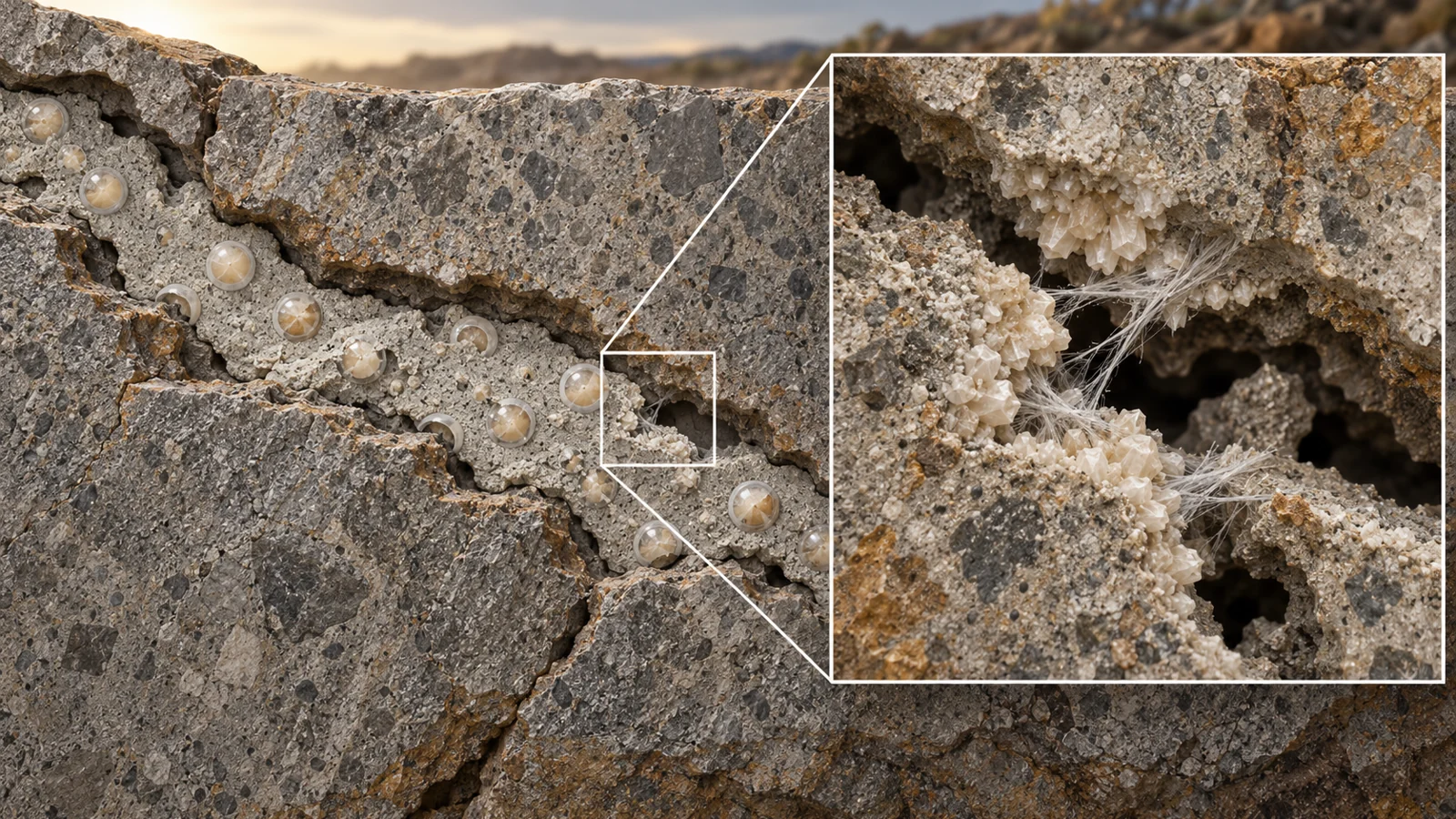
Once the bacteria are active, the material question becomes visible under the microscope. The study’s scanning electron microscopy images show calcium carbonate deposits associated with Bacillus pasteurii. The reported crystal forms include vaterite and aragonite, and the images depict crystals mutually cemented around microbial secretions.
One image shows a crack that appears bridged by calcium carbonate crystals together with fibers associated with cement hydration. At an interface, the authors describe a tightly filled region with little visible pore space. These are local structural observations: they show mineral deposits and a bridged area in the imaged preparation. They do not translate directly into a percentage reduction in leakage across a whole structure.
Mercury intrusion porosimetry supplied a broader material measurement by recording how much mercury entered pores at different pressures. In the reported microbial-grouting result, the average pore diameter fell to 130.82 nanometers, and the proportion of smaller pores increased. Another pore-structure result reported permeability of 434.6 millidarcies, with a permeability fractal dimension of about 2.83 and a backbone fractal dimension of about 2.3. The fractal dimensions were reported as not significantly different from those of the conventional cement materials compared.
The study also identifies the 300-to-10,000-nanometer pore range as especially affected by environmental erosion. That gives researchers a concrete durability target: follow how these accessible pores change as the material faces more demanding conditions. It does not yet provide a service-life extension or a real-world water-tightness estimate.
The pore measurements and microscope images therefore describe two related but different scales. Microscopy shows where deposits appear to bridge or fill a local region. Mercury intrusion characterizes the accessible pore structure of a tested specimen. Together they support a material interpretation in which microbial mineralization refines some pathways, but they should not be read as proof that every crack becomes impermeable.
Before hardening, the capsules change how mortar moves
The bacteria’s eventual mineral deposits are only part of the engineering problem. A capsule-containing mortar must first be mixed, placed or injected without becoming impractical to handle.
In the rheology preparation, the mortar used a cement-to-water-to-sand mass ratio of 1:0.5:1.64. One portion received epoxy-coated Bacillus pasteurii microcapsules about 300 micrometers in diameter at a total mass fraction of 4 percent. Compared with ordinary mortar, the microbial mortar had a higher yield stress and higher composite viscosity.
Yield stress is the stress needed to start a material flowing. Viscosity describes its resistance once flow is under way. Higher values can help a mixture remain cohesive, but they also mean that more force may be needed to move it into a narrow fracture or through a placement system. The study links the change to the epoxy-coated capsules and their interaction with suspended particles. This result concerns handling before hardening, not the later success of bacterial mineralization.
That practical distinction connects the biological and structural parts of the proposal. A formulation has to protect or carry the spores, permit a workable mortar, allow activation under an appropriate chemical environment and leave enough access for mineral formation at a damaged region. Improving one stage can alter another. A capsule that changes flow behavior may affect placement even if it performs well in a germination test.
The unresolved question is persistence inside real structures
The experiments show short-term behavior in prepared solutions, rock fractures and mortar specimens. They do not follow bacterial activity across the years or decades expected from a major structure. The authors explicitly identify long-term activity as an incomplete question, including whether Bacillus pasteurii would survive and retain its repair function over a service life.
Environmental safety is another open issue. The study does not resolve what would happen if bacteria or their by-products moved out of the concrete, nor does it establish whether such movement would create harm. Those are questions for separate durability and environmental assessments rather than conclusions that can be drawn from the observed mineral deposits.
Mechanical interpretations also need to stay proportionate. The microbial capsules did not significantly alter compressive strength in the reported comparison, and microbial grouting provided normal-strength reinforcement in the tested rock-fracture preparation. Those findings are useful for judging compatibility with the material, but they are not a numerical measure of structural strength recovery after cracking.
The experiment’s main contribution is more specific. It links a set of activation comparisons to a visible mineralization process and to measurable changes in pore structure and mortar flow. The chain is plausible in the prepared laboratory conditions, yet its usefulness in infrastructure depends on whether the chain remains intact when access, chemistry, loading and time are no longer controlled in the same way.
What this could change
A dependable version of this technology could give concrete a way to obstruct water-entry routes from within damaged material, reducing the need for some repeated crack-repair work and helping structures retain durability for longer. That future depends on solving the connected problems shown here: waking spores without damaging later cell activity, placing the capsule-bearing mortar, forming mineral bridges in the right pore regions and preserving bacterial function over the structure’s life.
If those conditions can be demonstrated beyond assisted laboratory preparations, microbial repair could become a practical durability layer for concrete rather than simply a promising mineralization mechanism. The August 2025 study moves the field toward that possibility by showing how activation chemistry, local deposits, pore refinement and mortar handling belong to the same engineering problem. It does not yet show that the problem has been solved.
Key Sources
- Primary source: Optimizing Bacillus pasteurii spore germination and unveiling impermeability mechanisms in microbial self-healing concrete.
DOI or Journal Page · Peer-Reviewed Paper · 2025-08-07