
Since the previous research note · Earlier expectation not tested
Track continuity
Since the previous research note: Can bacterial concrete regain strength while facing chemical damage?
Previous expectation: Bacterial mineral formation that remains effective during sulfate exposure and repeated cracking could reduce infrastructure repair needs while preserving mechanical performance.
What this study adds: The current study reports improved strength and reduced water absorption in mortar containing a Bacillus cereus–Vibrio natriegens mixture, alongside mineral characterization and bacterial recovery after curing. Its verified comparisons concern formulation performance and do not test the earlier sulfate-exposure and repeated-damage forecast.
What changed in this study
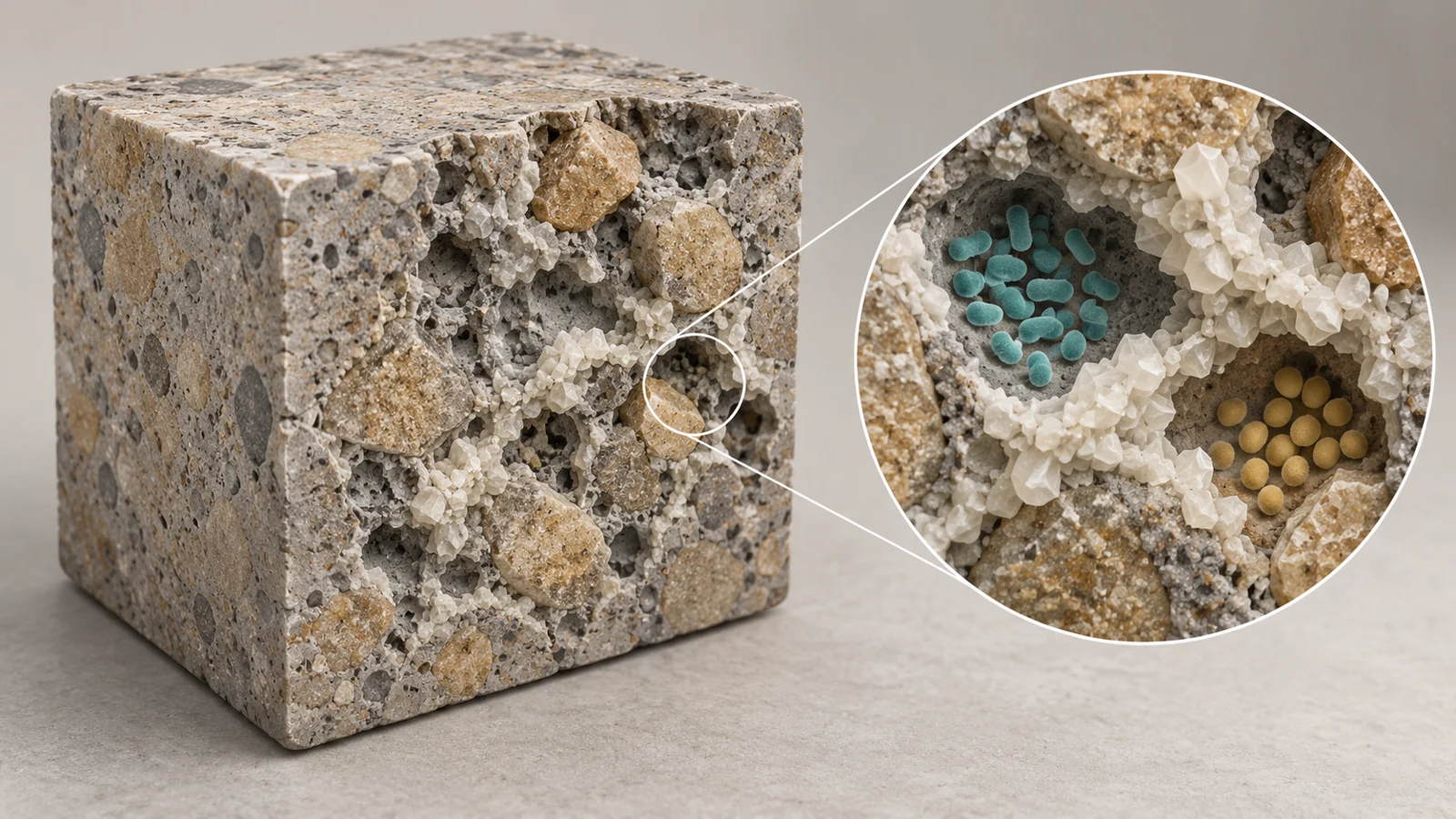
A cement-and-sand mortar can become stronger and take up less water when bacterial cultures are mixed into it, according to research published on July 1, 2025. In a laboratory study, a combination of Bacillus cereus and Vibrio natriegens produced the strongest reported improvement among the tested formulations: after 28 days of curing, compressive strength was 19.85% higher than in conventional mortar, while water absorption was 29.6% lower.
Those are meaningful changes in the hardened material. They suggest that mineral formation associated with the bacteria altered the mortar’s internal structure. But they answer a narrower question than the phrase self-healing concrete may imply. The experiment measured the performance and composition of mortar made with bacterial solutions. It did not turn the strength increase into a measurement of strength recovered after a crack formed.
A better hardened mix was the measured outcome
The study compared four broad conditions: conventional mortar, mortar containing B. cereus, mortar containing V. natriegens, and mortar containing both cultures. The bacteria were added directly as liquid solutions to a cement-and-sand mix. Additions ranged from 1% to 5%, with calcium acetate included as a calcium source. The specimens were cast as small 50-by-50-by-50-millimetre cubes and cured in water before testing.
Compressive strength was measured after 3, 7 and 28 days. At the 28-day point, the reported increase over conventional mortar was 14.99% for the B. cereus formulation and 15.19% for the V. natriegens formulation. The consortium reached 19.85%. Comparing the individual strains with the mixture matters because it shows that the result was not simply a treated-versus-untreated difference. Under these conditions, the two-culture formulation performed better than either single-culture option.
Water absorption provided a second view of the material. After curing, specimens were dried, weighed, immersed in water, and weighed again. Absorption fell by 9.6% with B. cereus, 23% with V. natriegens, and 29.6% with the consortium relative to the control. A mortar that takes up less water may have fewer or less connected pathways through its pore structure, which is consistent with the study’s explanation that calcium carbonate filled part of the internal space.
The practical meaning is therefore specific. The tested mortar carried more compressive load and admitted less water after curing. Those improvements are not measurements of crack closure, healing speed, or repeated damage recovery.
How bacteria may have changed the mortar
The proposed route begins with microbial activity and ends with mineral deposition. Both cultures gave positive results in the study’s urease test. In a separate mineralization assay, the bacterial consortium left a white residue after seven days of incubation. The residue was identified as calcium carbonate, and the combined culture produced more of it than either strain alone in that assay.
The mortar analyses added several kinds of support, each answering a different question. X-ray diffraction identified calcium carbonate phases including calcite, aragonite and vaterite, along with portlandite. Calcite, aragonite and vaterite have the same basic calcium-carbonate chemistry but different structures and stability. The consortium showed prominent peaks associated with calcium carbonate, including peaks near 29.5, 29.91 and 35.59 degrees.
Energy-dispersive X-ray spectroscopy measured elements in powdered mortar taken from the specimens’ inner core. Calcium accounted for 9.5% by weight in the control, compared with 20.4% in the B. cereus mortar, 22.1% in the V. natriegens mortar and 27% in the consortium mortar. The calcium signal was also strongest for the consortium sample. Calcium, carbon and oxygen signals are consistent with calcium carbonate formation, while the X-ray and elemental measurements together make the mineral explanation more credible than a strength comparison alone.
They still describe composition rather than directly observing a sealed crack. Mineral identification shows which phases are present. Elemental analysis shows where measured elements contribute to a sample’s composition. Neither measurement by itself quantifies how much of a crack was filled or isolates the contribution made by each organism.
The amount added changed the result
Increasing the bacterial-solution dose did not consistently improve performance. The response varied across organisms, ages and measurements. For B. cereus, the highest optical-density reading and one of the strongest mortar results occurred at 3%. V. natriegens showed its strongest growth at 4%, while the consortium’s growth and several of its results pointed to 3% as a favourable level. At 5%, performance declined in the comparisons described by the researchers.
The paper also contains a separate discussion reference to a 4% bacterial mixture achieving notably high compressive strength. Read together, these descriptions do not justify one universal consortium percentage. They show why formulation has to be treated as part of the material design: the amount that supports bacterial growth, mineral formation or compressive performance may depend on which culture and endpoint are being considered.
The most useful conclusion is not that 3% or 4% is ready to become a construction specification. It is that more liquid culture was not automatically better. Too much bacterial solution may change the balance among cement, sand, water and the mineral-forming process. A viable mixture therefore needs an experimentally selected range, with its target performance defined in advance.
Living cultures create a second operating problem
A conventional mineral additive has no need to remain biologically active. For these formulations, activity after curing is a separate question from the measured gains in hardened properties. The researchers tested growth in laboratory media and also attempted to recover bacteria from mortar after 28 days of curing. Powder from cured specimens was placed in prepared growth media, incubated, and assessed by visible growth and optical-density measurements. The consortium showed the highest growth pattern among the tested cultures, while the control mortar showed no bacterial growth in that procedure.
That recovery is useful because it indicates that cultivable organisms could be obtained from the cured bacterial mortar under the described laboratory conditions. It is not the same as proving uninterrupted activity inside a building element. Cultivation after crushing and transfer to nutrient media creates a new environment, so the result should not be treated as a direct measurement of bacterial behaviour throughout an intact structure.
Temperature tests illustrate the same point. The three cultures grew under several laboratory temperatures, with 35 °C identified as the most favourable tested condition and the combined culture showing the fastest growth there. At 60 °C, the growth curves were essentially flat during the measured interval. These observations help characterize the cultures, but they do not establish structural performance during real hot and humid exposure. Temperature, moisture, alkalinity, oxygen availability and the changing chemistry of cementitious material all affect whether a culture remains useful after mixing.
What strength and water uptake can tell us about repair
The study’s measurements are best understood as early material-performance evidence. Compressive testing shows how much load a cured cube withstands under compression. Water absorption shows how much water enters after drying and immersion. X-ray diffraction and elemental analysis characterize mineral phases and chemical elements. Bacterial recovery probes whether cultivable organisms can be obtained after curing. Together, these tests connect the formulation to a plausible mineralization pathway and show improved properties in the tested mortar.
A future crack creates a different experimental question. Researchers would need to form controlled cracks or damage, record their dimensions, observe how they change over time, and measure whether mechanical or water-transport performance returns. Repeated damage would test whether the effect persists through more than one event. The 19.85% figure is not a percentage of strength recovered after cracking; it is the reported difference between cured consortium mortar and conventional mortar in the compressive-strength comparison.
The same care applies to the water result. Lower absorption after curing is relevant to moisture transport through the material, but it is not a direct measure of a crack being sealed. A crack can alter water movement in ways that a bulk absorption test does not capture. Nor do the reported comparisons establish sulfate resistance, protection of reinforcement, service life in infrastructure, or dependable performance in the field. The laboratory findings also do not substantiate a quantified cost saving, environmental advantage or commercial readiness.
This leaves a clear but bounded interpretation. Bacterial mineral formation appears to have improved the tested mortar’s hardened properties, and the consortium outperformed the individual cultures in the reported comparisons. Whether the same formulation can repair damage after construction is a separate performance claim that requires its own evidence.
What this could change
A practical manufacturing capability is visible in the result: producers could incorporate a selected bacterial mixture during casting so that a cement-based material begins service with useful compressive strength and reduced water uptake. Builders and owners could benefit from components that are less vulnerable to moisture-related deterioration if the formulation remains reproducible at production scale and its advantages persist under actual service exposure.
That possibility depends on solving the biological and manufacturing constraints together. The useful mixture would need to tolerate mixing and curing, deliver repeatable mineral formation, and retain a meaningful advantage without relying on a single laboratory dosage or temperature. If those conditions hold, bacterial treatment could become a way to engineer the starting properties of mortar while preserving the longer-term ambition of materials that respond to damage. The reported mortar results advance the formulation evidence for that pathway; they do not establish automatic repair of a damaged building.
Key Sources
- Primary source: A comprehensive screening on the effect of Bacillus cereus and Vibrio natriegens bacterial consortia in cement mortar.
DOI or Journal Page · Peer-Reviewed Paper · 2025-07-01