
Since the previous research note · Earlier expectation not tested
Track continuity
Since the previous research note: When the material sheltering bacteria shapes concrete repair
Previous expectation: Persistent bacterial crack sealing could reduce deterioration and disruptive maintenance if bacterial reserves and concrete performance remain adequate in service.
What this study adds: The current source reports controlled crack-healing observations in specimens and reinforced beams, alongside mechanical-property comparisons involving manufactured sand. These findings address laboratory healing and mix performance but do not establish the earlier forecast's service-life protection or maintenance benefits.
What changed in this study
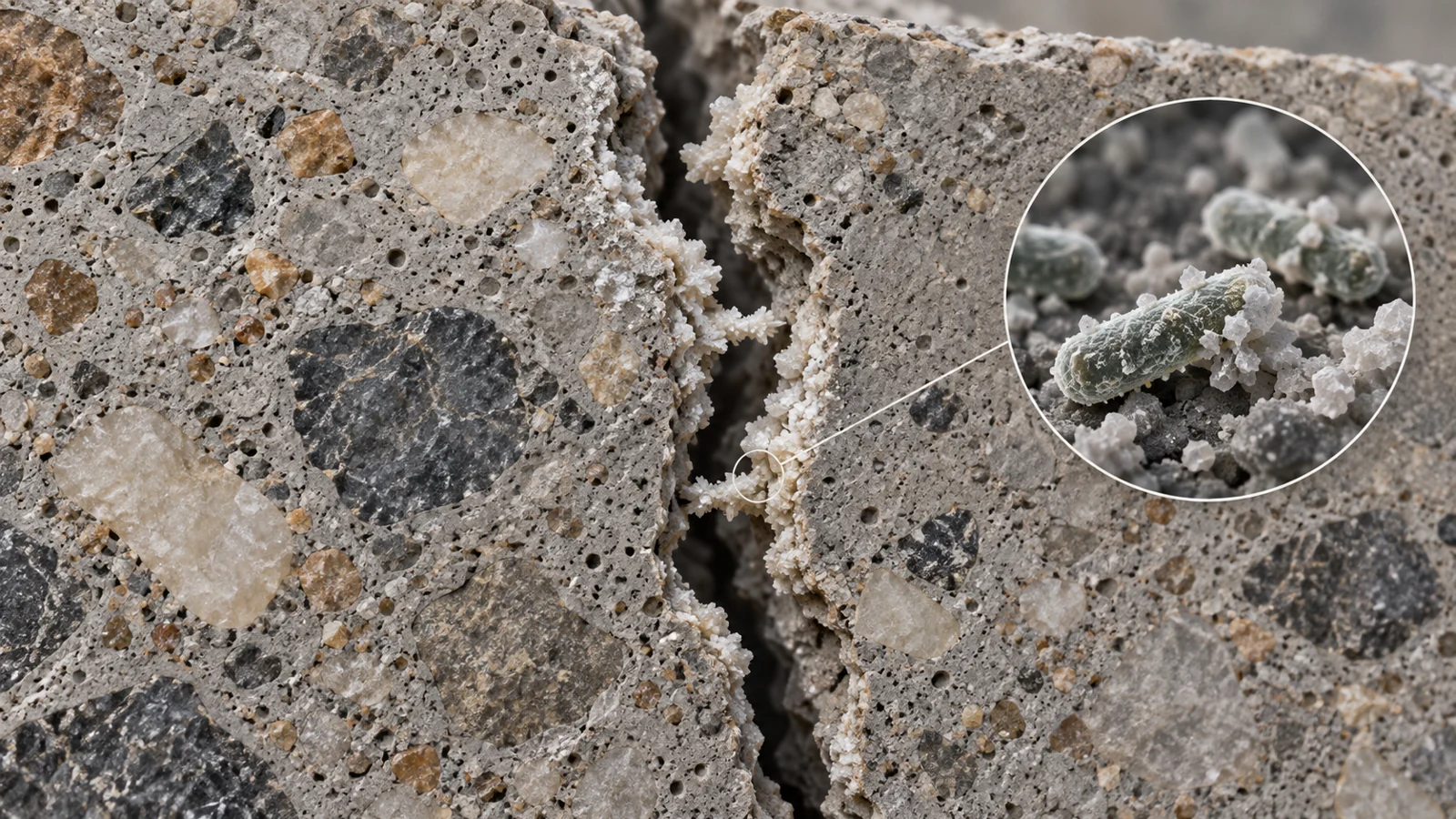
Concrete can develop cracks long before a structure reaches the end of its intended life. A 2025 study investigated whether Bacillus subtilis could help seal some of those openings by precipitating calcium carbonate, a mineral that can form along a crack. In controlled concrete tests, the researchers reported complete crack closure within 21 days under optimal curing conditions.
That is a useful laboratory observation, but it answers a narrower question than whether a bridge, building or pavement can repair itself in service. The work also compared concrete made with river sand and manufactured sand, asking a separate engineering question about how the mix performed mechanically.
What the 21-day result actually measures
Bacteria-free and bacteria-containing concrete specimens were deliberately cracked. The reported 21-day interval refers to the period in which complete closure was observed under the study’s stated optimal curing conditions; it is not a universal repair timetable for every concrete mixture or environment.
The proposed mechanism is biological but the visible outcome is mineral. Bacillus subtilis was investigated for its ability to support calcium carbonate precipitation. In practical terms, the bacterium is part of a system intended to produce mineral deposits that fill or bridge a crack. The supplied study summary does not provide enough detail to judge how consistently that process occurred across specimens or how the measurements varied.
The researchers also removed load and then applied it again in tests involving cracks up to 1 millimetre. The abstract describes effective healing in that setting, particularly for samples cured for 14 days. Reinforced concrete beams in the M20, M25 and M30 grades were tested under flexural stress, followed by load removal and reloading. For beams cured for 14 and 28 days, the study reports complete crack closure within 21 days.
The timing matters. The 14- and 28-day curing ages are distinct from the reported 21-day closure interval, but the abstract does not fully specify how these periods align with the loading sequence. The loading tests also make the result more informative than a photograph of an idle crack, because the specimens were examined in relation to a mechanical event. Even so, the supplied evidence does not show that visible closure restored the concrete’s original load-bearing capacity.
Sand changes the strength question
The study’s aggregate comparison adds another layer. River sand and manufactured sand are different mix choices, so the researchers compared bacterial concrete made with each. The abstract reports that the manufactured-sand version improved compressive strength by 9.27%, split tensile strength by 12.78% and flexural strength by 6.36%.
These properties describe different ways concrete resists stress. Compressive strength concerns being squeezed, as in the weight carried through a column. Split tensile strength estimates resistance to being pulled apart through an indirect test. Flexural strength concerns bending, where one side of a beam is compressed while the other is placed under tension.
The percentages therefore describe mechanical-property comparisons, not the amount of crack healing. They should not be read as evidence that manufactured sand made cracks close 9.27% faster, or that bacteria increased all forms of strength by the same amount. The available description does not provide the denominators, variability, statistical significance or enough comparator detail to isolate the contribution of bacteria alone.
Models can optimize a target without proving the outcome
Random Forest Method and the Kuhn–Tucker Condition were used in efforts to maximize healing efficiency. A Random Forest approach can be used to identify relationships among several inputs and an observed result. A Kuhn–Tucker condition belongs to constrained optimization, where a preferred result is sought while limits are imposed on the variables.
Here, those methods help explain how the researchers approached the design problem: healing efficiency was treated as something to optimize rather than merely observe. The supplied abstract does not quantify either method’s independent contribution, model accuracy, validation procedure or the size of any optimization benefit. Using an optimization method does not by itself demonstrate an improvement in observed crack closure.
The boundary between closure and repair
Crack closure is visually and practically relevant, yet it is not the same measurement as durable structural repair. The reported findings do not establish how long the closure would remain effective, whether the repaired zone would exclude water or chlorides, or whether reinforcement corrosion would be reduced. They also do not establish long-term bacterial survival, repeated healing after later damage, or performance under changing field conditions.
The 1-millimetre observation belongs to the described load-removal and reloading tests. It is not a universal threshold. Similarly, the 21-day interval belongs to the reported curing and observation conditions, not to every mix, climate or service environment. Cost savings, environmental gains and broad claims of cost effectiveness remain possibilities rather than measured outcomes in the supplied record.
What this could change
A concrete component that could address some early, small crack damage locally might eventually need fewer disruptive maintenance interventions. That could matter to infrastructure owners managing difficult access and to people who depend on roads, bridges and buildings remaining available for use.
The practical benefit is conditional. Bacterial mineral formation would need to remain effective after construction, while the concrete retained the mechanical performance required for its application. The reported laboratory closure and mix-strength comparison are steps toward that capability, but they do not yet show that self-healing concrete can protect service life or reduce maintenance in the field.
Key Sources
- Primary source: Advancing Sustainable Concrete with Bacterial Self-Healing Technology and Kuhn-Tucker Condition
DOI or Journal Page · Peer-Reviewed Paper · 2025-03-26