
Since the previous research note · Partly supported
Track continuity
Since the previous research note: How the material carrying repair bacteria changes concrete under load
Previous expectation: Bacterial concrete could make difficult infrastructure maintenance more manageable if its repair effect, carrier durability and structural performance remain reliable in service.
What this study adds: The current study supports the bacterial-survival part of that expectation under a bounded laboratory cold-exposure protocol and reports modest crack narrowing in a separate simulated-rain experiment. It adds curing history and water exposure to the track's explanation of what governs useful repair.
What changed in this study
Concrete is strong in compression but vulnerable where cracks let water, oxygen, and salts reach its interior. Biological self-healing concrete tries to make those cracks less persistent by placing bacteria inside the material. When a crack opens and the surroundings become suitable, the bacteria can help deposit calcium carbonate and narrow the opening.
Water creates a difficult timing problem. It is needed for concrete to harden and can help dormant spores become active later. But if it reaches them too early, the repair reserve may be used up before a crack needs attention. A laboratory study published on 26 November 2024 examined that problem through separate tests of cold exposure, early curing, and crack healing under simulated rain.
A protected repair reserve inside the concrete
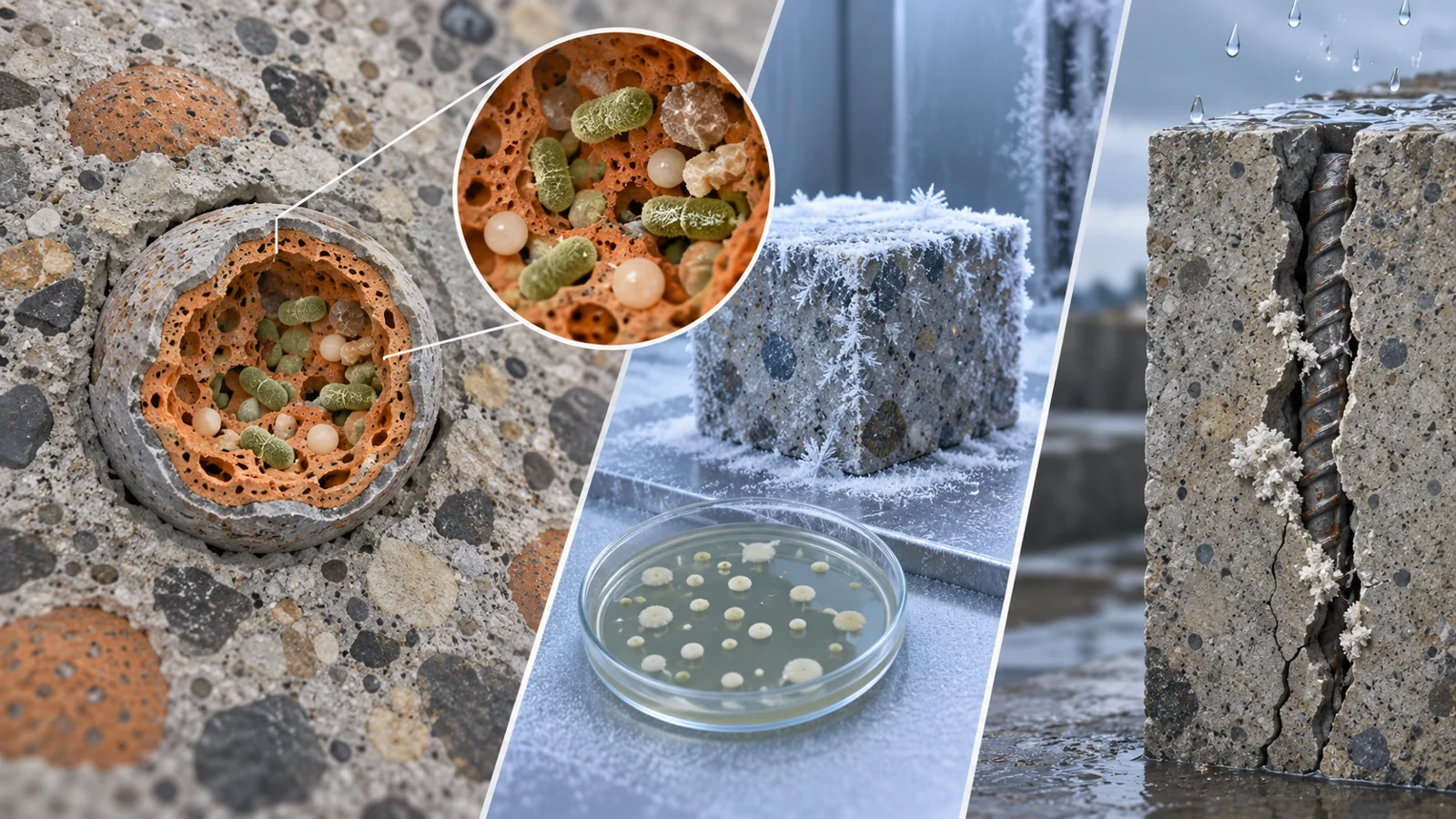
The study used spores from two non-ureolytic bacteria, Bacillus pseudofirmus and Bacillus cohnii. The spores were placed with nutrients inside expanded-clay particles. The particles were then given a styrene-acrylate coating intended to protect the biological material from the harsh concrete environment.
The arrangement matters because bacteria face several stresses at once. Concrete becomes highly alkaline, changes rapidly as it sets and hardens, and can subject cells to mechanical stress. A carrier gives the spores a more localized place to persist, while the coating adds another layer of protection. The goal is not for the bacteria to be active continuously. It is to keep enough of them viable until water and oxygen reach a later crack.
The researchers mainly measured viability by recovering bacteria from concrete, growing them on nutrient plates, and counting colony-forming units. A colony count therefore indicates how many organisms could be recovered and grown under the test conditions. It is not the same measurement as mineral production, crack closure, or restored structural performance.
Bacteria remained recoverable after repeated freezing and thawing
The freeze-thaw experiment used concrete specimens containing the bacteria-bearing expanded clay. Some specimens were placed in water and exposed to 20 cycles over 78 days. Each cycle involved two to four days at −20 °C followed by a day thawing at 20 °C. Another group experienced the same temperature changes while stored in air. Specimens held at room temperature served as controls.
After one, three, five, ten, fifteen, and twenty cycles, sections of concrete were ground and plated so the researchers could estimate the remaining colony count. The starting count fell by about half during the early part of the experiment and then stayed broadly stable through the twentieth cycle. A similar pattern appeared in the water-maintained controls, and the two bacterial strains showed comparable behavior.
That comparison changes how the result should be read. The roughly 50% decline cannot be assigned entirely to freezing and thawing, because the control specimens followed a similar trend. The authors suggest that concrete aging contributed substantially to the early loss. The authors identify uneven distribution of bacteria-bearing expanded-clay particles as a likely contributor to variation in colony counts. A ground portion containing more or fewer carrier particles could therefore produce a different count even when the overall specimen was behaving similarly.
The cold test offers useful evidence that the protected spores remained recoverable after repeated temperature stress. It does not show that the bacteria were actively producing calcium carbonate while frozen, nor that a component cracked during those cycles would later heal effectively. Survival through a temperature protocol is one part of the repair story, not the repair event itself.
Water curing changed when the bacteria became available
The early-curing experiment followed a different design. Cylindrical specimens containing B. pseudofirmus were first sealed and kept at room temperature for one day. Three were then immersed in water, while three remained in open air at about 50% relative humidity. All were kept at 20 °C, and viability was measured over 28 days.
The difference emerged quickly. After seven days, the water-kept specimens produced almost five times fewer colony-forming units than the air-kept specimens. After two weeks, the gap exceeded tenfold and stayed in that range through day 28.
The proposed explanation concerns premature germination. Water can dissolve nutrients and germinants, allowing dormant spores to become active vegetative cells. In an uncracked specimen, those cells may not have the conditions needed to multiply. The paper discusses the possibility that many then died, leaving fewer recoverable spores for later repair.
This makes water a dual-purpose ingredient in the material. During a later healing period, moisture can support germination, bacterial metabolism, and calcium carbonate precipitation inside a crack. During early curing, the same access to water may activate part of the biological reserve before a crack has formed. The comparison shows why the timing of exposure matters; it does not establish one universally best curing regime for both bacterial preservation and the concrete’s other performance requirements.
Simulated rain produced measurable but limited closure
The crack-healing tests examined another stage of the process. Reinforced concrete prisms were cured by water immersion for 28 days and then cracked through three-point loading. The researchers selected visible cracks wider than 50 micrometres for measurement. The prisms were moved to rain-simulating basins, where they received water sprays for 30 minutes twice a day, with drying between wet periods and relative humidity otherwise kept around 40–50%.
Healing was expressed as the percentage reduction in crack width. A bacterial specimen that began with a crack width of 100 units and ended at 86.4 units would therefore have a healing ratio of 13.6%.
At the final measurement, 98 days into the healing period, the bacterial specimens showed crack-width reductions of 13.6% in one test series and 16.8% in the other. Controls without bacteria showed only 0.4–2.2% closure. The bacterial mixtures therefore produced several times more measured narrowing than the controls, but the absolute closure remained modest. The two test series also used different prism configurations, so their percentages should not be treated as a clean comparison between bacterial strains.
Intermittent rain may have limited the visible result. The paper discusses how flowing water could wash newly formed bacterial precipitate and loose aggregate out of a crack, increasing the measured width. Water can create the conditions needed for biological activity, yet moving water can also disturb the material that activity produces. The test therefore speaks to a particular exposure pattern rather than to every wet environment a concrete component might encounter.
The results describe separate links in the repair chain
The study’s three experimental arms cannot be assembled into a demonstrated sequence of winter exposure followed by durable repair in the same component. The cold experiment measured recoverable colonies after temperature stress. The curing experiment measured how early water exposure changed the available biological reserve. The rain experiment measured crack-width reduction in separately prepared reinforced prisms.
Those outcomes answer different questions. Recoverable organisms may still be inactive, depleted, unevenly distributed, or unable to produce enough mineral deposit when a crack opens. A narrower visible crack may reduce an opening, but the measurement does not establish restored load capacity, lower permeability, prevention of reinforcement corrosion, or longer service life. The reported healing ratios also do not show how long the closure would persist under a broader range of weather and loading conditions.
The most useful interpretation at the study’s publication date is therefore specific. The coated expanded-clay system retained recoverable bacterial spores under the tested low-temperature and freeze-thaw conditions. Early water curing substantially reduced later recoverable counts for B. pseudofirmus. Under twice-daily simulated rain, bacterial specimens narrowed cracks more than controls, but only by a limited percentage. Together, the findings make preservation and exposure timing central to the promise of bacterial concrete without showing that cold-weather repair has already been demonstrated.
What this could change
Concrete components that preserve a useful bacterial reserve during production and later maintain persistent crack sealing in service could eventually make small cracks less disruptive for infrastructure owners and users. A modest, durable reduction in openings would matter because it could reduce routes for water, oxygen, and salts to reach vulnerable interior materials, potentially making maintenance less frequent or less intrusive.
That possibility depends on several conditions holding at once: the bacteria must survive manufacturing and early curing, suitable moisture must reach them after cracking, deposits must remain in place despite intermittent water movement, and the complete concrete component must retain its required structural performance. The cold-survival result supports one part of that pathway; the rain experiment shows why useful infrastructure protection requires more than recoverable bacteria alone.
Key Sources
- Primary source: Effects of Low Temperature, Freeze-Thaw Cycles, and Healing Conditions on Viability of Non-Ureolytic Bacteria in Biological Self-Healing Concrete.
DOI or Journal Page · Peer-Reviewed Paper · 2024-11-26