
Since the previous research note · Earlier expectation not tested
Track continuity
Since the previous research note: How bacteria and mix ingredients shape concrete predictions
Previous expectation: Predictive models might help concrete producers narrow formulation trials if their predictions transfer to fresh mixes that also meet strength, workability and healing requirements.
What this study adds: This laboratory study compares bacterial carriers and concentration readings across mechanical and environmental tests, identifying carrier reinforcement and endpoint-dependent results. It does not test prediction transfer or a reduction in formulation effort.
What changed in this study
Concrete can be made to carry bacteria intended to help seal small cracks, but the material holding those bacteria is part of the engineering problem. It can influence how well the bacterial spores are retained, while also changing how the concrete behaves when it is crushed, bent, frozen or exposed to a salt solution.
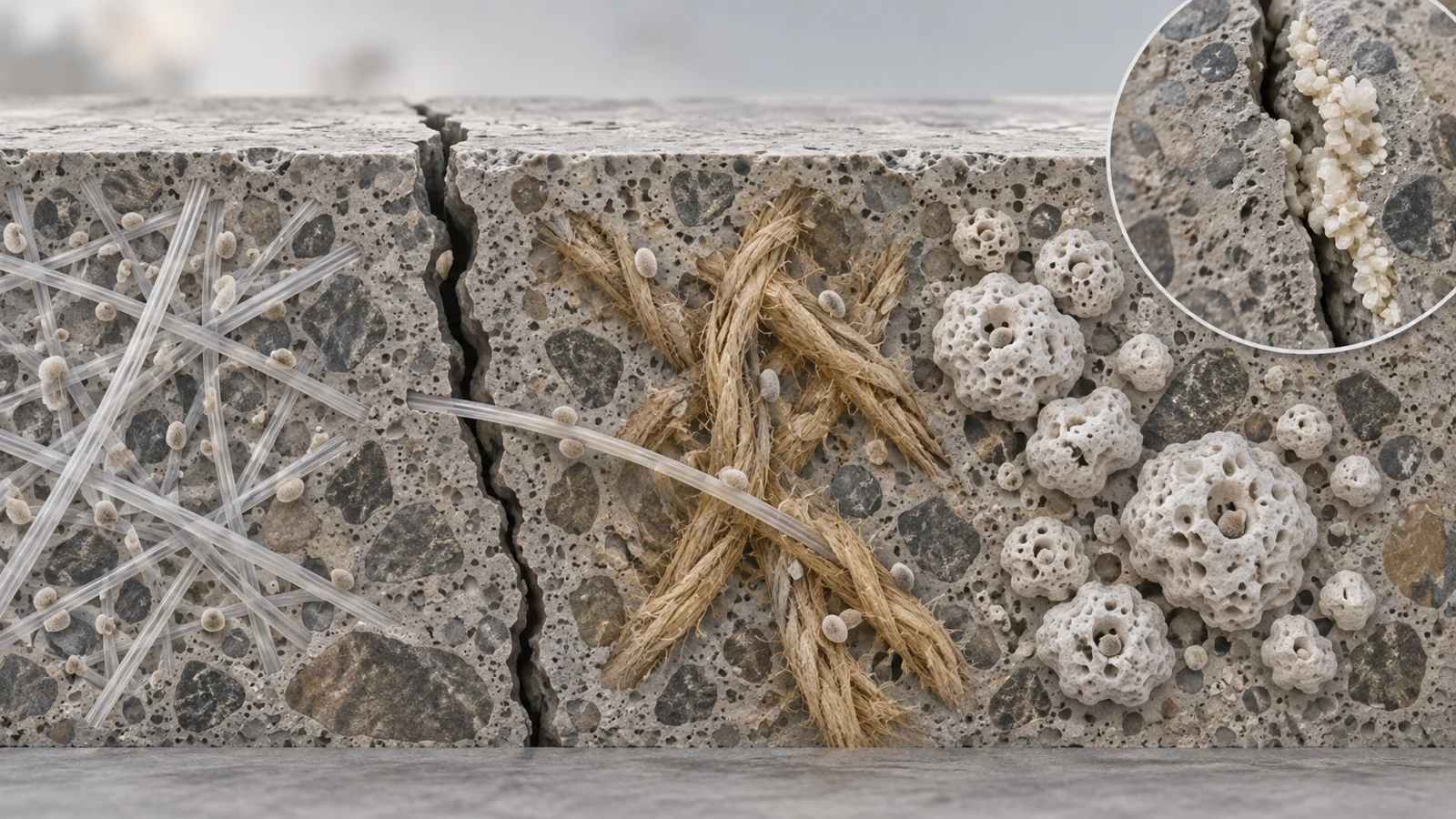
A laboratory study published on July 4, 2024, investigated that double role in self-healing concrete made with Bacillus subtilis V372. The researchers compared three carriers: sisal fiber, polyvinyl alcohol fiber and expanded perlite, a porous particle. They also tested three bacterial-solution readings, labeled 2, 2.5 and 3 in the paper. Plain-concrete controls and specimens containing carriers without bacteria helped separate some of the carrier’s physical contribution from the possible contribution of the bacteria.
The result is not a single winning recipe. The comparison suggests that the best-performing carrier depends on the kind of demand placed on the concrete, while the paper’s recommended bacterial concentration is difficult to reconcile with parts of its own detailed results.
A carrier has two jobs inside the concrete
The biological idea is straightforward in outline. Under suitable conditions, Bacillus subtilis may help produce calcium-carbonate mineral that can fill or seal cracks. The study selected an alkali-resistant strain after comparing three bacterial strains in a highly alkaline culture condition. Only the strain identified as V372 grew extensively in that screening step.
The researchers then prepared bacterial spores and fixed them onto different materials. Sisal and polyvinyl alcohol fibers were cut to a specified length and mixed with the bacterial solution so the fibers could carry spores. Expanded perlite was mixed with the solution and allowed to absorb it. The concrete specimens were cured for 28 days before the mechanical and durability tests.
The carrier is therefore more than a passive container. A fiber can bridge or connect parts of a cementitious mixture, affecting how forces move through a specimen even without bacteria. A porous particle can offer space for spores while interacting differently with the surrounding concrete. If a bacterial specimen is stronger than a plain-control specimen, that improvement cannot automatically be assigned to biological crack repair. The carrier itself may be reinforcing the material, changing its internal structure or affecting how damage develops.
The carrier-only comparisons make this point visible. In the compression discussion, specimens containing sisal or polyvinyl alcohol fibers performed better than the blank control, even when the comparison did not depend on adding bacteria. Expanded-perlite specimens were lower than the blank control under the tested conditions. The biological and physical parts of the formulation were operating together, not in isolation.
Compression and bending tell different stories
When the specimens were tested for resistance to crushing, the fiber carriers were favored over expanded perlite. The paper’s detailed compression discussion presents polyvinyl alcohol as the strongest of the three carrier types under those conditions. Fiber reinforcement appears to have helped the concrete resist compressive loading, while the expanded-perlite formulation imposed a different physical trade-off.
Bending produced another ranking. The study’s bending comparison placed sisal fiber above polyvinyl alcohol, with expanded perlite lowest across the reported carrier comparisons. Some of the reported bending values also changed differently as the bacterial-solution reading changed. Sisal reached its reported maximum at the lower reading, while the polyvinyl alcohol results increased toward the highest reading in that part of the discussion.
Concrete that performs well when compressed is not necessarily the concrete that best resists bending. Crushing mainly tests how a specimen carries force under compression; bending also places tension on one side of the specimen, making the way fibers connect and transfer force especially important. A carrier that looks favorable in one test can therefore have a different value when the intended application depends on flexural behavior.
This matters for how the experiment should be read. The study compares formulations under several laboratory demands, rather than identifying a universal carrier for every structural situation. Polyvinyl alcohol is favored in the paper’s broad conclusion, but the bending section gives sisal the higher ranking for that specific response.
Repeated exposure changes the question
A concrete element in service does not experience only one loading event. Water can enter developing cracks, temperature changes can repeatedly stress the material, and salts can attack vulnerable regions. The study therefore included freeze-thaw cycling and sodium-sulfate exposure alongside its strength tests.
For the freeze-thaw work, the researchers tracked mass changes through 25, 50, 75 and 100 cycles. The early pattern needs careful interpretation. The authors explain that initial microcracking can draw free water into the specimens, so mass may rise during the first part of the test. That increase is not itself evidence that the concrete has become more durable. With more cycles, surface damage and spalling can cause mass loss. The reported loss became more pronounced as cycling continued, especially for expanded-perlite specimens.
The fiber-containing specimens showed flatter mass-loss curves in the later part of the freeze-thaw sequence. The paper attributes this behavior to fibers helping hold fragments around the specimen in place. Expanded perlite did not provide the same fiber connection, so more material could be lost under repeated cycling. The observation concerns resistance to damage and material loss during the laboratory sequence; it is not a measurement of how much crack healing occurred.
The sulfate experiment used repeated wetting and drying in a 5 percent sodium-sulfate solution after standard curing. The study evaluated mass loss and compressive strength after the exposure. In this comparison, the polyvinyl alcohol specimens had higher reported compressive performance and corrosion-resistance behavior than the sisal and expanded-perlite specimens under the tested conditions. The authors suggest that repairing small cracks could slow sulfate entry, but the selected results do not provide a numerical separation between protection from bacterial activity and protection associated with the carrier and its reinforcement.
The concentration recommendation is not settled
The paper’s conclusion identifies the 2.5 reading as the best overall bacterial-solution concentration. It links that recommendation to the combined compression, bending, freeze-thaw and erosion-related results.
The detailed results are less tidy. In the compression discussion, the authors report that the polyvinyl alcohol specimens at the 2.5 reading had lower compressive strength than the specimens at the 2 and 3 readings. The same passage describes the 3 reading as relatively stable for the polyvinyl alcohol carrier. That does not align cleanly with a simple claim that 2.5 is the mechanical optimum.
The bending discussion also uses different concentration patterns for different carriers. Sisal reaches its reported bending maximum at one reading, while polyvinyl alcohol reaches its reported maximum at another. The sulfate section likewise describes different peak conditions by carrier, including a lower reading for the strongest polyvinyl alcohol result in that passage.
Those inconsistencies are important because a bacterial concentration is not an independent dial in a finished material. Changing it may alter the distribution of spores, the interaction between the carrier and cement, and the mechanical response of the specimen. The study provides a useful comparison of tested formulations, but it does not resolve a precise concentration recipe that can be carried confidently from one endpoint to every other.
The biological component was not fully characterized
The experimental program describes pre-cracking and subsequent curing for the bending investigations, which is relevant to the paper’s interest in repair after damage. Yet a claim about self-healing requires more than observing that one formulation retains or develops favorable mechanical properties. It also requires knowing how much biological material entered each specimen and where it was located.
The authors acknowledge that they did not actively determine the exact number of spores before preparing the specimens. They also could not guarantee uniform spore distribution within each specimen. As a result, specimens assigned to the same bacterial-solution reading could have received different biological payloads. That helps explain why repeated samples at the same nominal condition might show different physical properties, and it limits how precisely the biological contribution can be inferred.
The paper discusses calcium-carbonate formation as the crack-filling mechanism associated with the bacteria. A microscopy passage refers to comparisons involving specimens with and without Bacillus subtilis, but the selected material does not support treating that discussion as an independently verified, quantitative account of mineral formation in every tested specimen. Nor does it establish a crack-closure limit, a healing rate or a recovered-strength fraction for the formulation.
The practical meaning is narrower and more useful: the experiment shows how a carrier-and-bacteria formulation behaved across several laboratory tests, while leaving the delivered biological component incompletely measured. That is a central part of interpreting the results, not a minor detail about sample preparation.
A formulation study rather than a field-ready material
The study helps expose a design problem that can be hidden by the phrase “self-healing concrete.” A formulation must support the bacteria, but it must also survive the physical demands of concrete. The carrier may reinforce the mix, alter bending behavior, affect resistance to freeze-thaw damage and change how sulfate exposure appears in the results.
The findings are consequently strongest as a comparison within the tested laboratory setup. They show that fiber carriers, especially polyvinyl alcohol in the compression and sulfate discussions, can behave differently from a porous expanded-perlite carrier. They also show that sisal can lead in bending even when the overall conclusion favors polyvinyl alcohol. These are formulation-specific observations rather than proof that one carrier will perform best in every concrete mix or service environment.
The experiments do not establish long-term survival of the bacteria in infrastructure, performance across repeated cycles of damage and repair, structural deployment readiness or a service-life extension. They also do not demonstrate maintenance savings, lower construction emissions or the elimination of inspection and manual repair. Those outcomes would require reproducible biological characterization and validation under conditions that represent actual service demands.
What this could change
Concrete that can limit the progression of small cracks while continuing to carry useful loads could eventually make difficult infrastructure maintenance more manageable. Bridge components, retaining structures and other hard-to-access concrete assets could benefit from a material that helps protect vulnerable regions before deterioration becomes a repair emergency, reducing the need for some disruptive interventions by owners and maintenance crews.
That possibility depends on several links holding at once: the bacteria must produce a reproducible repair effect, the carrier must remain mechanically and environmentally durable, and the complete formulation must perform reliably under real service conditions. This study contributes an early piece of that chain by showing that the carrier itself strongly shapes the outcome. It also shows why a future material cannot be judged by a single strength value or a single preferred bacterial reading.
Key Sources
- Primary source: Investigation on the mechanical properties of Bacillus subtilis self-healing concrete.
DOI or Journal Page · Peer-Reviewed Paper · 2024-07-04