
Since the previous research note · Earlier expectation not tested
Track continuity
Since the previous research note: How bacterial repair changed damaged concrete’s grip on steel
Previous expectation: Bacterial repair might help damaged lightweight reinforced-concrete components retain useful load transfer between steel and concrete when repair delivery and durability under service conditions can be secured.
What this study adds: The April 2024 source adds a modeling contribution using an existing dataset to predict concrete strength and slump from bacteria concentration and conventional mix ingredients. Those prediction outputs do not test the earlier forecast about durable recovery of steel-concrete bond.
What changed in this study
Self-healing concrete begins with a biological idea: when a crack lets moisture in, dormant bacteria can become active and help produce limestone that fills part of the opening. In the system described by this research, bacteria such as Bacillus or Sporosarcina are combined with a calcium-based healing agent. The promise is appealing, but a usable building material still has to behave like concrete before anyone can ask whether it can repair damage.
That creates a practical formulation question. How might bacterial concentration be considered alongside cement, aggregates, and water when engineers estimate the strength and workability of a mix? A modeling study published on April 10, 2024, approached that question with data from an earlier research paper. Its goal was to predict measured concrete properties from mix ingredients, not to demonstrate that a particular formula would close cracks or restore a damaged structure.
A repair idea enters a formulation problem
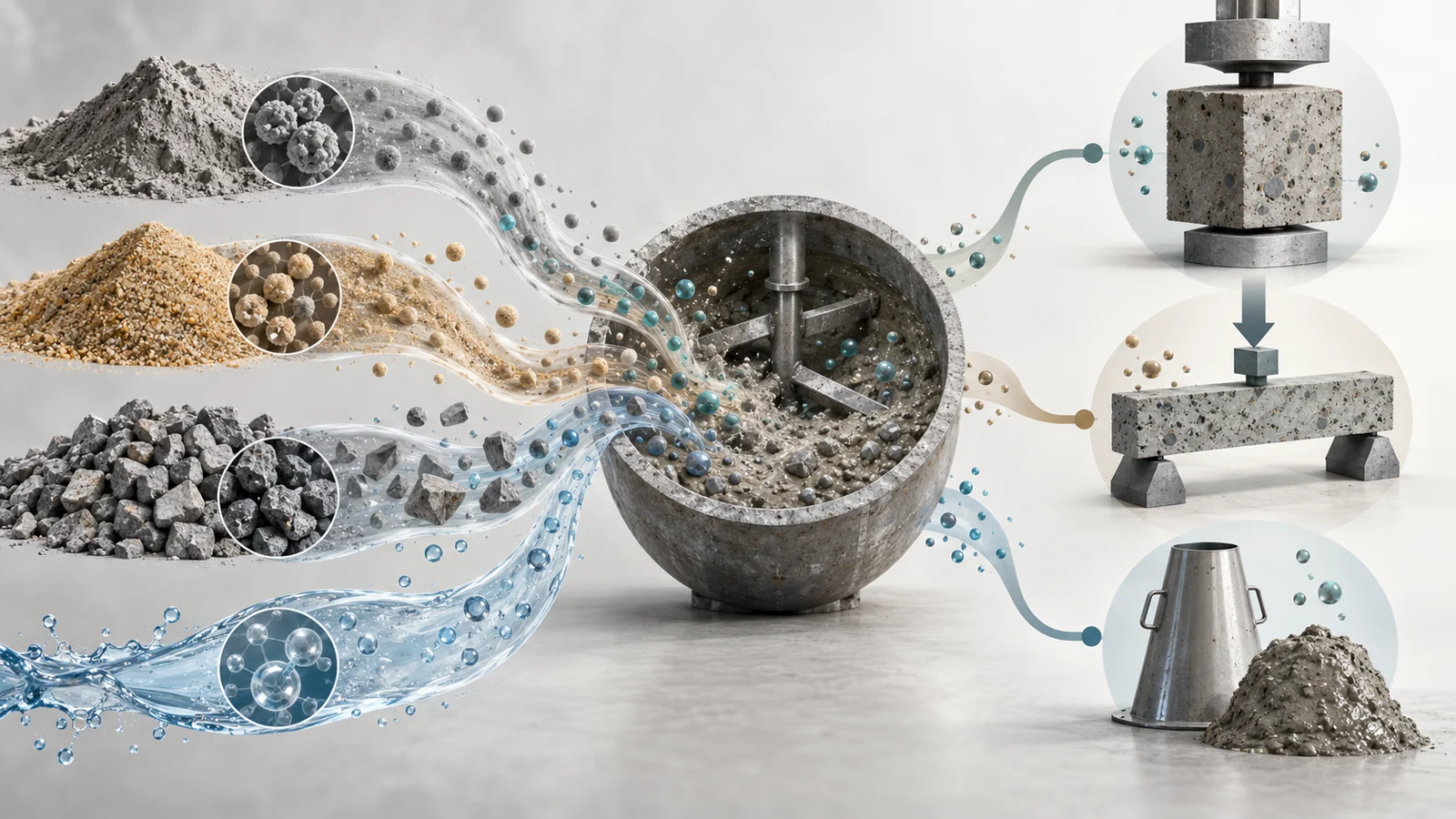
The study treated bacterial concentration as one input among several. The other principal inputs were cement, fine aggregate, coarse aggregate, and the water-to-cement ratio. Together, these variables describe a mixture rather than an isolated bacterial dose. The researchers then modeled three outputs that matter when concrete is being designed.
Compressive strength describes resistance to being squeezed. Flexural strength describes resistance to bending. Slump is a fresh-concrete measurement associated with workability, or how readily the mixture can be placed and handled before it hardens. These outputs do not capture every requirement for a structural material, but they provide different ways to ask how the ingredients are related to concrete performance.
The dataset had been collected in earlier work, then prepared and shuffled for the modeling exercise. The paper compared multilinear regression and response surface methodology with five optimization-based approaches: gray wolf optimization, multiverse optimization, moth-flame optimization, particle swarm optimization, and whale optimization. Their names are metaphors for search strategies. The algorithms iteratively explore candidate relationships and retain solutions that reduce prediction error; they are not simulations of wolves, moths, particles, or whales, and they do not reproduce the biological healing process.
From ingredients to three practical outputs
The models were judged with several statistics, including the coefficient of determination, or R², along with root mean squared error, mean absolute error, mean squared error, variance accounted for, and coefficient of error. R² is useful here because it summarizes how closely predicted and measured variation align within an evaluation. It is not a percentage of concrete that will heal, and it does not describe crack closure.
The paper reported separate training and test results. Training statistics show how a model performed during development with the data used to fit it. Test statistics show how it performed on the study’s designated test portion. That distinction matters because a model can describe a prepared dataset impressively without automatically transferring its relationships to every new formulation, bacterial system, or construction environment.
The route from input to output is therefore straightforward in concept but limited in meaning. Records of ingredient combinations entered the models, and the models returned estimates for compression resistance, bending resistance, and fresh-mix workability. The resulting scores tell us how the candidate mathematical relationships behaved in this dataset. They do not turn bacterial concentration into a verified construction recipe.
Three strong scores with different model leaders
The study highlighted a different leading method for each output. For slump, gray wolf optimization produced an R² of 0.998 during training and 0.989 during testing. For flexural strength, particle swarm optimization produced 0.989 during training and 0.937 during testing. For compressive strength, multiverse optimization produced 0.998 during training and 0.958 during testing.
These paired values are strong reported prediction statistics, especially when the training and test results remain close for the highlighted model-output combinations. They suggest that the selected mathematical forms captured substantial patterns in the prepared data. They do not mean that one algorithm discovered the amount of bacteria that guarantees self-repair, or that a high R² can substitute for testing concrete after cracking.
The output-specific pattern is more useful than a single overall champion. A method that performs well for slump is not automatically the best choice for bending or compression. Concrete workability, bending resistance, and compression resistance respond to different combinations of ingredients in the modeled relationships, so the question is not simply which algorithm wins. It is which model is most useful for a particular output and evaluation measure.
Why the ranking changes with the scorecard
The paper also used an aggregate ranking that combined training and testing results across several performance indicators. Under that broader score analysis, multiverse optimization ranked first for compressive strength and flexural strength, while gray wolf optimization ranked first for slump.
That ordering is not identical to the ranking produced by looking at one test R². Particle swarm optimization has the larger highlighted flexural test R² at 0.937, yet multiverse optimization leads the paper’s aggregate strength ranking. The supplied compressive-strength results show a similar reason for caution: gray wolf optimization has a test R² of 0.966 in the reported table row, higher than the highlighted multiverse value of 0.958, while the aggregate ranking still places multiverse optimization first for compressive strength.
Both statements can be true because they answer different questions. One asks which method has the strongest value for a selected statistic and output. The other combines multiple statistics and both stages of evaluation into a broader score. Model-winner language therefore needs a qualifier: the leading method depends on the output, the metric, and the way results are aggregated. The paper does not establish one best algorithm across every property and measure.
Ingredient influence is not a dose rule
Once the algorithms had been compared, the study examined the relative influence of the inputs. The sensitivity analysis placed fine aggregate ahead of bacterial concentration for compressive strength. Cement was the leading input for flexural strength, with bacterial concentration following it. For slump, the water-to-cement ratio was the most influential, while bacterial concentration was close behind or approximately level in the comparison described by the paper.
This pattern gives bacterial concentration an important place without making it the sole control knob. The same concentration can sit inside different cement, aggregate, and water relationships, and those surrounding choices affect the output being predicted. A formulation that looks favorable for compression may not be the one that gives the desired fresh workability or bending performance.
Sensitivity analysis also needs careful interpretation. It ranks the influence of variables within the modeled relationships; it does not establish a causal dose-response law. The findings do not show that increasing the bacterial concentration will always improve concrete, identify a universal optimum, or provide a practical dose with verified units and constraints. They show why concentration deserves attention as part of the mix design rather than being treated as an independent answer.
What prediction can and cannot tell us about repair
The study’s central achievement is computational. It uses previously collected data to estimate conventional concrete properties from bacterial concentration and ordinary ingredients. That could help researchers narrow the formulations worth making, but it remains separate from demonstrating that bacteria will activate under real cracking conditions, produce enough mineral material, and continue to function through repeated or prolonged service.
A model can predict compressive strength without measuring crack closure. It can estimate flexural strength without showing recovered load transfer through a damaged reinforced-concrete element. It can predict slump without establishing that a hardened material will retain a useful repair capacity. The reported scores therefore describe prediction performance, not recovery after structural failure, repeated healing, or extension of service life.
The distinction is especially important because the data were reused for this modeling exercise. High scores indicate that the candidate methods matched patterns in the study dataset under its reported training and test evaluations. Application to fresh formulations and service environments would require those relationships to transfer beyond the combinations represented in the modeling exercise, while the healing function would still need independent physical demonstration.
What this could change
For concrete producers and materials engineers, the practical prospect is a shorter path through formulation trials. A useful model could narrow the combinations of bacteria, cement, aggregates, and water that are worth producing and testing, reducing the need to make every plausible batch before identifying workable candidates.
That benefit remains conditional. The predictions would need to transfer to fresh mixes, and the resulting concrete would have to satisfy ordinary strength and workability requirements as well as independently demonstrated healing requirements. The study supports the possibility of using computation to reduce formulation effort; it does not quantify construction-cost savings, carbon reductions, longer service life, or readiness for deployment.
Key Sources
- Primary source: Modeling the influence of bacteria concentration on the mechanical properties of self-healing concrete (SHC) for sustainable bio-concrete structures.
DOI or Journal Page · Peer-Reviewed Paper · 2024-04-10