
Since the previous research note · Earlier expectation not tested
Track continuity
Since the previous research note: Predicting crack-area repair in concrete with bacteria and fibers
Previous expectation: Computational screening might help researchers select promising bacteria-and-fiber mixtures before laboratory testing, provided predictions work on genuinely new mixtures.
What this study adds: The current abstract reports a soil-derived Bacillus cereus strain and a four-thickener comparison, with the selected formulation achieving over 90% reported crack repair. This adds a formulation experiment to the timeline but supplies no basis for treating it as a test of the earlier predictive models.
What changed in this study
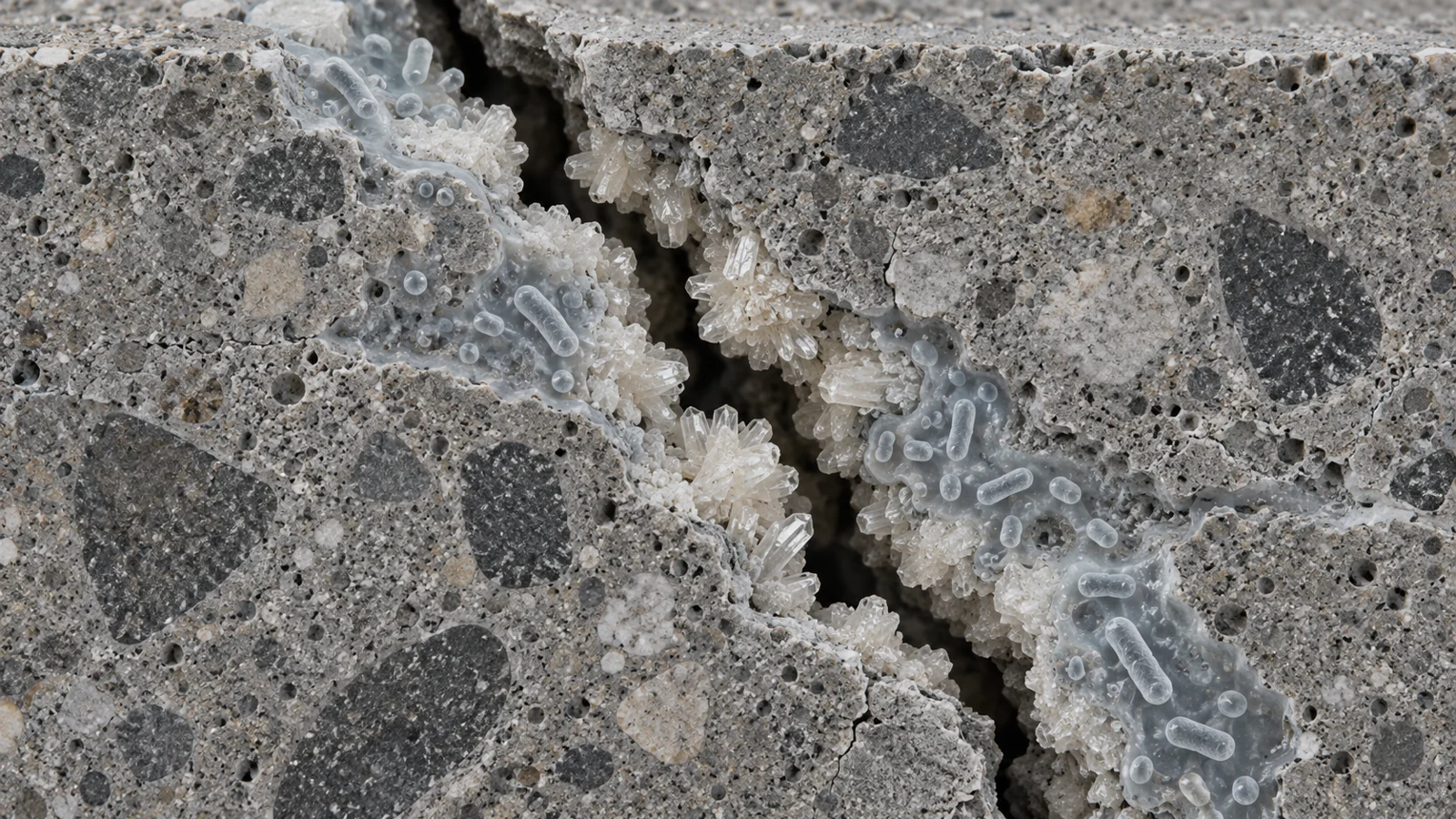
Concrete cracks can damage both a structure’s integrity and its appearance. One proposed response is microbe-induced calcium carbonate precipitation, or MICP, in which bacteria help calcium carbonate form as solid mineral material around a crack.
A research article published on August 22, 2023 tested this approach with a soil-derived strain of Bacillus cereus. The researchers selected the strain for its high urease activity and evaluated it alongside different thickener formulations. The study reported more than 90% crack repair for the best-performing strain-and-thickener formulation among those tested.
The candidate strain was chosen for its biological properties
The strain showed growth under strongly alkaline and salty conditions. The abstract reports growth at pH 13 and at a 4% salt concentration. These are separate observations in the reported description; they do not establish that the bacterium tolerated both conditions simultaneously.
Its high urease activity made the strain relevant to a precipitation-based repair strategy. In this setting, bacterial activity is connected to the formation of calcium carbonate as mineral material that may occupy part of a crack. That describes the role the organism was being tested for, without showing that concrete had become autonomously self-repairing or that the process would continue indefinitely inside a structure.
The study also assessed the quantity and sizes of crystals generated during bacterial mineralization over time. Those observations add information about mineral formation, while the crack-repair percentage addresses the performance of the tested repair system. The abstract does not provide the resulting crystal-size or crystal-quantity trajectories.
The formulation changed what was being compared
The researchers assessed four thickeners at varying concentrations. Sodium carboxymethyl cellulose, commonly shortened to CMC-Na, produced the most effective reported results at 10 grams per liter among the tested formulations.
This comparison means the experiment evaluated a combined treatment rather than the bacterium in isolation. The selected strain was used with a particular thickener and concentration, so the reported outcome belongs to that tested arrangement. The abstract does not establish why the 10 g/L CMC-Na formulation performed best, and the result does not make that concentration a universal optimum for every concrete mixture, crack or repair setting.
What the reported percentage can and cannot show
The abstract reports over 90% crack repair for the selected system and gives an initial water penetration time of 30 seconds. The 30-second figure is attached to the description of the repair result; it does not mean that the crack healed in 30 seconds. It is not a healing-speed measurement, nor can it be turned into a quantified waterproofing improvement without a defined measurement procedure and a before-and-after comparison.
The meaning of the repair percentage is also narrower than a claim of restored concrete performance. The abstract does not define what counted as “repair,” identify the percentage’s denominator, or show how the figure relates to recovered structural strength. The reported percentage alone therefore cannot establish the extent of functional recovery, and longer-term behavior remains unresolved.
The available findings likewise do not establish prolonged survival inside concrete, repeated autonomous healing, service life, field performance or deployment safety. Those questions matter because a crack treatment intended for buildings and infrastructure would need to remain effective under changing service conditions, not only produce a favorable result in an experimental arrangement.
What this could change
For building and infrastructure maintainers, a bacterial mineral-forming treatment could eventually provide another way to address concrete cracks and potentially reduce recurring repair work. That possibility depends on the repair persisting under real service conditions and the selected formulation proving suitable for practical use. The August 2023 study adds a strain-and-thickener experiment toward that capability, rather than evidence that self-repairing concrete was ready for deployment.
Key Sources
- Primary source: Exploring a high-urease activity Bacillus cereus for self-healing concrete via induced CaCO 3 precipitation.
DOI or Journal Page · Peer-Reviewed Paper · 2023-08-22