
Since the previous research note · Earlier expectation not tested
Track continuity
Since the previous research note: How old mortar on recycled concrete helps crack-sealing bacteria work
Previous expectation: Recycled concrete particles might carry useful bacteria into new concrete and eventually help limit water entry and recurring crack repairs if microbial activity and concrete performance endure in service.
What this study adds: The current study reports mineral formation and bonding in a deliberately applied repair mortar on artificially aged travertine. It adds a heritage-stone repair application without testing the earlier recycled-carrier forecast.
What changed in this study
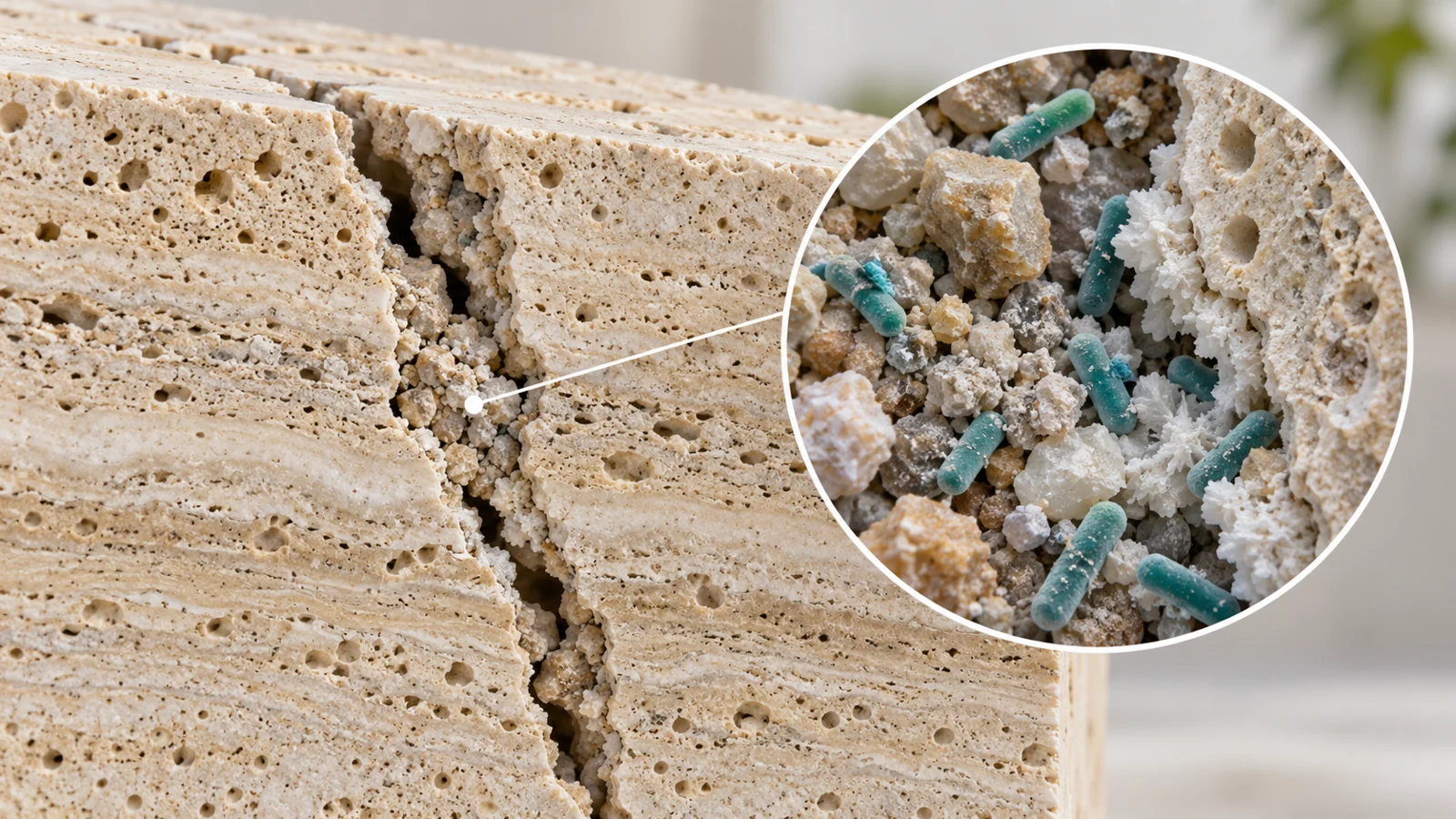
A small crack in travertine, a pale building stone often used in historic structures, can become a pathway to larger damage. A 2023 study tested whether a repair mortar containing calcifying bacteria could do more than fill that narrow opening: could it form a coherent connection with the surrounding stone?
The experiment focused on artificially aged travertine test stones and cracks smaller than 2 millimeters. Published on April 4, 2023, the study examined where new minerals formed and whether the biological mortar appeared to bond with the stone. Those observations offer a specific step toward bacteria-assisted repair, while leaving the harder questions of long-term monument conservation open.
A repair aimed at a narrow kind of damage
The researchers designed a biological mortar, or BM, for infilling micro-cracks in historic travertines. The target was a localized repair rather than a claim about restoring an entire stone or making a structure self-healing.
They applied the mortar to artificially aged test stones rather than to a monument in service. That setting allowed the researchers to inspect the treated cracks and the contact between the repair material and travertine after application. The stated crack range was below 2 millimeters. It should be read as the intended application range for this experiment, not as a measured upper limit for every crack the material could repair.
Three ingredients, one proposed binding process
The mortar combined three purposeful elements. First came a calcifying Bacillus species isolated from thermal spring water in the Pamukkale Travertines of Denizli. The bacteria were not simply included as an inert filler. Their role was tied to microbial mineral formation.
Second, the mixture used stone powder collected from nearby travertine quarries. That ingredient gave the mortar a stone-derived particulate component related to the material being repaired. Third, the researchers added a triggering solution designed to initiate calcium carbonate precipitation.
Together, these ingredients created a setting in which bacteria-associated calcification could produce mineral deposits within the mortar. The proposed result was a repair material whose grains and matrix became more tightly connected as calcium carbonate formed around bacterial bodies and among the mortar components. Because the mortar was placed directly into existing cracks, the same process could also contribute to contact between the infill and the travertine walls.
What the microscopes found at the crack
The study used several kinds of observation, each addressing a different part of that proposed process. Scanning electron microscopy revealed Bacillus bodies coated with calcium carbonate in the mortar matrix. That finding located mineral formation around the bacterial cells themselves rather than showing only a visually filled crack.
Optical microscopy showed secondary calcite minerals throughout the treated micro-cracks. In other words, the mineral phase was observed inside the repaired openings, where it could participate in the connection between the infill and the stone.
Stereomicroscopy then provided a broader view of the repair contact, while nanoindentation supplied local mechanical information about the material. Together, those analyses supported the paper’s report that the biological mortar bonded with the stone through microbial calcification activity. The abstract describes the contact between the original material and BM as continuous and coherent in all tested samples.
These results matter because a crack filler and a bonded repair are not quite the same thing. A filler can occupy space; the reported observations instead address mineral formation within the mortar and at its relationship with the surrounding travertine. They still describe a laboratory material interface, not a proven conservation system.
The boundary between contact and conservation performance
The reported mineral growth and bonding do not establish autonomous healing of cracks that form later, repeated healing after further damage, or complete closure at every width below 2 millimeters. They also do not establish restored whole-stone strength, reduced water entry, outdoor durability, or a longer service life for historic stone.
Comparisons with conventional repair methods, cost savings, lower environmental impact, and readiness for routine conservation practice require evidence beyond the findings described here. The study’s travertine application is also distinct from carrying bacteria into structural concrete with recycled particles. It tests a deliberately applied repair mortar in aged building stone, not bacterial performance in concrete infrastructure.
That distinction keeps the result useful without stretching it. The study reports mineral formation and a coherent-looking, locally supported connection in its test setting. Whether that connection remains stable under the changing moisture, temperature, loading, and conservation conditions of a historic site is a separate question.
What this could change
If this kind of bonded repair proves durable and compatible with historic stone, conservators could gain another way to stabilize localized travertine damage before small cracks develop into larger detachments. The potential benefit is not autonomous repair of a monument. It is a more targeted opportunity to retain original stone while intervening at a damaged area with a mortar designed to bind the infill to the surrounding travertine through mineral formation.
That possibility depends on the unresolved practical tests: the repair would need to remain suitable for the stone over time, perform under real exposure, and meet conservation requirements for protecting original material. The 2023 study contributes the laboratory observation that bacterial mineral formation can be associated with a coherent mortar–travertine contact. It does not yet turn that observation into a field-ready restoration claim.
Key Sources
- Primary source: Use of bacterial binder in repair mortar for micro-crack remediation.
DOI or Journal Page · Peer-Reviewed Paper · 2023-04-04