
Since the previous research note · Earlier expectation not tested
Track continuity
Since the previous research note: How wood ash carries bacteria into self-healing concrete
Previous expectation: Waste-derived bacterial carriers could reduce later crack-sealing work if their biological response and concrete performance remain useful under realistic service conditions.
What this study adds: The March 2023 study compares coarse and fine recycled-concrete carriers, linking their different laboratory repair behavior to attached old mortar and examining water-flow behavior. It expands the carrier-design evidence without testing wood ash or resolving the earlier service-performance condition.
What changed in this study
Concrete made with demolition waste may be able to do more than replace some newly quarried stone and sand. In one laboratory study, recycled concrete particles also served as homes for dormant bacteria that can deposit calcium carbonate inside cracks. The useful question was not simply whether the bacteria worked, but whether the size and texture of the recycled material placed them where repair could matter.
Published on March 16, 2023, the study compared recycled coarse aggregate with recycled fine aggregate as microbial carriers in self-healing concrete. The coarse particles produced the stronger crack-closure result in the reported comparison. Yet the experiment also showed why a crack that looks narrower at the surface is not automatically a crack that has stopped carrying water through the concrete.
The experiment gave demolition waste a second job
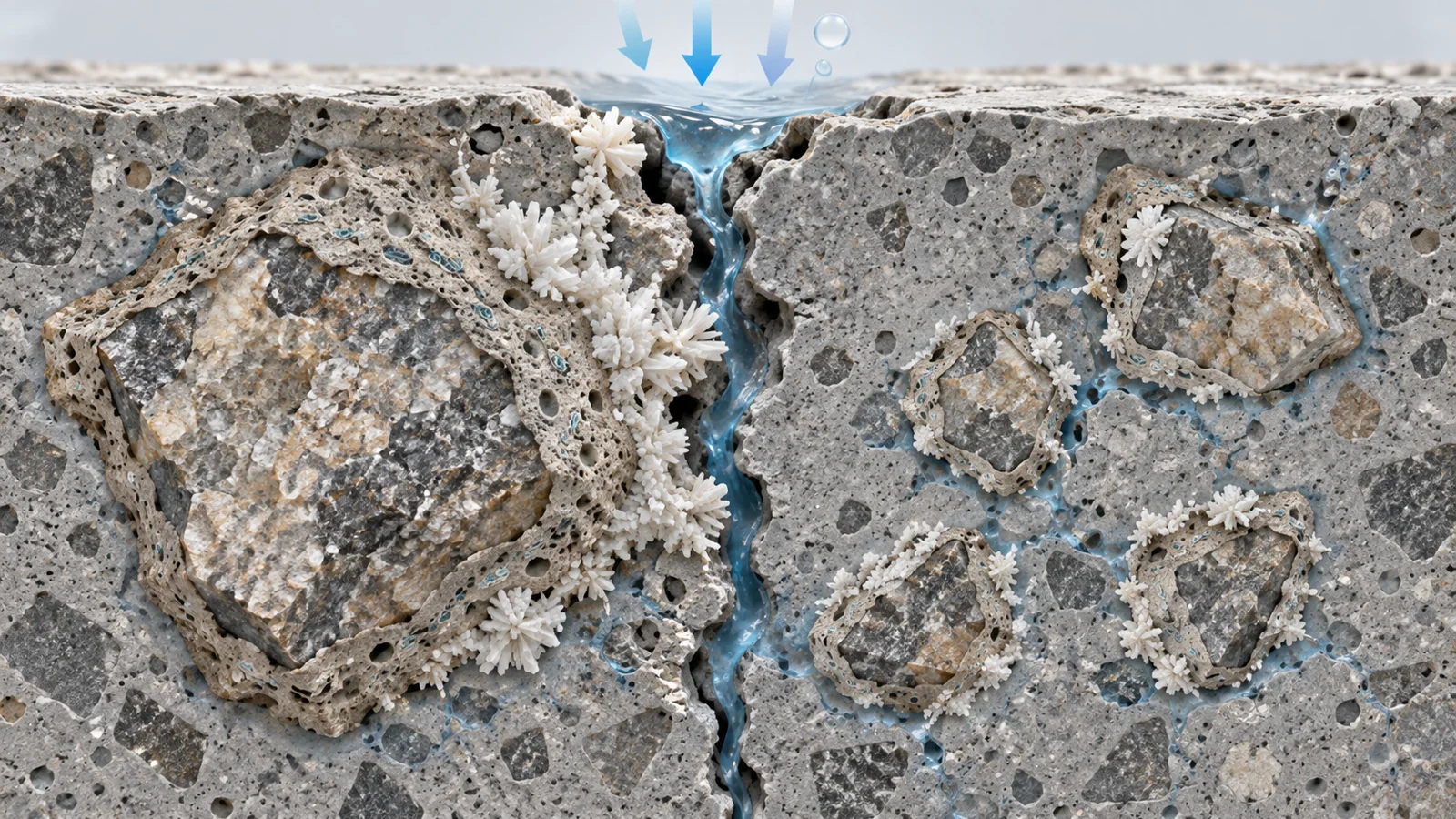
The recycled material came from demolished ring beams and structural columns collected in Xi’an, China. After crushing and sieving, the researchers separated recycled coarse aggregate into particles 5–20 millimeters across and recycled fine aggregate into particles 1.18–4.75 millimeters across. Both had a rough, angular surface covered in remnants of old cement mortar. That attached mortar was central to the experiment because its pores provided places for the bacteria to lodge within the recycled aggregate carrier.
The researchers loaded the particles with a bacterial solution using vacuum-assisted adsorption and then dried them. The procedure was intended to place dormant Bacillus pasteurii in the pores of the old mortar without adding the solution’s water directly to the concrete mix. Calcium lactate was added as a nutrient when the concrete was mixed.
The design used 54 standard specimens. Eighteen belonged to the group with coarse recycled particles carrying the bacteria, and 18 used fine recycled particles as carriers. A third group received the bacterial solution directly during mixing, while a natural-aggregate group served as a control. The test specimens used coarse carriers 5–10 millimeters across and fine carriers 1.18–4.75 millimeters across, with a 30% carrier replacement ratio and a 40% bacterial-solution concentration chosen to balance concrete performance, repair effectiveness and microbial cost.
To create comparable damage, the specimens were loaded in three-point bending until a crack appeared on the tension side. The researchers stopped when the crack reached roughly 0.1–0.3 millimeters at the observation area, held the load briefly, and then placed the specimens in a natural environment with water maintenance. Crack widths were recorded at marked points over time rather than inferred from a finished structure.
A bigger particle created a more useful microbial neighborhood
The clearest matched comparison came after 14 days. For a crack that began at 0.15 millimeters, the coarse-carrier group had a remaining width of 0.06 millimeters. That corresponds to a reported 60% repair rate at the measured point. The fine-carrier group had a remaining width of 0.11 millimeters, or 26.67% repair. Both recycled-carrier groups performed better in the study’s conclusions than the directly mixed bacteria and natural-aggregate controls.
The difference was not explained simply by the presence or absence of bacteria. It was linked to where the organisms could live and where their mineral products accumulated. When water and oxygen entered a crack, dormant spores attached to the old mortar could become active. The microorganisms helped bring calcium ions and carbonate together to form calcium carbonate, or calcite. The deposits tended to grow outward from the carrier toward the crack.
A coarse recycled particle carried a larger attached-mortar region and, in the researchers’ observations, a greater microbial volume than a fine particle. Microscopy showed large, tightly aggregated calcium-carbonate deposits on the attached old mortar of coarse carriers. The growth therefore appeared concentrated around particular carrier regions rather than evenly spread across the crack.
That concentration can be useful. A larger carrier may put more active material in one connected location, giving the repair products a better chance of building across a local passage. The result is not that every large recycled particle is a superior carrier. It is that carrier geometry changes the spatial arrangement of the repair process.
Fine particles spread the material without guaranteeing better closure
Fine recycled particles might seem attractive because they can be distributed widely through a concrete mix. The study’s microscopy suggests why that distribution did not automatically produce more effective crack repair. The fine-particle specimens contained many areas occupied by cementitious material, including further-hydrated material that could limit contact between microorganisms, oxygen and water. The individual repair products were smaller and less densely distributed.
The amount of attached mortar also mattered in a more specific way than simply “more mortar is better.” Old mortar supplied the rough, porous attachment environment, while the exposed original stone was dense and relatively smooth. Very little repair product was seen on the raw aggregate surface. The locations that supported the strongest visible mineral growth were mostly those with less obstructive cementitious material and more accessible old mortar.
This helps explain the coarse-versus-fine result without turning particle size into a universal rule. A coarse carrier can provide a larger local habitat, but its usefulness still depends on the mortar attached to it, the size of the particle, the mix design and the conditions inside the crack. Fine particles can distribute repair products over a broader area while producing less concentrated filling at the places where a connected crack needs to be narrowed.
The same spatial distinction matters over time. Early in crack repair, water and oxygen are relatively available in the opening, so microbial activity can dominate the process. As deposits accumulate and the crack becomes smaller, the supply pathways narrow. Later repair may be limited by how much water and oxygen can still reach the carrier. The repair process can therefore slow as the visible opening closes, even though the biological material has not simply vanished.
A narrower surface crack can still carry water
The study treated crack width as an important observation, but it also questioned whether a surface image could represent the entire damaged path. The cracks were irregular and jagged rather than neat rectangular slots. A measurement at a few marked points captured surface change, but it could not by itself describe the crack’s depth, internal voids or the location of recycled particles beneath the visible face.
That distinction is easy to miss. Mineral can build along the edges of a crack and make the opening look smaller while a connected passage remains inside the specimen. At 14 days, repair material had begun filling pores within cracks, but some pores remained open. In later observations of smaller initial cracks, the researchers saw material covering and filling crack surfaces. Those observations are consistent with improved resistance to the movement of harmful substances, but they are not the same as proving complete internal closure or restored structural capacity.
For that reason, the researchers also examined crack water flux. Water flux describes how much water passes through a penetration route over time, so it can reveal internal changes that a surface-width measurement misses. A crack may narrow at the observation point yet continue to pass water through a connected channel. Conversely, a visible deposit may occupy only part of the opening while changing the path that water takes through the concrete.
The study’s time sequence illustrates why both measurements matter. Smaller cracks showed little repair at three days. By seven days, larger cracks showed more pronounced calcite formation inside and extending outward from the crack. At 14 days, deposits had filled some internal pores but left others unfilled. Observations at 28 and 56 days showed more extensive covering and filling for smaller initial cracks. These are changes in specimens under the study’s water-maintained laboratory conditions, not a direct measure of how a building, bridge or other full-scale structure would behave.
More carrier is not automatically a better recipe
The carrier has to satisfy several competing requirements. It must preserve enough basic concrete performance, provide space for microbial activity, allow water and oxygen to reach the organisms, and remain practical to prepare. Increasing the recycled-material replacement ratio could weaken the concrete’s initial properties, according to the study’s design rationale, while adding more microbial material would increase expense and could reduce the average living space available to individual strains.
The selected 30% replacement ratio was therefore not presented as a maximum healing setting or a universal formulation. It was a compromise chosen for this experiment. The same applies to the 40% bacterial-solution concentration. More concentrated treatment is not automatically more active, and more carrier is not automatically more useful if the surrounding concrete blocks the conditions needed for repair.
This tradeoff also makes the recycled aggregate’s old mortar a mixed feature rather than a simple advantage. Its pores can hold the microbial material, but its condition and distribution vary from one demolished concrete source to another. The study used material recovered from particular beams and columns, processed into particular particle ranges. A different demolition stream could carry a different amount or arrangement of old mortar and therefore create a different repair environment.
The model follows a crack through time
To describe repair over time, the researchers developed a model based on the changing crack condition and water-flow behavior. Its main variables included bacterial-solution concentration, carrier replacement rate, repair time and temperature. The reported formulation assumes a temperature of 25 °C, described as the peak microbial-activity temperature for the test conditions, and uses the carrier ratio and bacterial concentration to estimate changes in repair width.
The model was reported to be more accurate when its calculated value was 0.5 millimeters or less. The researchers said it was not applicable to a 1-millimeter crack under their tested conditions because microorganisms appeared rarely or not at all in the repair products there. They also recommended keeping the coarse-carrier size at no more than 15 millimeters for the calculation because accuracy declined as carrier size changed.
Those limits should not be confused with the abstract’s separate result that the coarse-carrier approach reached a maximum healing width of 0.27 millimeters by 28 days. The 0.27-millimeter figure is an observed result under the study’s formulation and exposure. The model’s 0.5-millimeter applicability statement describes where its calculation performed better; it does not mean cracks of that width were fully healed. Neither figure establishes restored load-bearing capacity, a particular extension of service life or durable performance under repeated cracking and varied outdoor exposure.
The broader lesson is methodological. A visible width reduction is one kind of evidence. Mineral identification, microscopy, pore measurements and water-flow behavior add different kinds of information. Together they can show whether deposits are merely decorating the surface or changing the internal route through which water moves. No single measurement carries all of that meaning.
What this could change
If recycled carriers retain useful microbial activity while preserving adequate concrete performance in real service, demolition material could acquire a second function inside new concrete. Instead of serving only as a substitute for some newly quarried aggregate, selected recycled particles might also help seal small cracks from within their attached old mortar.
That could eventually give infrastructure owners another way to limit water entry through localized cracking and reduce some recurring sealing interventions. The possible benefit would come through a specific chain: recycled concrete supplies the carrier, old mortar provides a microbial habitat, mineral deposits obstruct parts of a crack, and reduced water movement lowers the need for certain repairs. At the same time, natural aggregate could be displaced by material recovered from demolition.
The March 2023 experiment supports the first links in that chain under controlled laboratory conditions. It does not yet establish the last ones for full-scale infrastructure. Whether the approach can survive changing moisture, repeated damage, different recycled-concrete sources and long service periods remains part of the practical challenge. The result is therefore best read as evidence for a design direction: the size and internal texture of a recycled particle may determine whether its biological cargo reaches the crack in a useful form.
Key Sources
- Primary source: Study on the Performance of Recycled Coarse and Fine Aggregates as Microbial Carriers Applied to Self-Healing Concrete.
DOI or Journal Page · Peer-Reviewed Paper · 2023-03-16