
Since the previous research note · Earlier expectation not tested
Track continuity
Since the previous research note: A treated wall reveals a bacterial mix for concrete surface repair
Previous expectation: A bacterial mixture selected from organisms living on concrete might become a useful surface treatment for small defects in existing indoor walls if its mineral deposits remain effective.
What this study adds: This source reports a different spores-and-calcium-nitrate treatment for early-age cracks, with crack-closure and water-permeability repair outcomes after 28 days of dry–wet cycles. It does not establish that the earlier wall-treatment consortium achieved persistent repair.
What changed in this study
A concrete crack can look nearly closed while still allowing water to pass. That distinction matters because visible narrowing describes the crack’s appearance, whereas reduced water passage speaks to one of its practical functions. A version 1 research article dated 8 December 2022 examined both outcomes in an experiment involving bacterial spores, calcium nitrate and early-age concrete cracks.
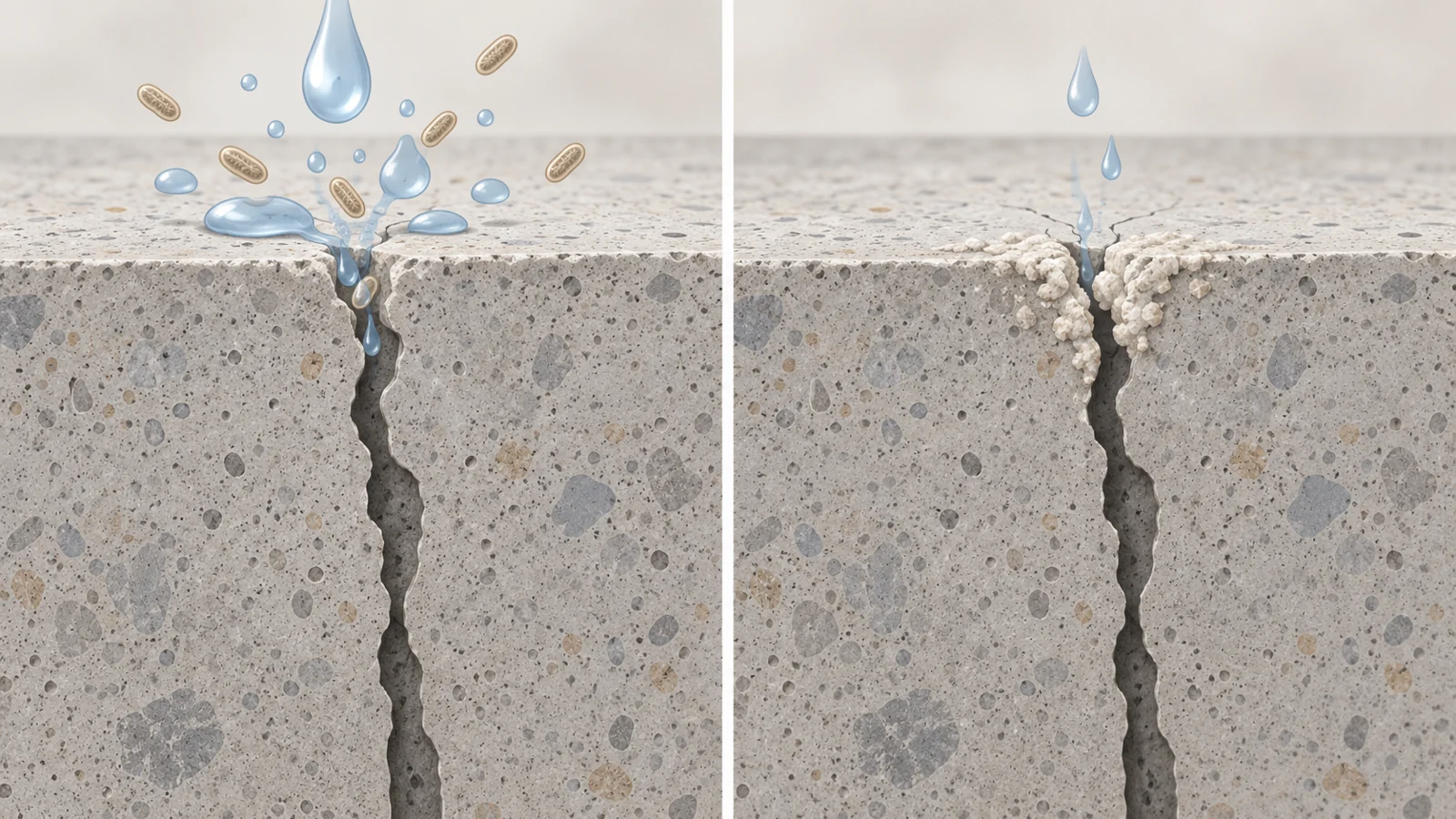
The study focused on the biomineralization process associated with calcium carbonate precipitation by Bacillus mucilaginous. It also investigated conditions linked to bacterial growth and extracellular carbonic anhydrase activity. The result is a specific experimental contribution: mineral deposits appeared at the crack opening, and the researchers reported separate measurements for crack closure and water-permeability repair after a defined healing period.
The treatment paired spores with a calcium source
Microbial induced calcium carbonate precipitation, or MICP, is a form of biomineralization in which calcium carbonate forms through biological activity. In this study, the researchers examined temperature, initial pH and calcium concentration in relation to bacterial growth and extracellular carbonic anhydrase activity. They also considered calcium concentration and calcification rate while observing mineral formation in an alkaline environment.
For the concrete-healing part of the work, they prepared a microbial healing agent containing bacterial spores and calcium nitrate. The treatment was intended for early-age cracks. That detail sets the boundaries of the result: this was an investigation of a defined treatment at an early stage of concrete development, not a demonstration that the same approach works for every crack or every service environment.
The study therefore connected two parts of the process. Bacterial activity was examined alongside the conditions associated with calcium carbonate formation, while the healing test asked what happened when the resulting treatment was applied to cracks. The mineral product was not inferred only from the appearance of the surface; the researchers used X-ray diffraction to identify the material found at the crack mouth.
Two measurements captured different kinds of change
The healing period lasted 28 days and included dry–wet cycles. Under those conditions, the abstract reports that crack closure reached 95.62% for crack widths up to 0.339 millimetres. It also reports an 87.54% water-permeability repair rate compared with a reference.
Those figures answer related but different questions. Crack closure indicates how much of the visible opening became closed according to the study’s measurement. Water-permeability repair indicates a change in the movement of water through the tested material. The second result is important because a deposit can alter water passage even when the surface appearance alone cannot show how continuous the sealing is.
The percentages should therefore be read as paired measurements from one bounded experiment, not as interchangeable proof of a single kind of repair. They show that the treatment was associated with both substantial measured closure and a reported reduction in water permeability under the stated 28-day dry–wet schedule. They do not, by themselves, establish recovery of mechanical strength or load-bearing capacity.
Calcite was found at the crack mouth
X-ray diffraction identified calcite, a form of calcium carbonate, in the precipitations at the crack mouth. This finding gives the result a concrete material basis: the visible deposit was identified as a particular mineral rather than described only as an unspecified residue.
It also clarifies what the result does and does not reveal. Calcite at the crack mouth is consistent with the study’s focus on calcium carbonate biomineralization, but it does not establish how far the mineral extended into the crack or whether a continuous barrier formed throughout its depth. The water-permeability measurement provides functional information under the test conditions, while the mineral identification provides compositional information. Neither one alone describes the complete internal structure of the crack.
The same caution applies to the numerical comparison. The abstract does not provide enough verified detail to reconstruct the reference composition, percentage calculations, sample distribution or statistical uncertainty. Those details would matter when judging how broadly the reported values should be applied.
A promising repair signal with a narrow reach
This experiment supports a more limited conclusion than the phrase “self-healing concrete” can sometimes suggest. The treatment was associated with mineral deposition, high reported crack closure for cracks up to the stated width and a separate water-permeability repair result after 28 days of dry–wet healing. That is meaningful evidence of performance in the tested setting.
It is not evidence of persistent repair during long-term service, repeated healing after later damage, effectiveness across larger cracks or consistent performance under different exposure conditions. The study’s environmental description also needs to remain proportionate. The authors characterize the mineralization process as environmentally friendly, but this report does not establish comprehensive lifecycle environmental performance, pollution accounting, maintenance savings or commercial deployment.
For readers, the practical question is consequently not whether bacteria can make a crack disappear in an image. It is whether a mineral deposit can continue to limit water passage when concrete faces the changing conditions that matter in use. The reported permeability result makes that question measurable, but it does not settle it for settings beyond this experiment.
What this could change
If spores-and-calcium-nitrate treatments can repeatedly produce stable mineral deposits that limit water passage through small early-age cracks under real service conditions, concrete owners could gain a biological way to reduce moisture ingress before defects require later sealing work. That could eventually mean fewer interventions for some small defects and a longer interval before conventional maintenance becomes necessary.
The possibility depends on persistence, crack size, exposure and the relationship between surface deposits and the crack’s internal path. The 2022 study supplies a dated experimental example of how bacterial mineralization and water-permeability testing can be considered together. It does not yet turn that example into a general promise of structural restoration or field-ready protection.
Key Sources
- Primary source: Biomineralization process of CaCO3 precipitation induced by Bacillus mucilaginous and its potential application in microbial self-healing concrete
DOI or Journal Page · Peer-Reviewed Paper · 2022-12-08