
Since the previous research note · Earlier expectation not tested
Track continuity
Since the previous research note: What can bacteria help repair inside lightweight concrete after severe heating?
Previous expectation: Reliable biological filling in heat-damaged concrete could reduce moisture entry and later deterioration if it persists beyond controlled curing and structural adequacy is independently verified.
What this study adds: The current source reports laboratory crack closure under simulated rain and establishes outdoor monitoring of deliberately cracked structural footbridge beams. It creates a distinct service-exposure milestone without testing repair after severe heating.
What changed in this study
A bridge is normally a sign that its materials have been asked to withstand cracking, not invited to produce it. Yet researchers building a small footbridge in Vilnius deliberately cracked some of its concrete beams before placing them outdoors. The purpose was to create a controlled starting point for studying whether bacteria-assisted concrete could narrow those cracks under ordinary weather exposure.
That distinction matters. The study demonstrated laboratory crack closure and established an outdoor experiment. It did not show that the installed bridge had already repaired itself, restored its original structural capacity, or extended its service life.
A bridge built to be investigated
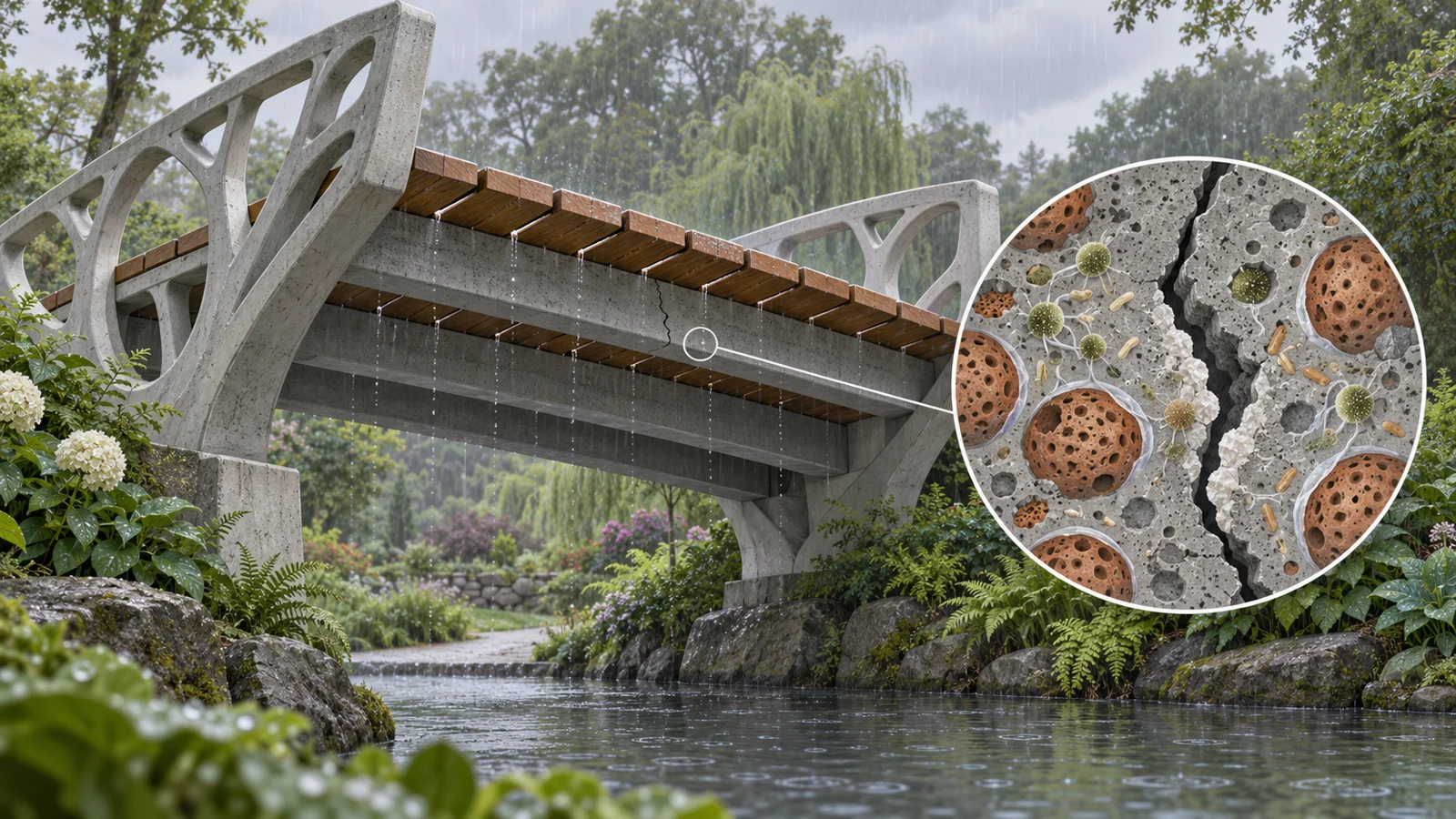
The prototype spans 7.2 meters across a small stream in the Botanical Gardens of Vilnius University. Its architectural form was inspired by the branching growth of Scots pine. Four tree-like cantilever trusses carry the main structure, while a central span contains the beams made from biological self-healing concrete.
The central beams were designed to be replaceable. That feature serves a practical research purpose: beams could be loaded and cracked in the laboratory, installed in the bridge, monitored outdoors, and eventually removed so that later beams could be studied in the same setting. The researchers were therefore not trying to hide a test specimen inside a finished bridge. They made the bridge itself part of a repeatable field experiment.
The distinction between the materials was also important. The branching trusses used ultra-high-performance fiber-reinforced concrete, selected for their thin, complex geometry. The biological concrete was used in the central beams. The entire bridge was not made from one experimental material, and the trusses were not evidence of bacterial crack healing.
What the healing mix puts inside concrete
Concrete is strong in compression but vulnerable to cracks. Once a crack opens, it can provide a route for water, oxygen, and salts toward reinforcement. The idea behind biological self-healing concrete is to place a dormant repair system inside the material before damage occurs. When conditions allow, calcium carbonate-precipitating bacteria may contribute to mineral deposition within a crack, helping reduce its open width.
In this study, the bacterial material was carried in expanded-clay particles. The particles were impregnated with calcium lactate and yeast extract, along with spores of either Bacillus pseudofirmus or Bacillus cohnii. A styrene-acrylate coating was added to protect the spores. The expanded clay therefore acted as more than a lightweight ingredient: it provided a protected carrier for spores and the nutrients prepared to support the healing system.
The researchers did not treat the concrete as a material that could simply close any crack under any condition. The surrounding environment was part of the test. Water had to reach the crack, but the way it arrived could influence the measurement. That is why the laboratory program used rain-simulating spray rather than relying only on constant immersion.
What the laboratory percentages actually measure
The study defined healing ratio as the reduction in measured crack width over time. In simplified form, the calculation compares the initial width with the later width. A value of 100% would mean that the measured opening had fully closed. It is a measurement of surface crack narrowing, not a direct measurement of restored load-bearing capacity or a guarantee that water can no longer pass through.
The researchers first created reinforced concrete specimens and induced cracks wider than 50 micrometers. They measured each selected crack at many locations, using repeated optical measurements to establish its starting width. The specimens then spent either 28 or 98 days in basins that sprayed them with water for 30 minutes twice a day. Between spray cycles, they remained in air with relative humidity between 40% and 50%, a setup intended to resemble exposure more closely than continuous water immersion.
After 98 days, the series containing B. pseudofirmus showed an average healing ratio of 14%, compared with 3% in the bacteria-free controls. The series containing B. cohnii showed 17% in the biological specimens and 2% in the controls. In relative terms, the biological readings were several times higher than the controls in both comparisons. In absolute terms, however, the measured closure remained partial. A 14% reduction means that most of the original measured opening remained.
The control results are essential to interpreting the numbers. Plain concrete can narrow some cracks without bacteria through continued cement hydration, swelling, or the mechanical blocking of openings by fine particles. The small control changes show why the bacterial and non-bacterial specimens had to be compared under the same conditions. They also show why a multiple over the control should not be read as complete sealing.
Water exposure made the result more complicated. The paper discusses the possibility that direct spraying may affect material moving through the crack, and it notes that the flow of water can influence apparent healing. That possibility is not a complete explanation of the result, but it illustrates why a rain-exposed measurement cannot be interpreted as a simple test of bacterial activity alone. The environment changes the pathway through which the repair process is observed.
Cracking the beams was part of the experiment
The bridge beams needed to be damaged in a controlled way before they could be observed in service. Numerical simulations were used to select the beam dimensions and reinforcement arrangement so that loading would create roughly 10 to 15 cracks in the central region. The beams were then tested in the laboratory with four-point bending, allowing the researchers to control the load, the number of cracks, and their approximate widths before installation.
The procedure produced 12 to 15 visible cracks in the side profiles of the beams. For long-term inspection, the researchers marked cracks wider than 50 micrometers on the bottom surfaces and recorded their initial widths with a digital crack microscope. This preparation gave the outdoor experiment known locations and known starting conditions. Without it, an uncracked or lightly cracked beam might reveal very little about how the embedded healing system behaved.
The selected bridge mix was not simply the laboratory mix poured at a larger scale. The researchers chose B. pseudofirmus for the structural beams because it sporulates faster than the alternative strain. They produced two biological beams and two control beams for the central span. The structural mix also replaced part of the cement with silica fume and added steel fibers to provide the required shear strength. Its reported average compressive strength was 26.84 megapascals, but that figure alone does not establish that the complete bridge system had recovered from cracking or that it would resist every relevant service condition.
This is the engineering work hidden behind the phrase “self-healing concrete.” The material had to be formulated, cast, reinforced, loaded, measured, transported, and integrated into a bridge whose other components had different structural roles. The biological claim could not be separated from those construction decisions.
Rain reached the beams through the deck
The bridge was assembled so that the central beams would experience a realistic outdoor arrangement. Timber decking boards were placed above them with gaps between the boards. Rainwater could therefore pass through the deck and reach the horizontal beam surfaces rather than being isolated from the cracks by a sealed covering.
That detail links the laboratory design to the field installation. The beams were not placed in a protected chamber with carefully fixed humidity. They were incorporated into a footbridge in an open-air botanical garden, where temperature, humidity, rain, fog, and seasonal changes could affect both the concrete and the biological system.
At the same time, the bridge layout preserved experimental control. Two biological beams could be compared with two control beams, and the central elements could later be replaced. The tree-like trusses carried their own architectural and structural duties, while the central beams supplied a manageable location for deliberate damage and repeated observation.
The field stage had only just begun
The paper was published on December 1, 2022, and reports that crack monitoring began in September 2022. By publication, the footbridge had been built and its central beams had been deliberately cracked under laboratory loading, installed, and placed under outdoor observation. The long-term seasonal record was the experiment still being gathered.
Optical crack-width measurements are useful because they can be made directly on the exposed bottom surfaces of the beams. They also have limits. Narrowing at a visible crack does not by itself show that the surrounding concrete has regained its original strength, that permeability has fallen enough to protect reinforcement, or that corrosion and other forms of deterioration have been prevented.
There is another important difference between many measurements and many independent structures. Measuring a crack at numerous points improves the description of that crack, but it does not turn those points into separate bridge replications. The two biological and two control beams provide a small structural comparison, while the detailed optical readings describe selected cracks within those beams.
The study therefore occupies a precise middle ground. It moved biological concrete from controlled specimens into structural bridge elements and created a way to observe deliberately damaged beams under natural exposure. Its laboratory results show a bacterial contribution to measured crack-width reduction under a rain-simulating schedule. They do not yet provide a completed account of how the installed beams perform across the site’s seasonal conditions.
What this could change
If a biological concrete mix can repeatedly seal small cracks during real outdoor service while retaining adequate structural performance, it could reduce one of the pathways through which water and salts reach reinforcement. For bridges and other exposed concrete structures, that could eventually mean fewer opportunities for cracking to accelerate deterioration and fewer repair interventions caused by small openings becoming larger maintenance problems.
The practical benefit would depend on two things happening together. The mineral deposition would need to remain effective as weather and moisture conditions change, and the structural element would still need to meet its engineering requirements independently of the crack-narrowing effect. A narrower visible crack is an encouraging material signal, but durable infrastructure protection would require that narrowing to persist and correspond to meaningful resistance to deterioration.
The Vilnius footbridge was built to make that question observable. Its replaceable central beams, deliberately generated cracks, control specimens, and gaps in the decking created a way to connect a laboratory measurement with the demands of an operating outdoor structure. At the December 2022 stage, the important advance was not proof of a self-repairing bridge. It was the construction of a bridge capable of testing whether that promise could survive contact with rain, loading, and time.
Key Sources
- Primary source: The Construction of a Footbridge Prototype with Biological Self-Healing Concrete: A Field Study in a Humid Continental Climate Region.
DOI or Journal Page · Peer-Reviewed Paper · 2022-12-01