
Since the previous research note · Earlier expectation not tested
Track continuity
Since the previous research note: How a soil bacterium helps build mineral filling inside cracks
Previous expectation: Incorporated bacteria and available reactants might eventually give concrete a local response to small cracks that reduces some manual sealing work.
What this study adds: This study examines external treatment of already-cracked mortar and reports surface sealing and reduced permeability after repeated bacterial and calcium-lactate immersions. It develops a repair branch for existing material without testing an incorporated, service-activated healing system.
What changed in this study
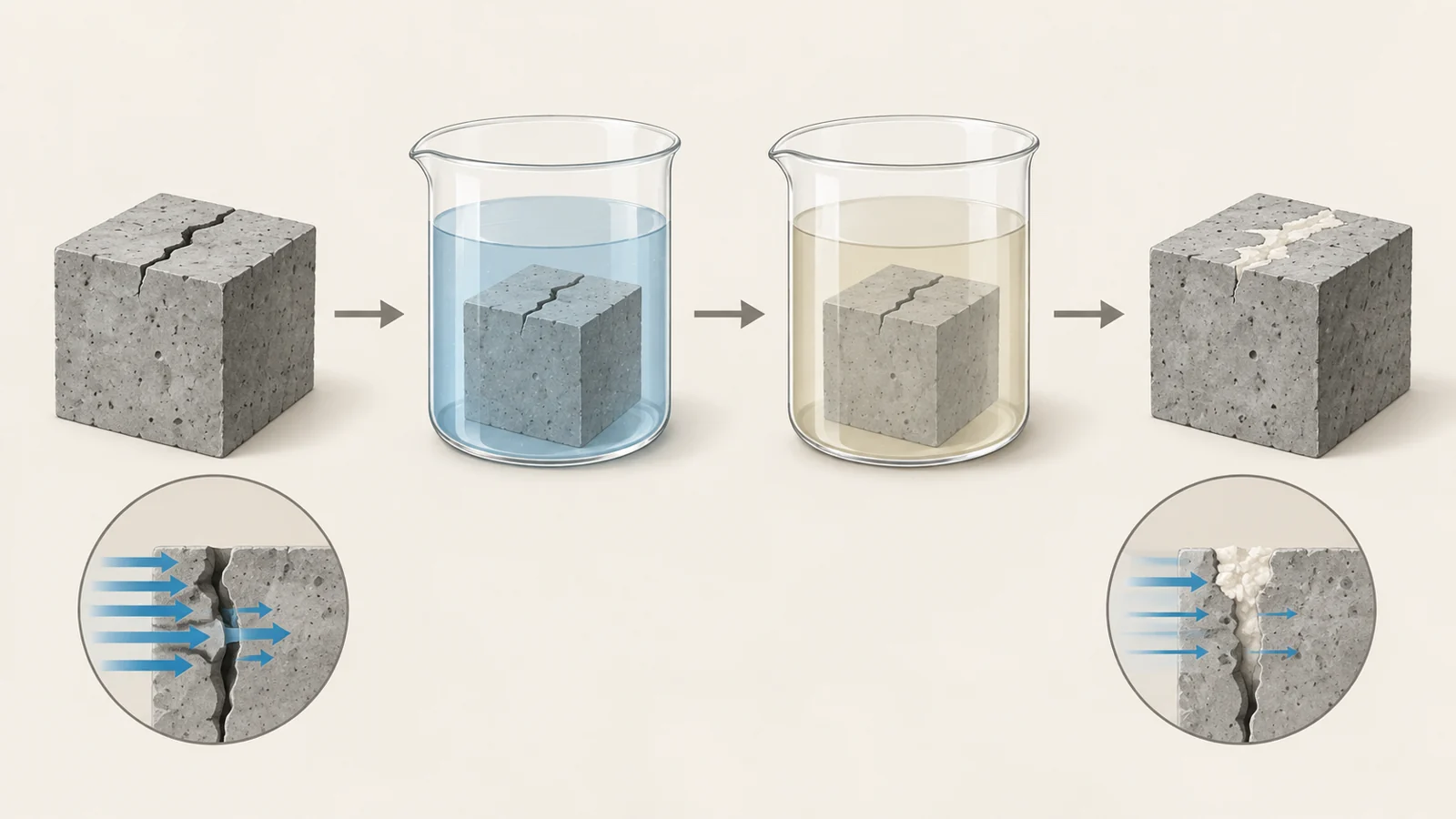
Bacterial crack repair can begin after a material has already cracked. In a research article published September 23, 2022, researchers treated deliberately damaged mortar cubes with repeated baths of bacterial solution and calcium lactate. Mineral deposits eventually sealed the visible crack openings, and tests showed that water passed through the treated specimens less readily.
The experiment investigated a repair treatment delivered from outside the material. The bacteria had not been incorporated when the mortar was made, and the specimens depended on repeated handling and immersion. Its practical question was therefore about existing damage: what could this treatment restore once cracks were already present?
Across 22 specimens, the researchers examined the crack surfaces, measured water permeability, tracked ultrasonic pulses through the mortar, tested compressive strength, and analyzed the deposited mineral. Those measurements give the study more substance than a photograph of a disappearing crack. They also reveal why sealing, resistance to water passage, and mechanical recovery need separate interpretation.
How calcium lactate helps mineral deposits form
The treatment used Bacillus pumilus, a bacterial strain with negative urease activity. The proposed route therefore involved metabolism of an organic substrate rather than relying on the bacterial breakdown of urea. Calcium lactate supplied both that organic substrate and calcium needed to form calcium carbonate.
In the authors’ explanation, bacterial metabolism of lactate supports carbonate formation. In a calcium-rich environment, carbonate can precipitate as calcium carbonate, including the crystalline form called calcite. The authors also describe a contribution from carbon dioxide reacting with calcium hydroxide already present in the cementitious material. Together, these processes offer an explanation for mineral accumulation around the cracks.
The researchers separately examined what had actually accumulated. Material carefully recovered from treated crack surfaces underwent Raman spectroscopy, X-ray diffraction, scanning electron microscopy with elemental analysis, and thermal analysis. These methods examine different properties, including molecular vibrations, crystal structure, composition, and behavior during heating. Their findings supported the presence of calcite in the deposits.
That mineral identification is firmer evidence than the experiment provides for the exact contribution of each chemical or biological step. Detecting calcite establishes what the repair product contained; assigning how much formed through bacterial metabolism requires comparisons that this design did not fully supply.
A repair cycle took more than a day
The specimens were small mortar cubes, each 50 millimeters on a side, made from Portland cement, siliceous sand, and water. Mortar contains the cement-and-sand portion of familiar construction materials, but these cubes did not reproduce a full concrete structure with coarse aggregate and reinforcement. The researchers induced cracks before applying any repair treatment.
Twelve specimens received bacterial solution plus calcium lactate. Their average crack widths ranged from 0.29 to 1.08 millimeters. Five other specimens received bacterial solution without the added calcium-lactate bath, and five received distilled water.
For the combined treatment, each cube spent four hours immersed in bacterial solution. Researchers then removed it, allowed a short interval on the table, and wiped its surface. Next came a 24-hour soak in calcium-lactate solution, followed by another brief drying interval. That sequence was repeated, with assessments after seven and 14 cycles. The calcium-lactate solution contained 80 grams per liter of distilled water.
The bacterial-only treatment followed a different schedule. Its specimens spent four hours in bacterial solution and then dried for 24 hours before the sequence began again. They were assessed through seven cycles. Thus, the comparison changed both the supplied chemistry and the time spent immersed rather than drying. The calcium-lactate group also received more cycles by its final assessment.
These details make the intervention tangible. It required separate solutions, long contact times, and repeated transfers of specimens between containers. The study tested a sustained laboratory treatment, with no demonstration of how the same exposure would be delivered to a crack in a standing structure.
Surface sealing and water resistance developed together
Digital image processing tracked the visible crack area before and during repair. After seven cycles of the combined treatment, most specimens had more than half of that area healed. After 14 cycles, all cracks in that group were sealed by a calcite coating at the top surface. The bacterial-only and distilled-water groups did not show comparable visible healing under their reported treatment schedules.
Surface imaging answers where an opening remains visible. It cannot establish uniform mineral filling throughout the crack depth. To assess a functional consequence of treatment, the researchers also measured how readily water traveled through the specimens.
For those tests, they sealed the sides of each cube, leaving its top and bottom exposed. A constant water head drove flow through the specimen, and the researchers collected the water that emerged over measured intervals. Lower permeability meant greater resistance to water passage under those test conditions.
Permeability fell with the bacterial-plus-calcium-lactate treatment. The authors reported the strongest gains during the first seven cycles, with smaller additional gains as treatment continued. Bacterial solution alone and distilled water produced much smaller changes. This gives the visible mineral accumulation a measured function: it obstructed water entry sufficiently to reduce flow through the samples.
The timing is useful. The largest permeability improvements occurred before every treated crack had reached complete visible surface sealing. A crack’s photographed area and its contribution to water flow therefore did not improve in a simple one-to-one progression. For a repair intended to restrict water ingress, the flow test adds information that appearance alone cannot supply.
The paper’s aggregate permeability ranges and numerical descriptions do not support assigning one reduction factor to every specimen. The defensible result is the observed improvement with the combined treatment, together with diminishing gains over successive cycles. Water passage was reduced, not shown to be eliminated.
What happened to the mortar’s mechanical performance
Ultrasonic testing provided another way to examine the treated material. A crack interrupts the path of a sound pulse, affecting how quickly it travels through a specimen. Changes in pulse velocity can therefore reveal changes in continuity, although they are not a direct measurement of load-bearing capacity.
Before treatment, ultrasonic velocities in the calcium-lactate group ranged from approximately 2,117 to 3,079 meters per second. After 14 cycles, the reported range was approximately 2,903 to 3,908 meters per second. The increase was consistent with improved transmission through the repaired specimens. The bacterial-only and water groups showed little substantial change under their schedules.
Compression testing addressed a different question by loading the mortar until failure. The researchers reported the greatest compressive-strength recovery in the group receiving bacteria plus calcium lactate, while both comparison groups performed less well. Repaired specimens nevertheless remained below the pristine mortar reference in the paper’s account.
There is a numerical caution here. The printed equation for the paper’s strength-recovery index is ambiguous, so its reported recovery percentages should not be read straightforwardly as the percentage of original strength restored. The qualitative comparison between treatments is more defensible than converting those values into a familiar engineering claim about regained capacity.
Taken together, the tests support improved water resistance, sound transmission, and compression performance under laboratory conditions. They do not establish a return to the original mechanical behavior. A surface coating can restrict a water pathway while the damaged material beneath it still differs from intact mortar; demonstrating complete structural restoration would require evidence beyond these observations.
What the comparisons leave unresolved
The experiment’s most important causal limitation is the absence of a calcium-lactate-only group. The combined treatment supplied bacteria, an organic substrate, additional calcium, and a different immersion schedule. Its stronger performance does not separate the contribution of bacterial activity from the contributions of the added solution and exposure conditions.
The bacterial-only group helps answer whether bacterial solution under its own schedule produced a similar result. It does not answer what calcium lactate could have produced without added bacteria. Likewise, the water group provides a comparison for repair associated with water exposure, including further cement hydration, but cannot resolve all the differences between the treatment protocols.
Group size and damage characteristics also constrain interpretation. There were only 12 specimens in the combined-treatment group and five in each comparison group, and average crack widths in the combined-treatment group ranged from 0.29 to 1.08 millimeters. Because crack geometry affects water movement, differences in starting damage could influence treatment comparisons. The upper average width of 1.08 millimeters describes the treated group; it is not a validated maximum width that this method can reliably repair.
Delivery presents a separate challenge. A five-centimeter cube can be immersed, removed, wiped, and soaked again. A building surface or other large cementitious component cannot usually be handled that way. The study did not establish a practical method for maintaining the required contact between solutions and cracks on a structure, nor did it compare the process with commercial repair products.
Durability under service conditions remained unresolved at this September 2022 stage. The experiment did not establish how long the deposits would remain effective through weather exposure, movement, or renewed damage. It also did not test an incorporated bacterial system that survives in concrete and activates later. These are different development questions from whether repeated external treatment can improve already-cracked laboratory mortar.
What this could change
If the sealing effect proves durable and the treatment can be delivered through a workable application method, externally supplied bacterial mineral repair could give maintenance crews another way to reduce water ingress through cracks in existing cementitious structures. Materials manufactured without any biological healing system could potentially receive that treatment after damage appears.
The possible downstream benefit follows from the water pathway. Cracks provide routes for water and dissolved substances to enter a material; a lasting reduction in that access could help slow water-related deterioration. Turning the laboratory result into that benefit would depend on sustaining the seal under actual service exposure. The opportunity suggested here is a maintenance treatment for material already in use, with mineral deposition performing a measurable barrier function.
Key Sources
- Primary source: Bacterial Carbonate Precipitation Using Active Metabolic Pathway to Repair Mortar Cracks.
DOI or Journal Page · Peer-Reviewed Paper · 2022-09-23