
Since the previous research note · Earlier expectation not tested
Track continuity
Since the previous research note: A mineral can seal concrete cracks while carbonation puts steel at risk
Previous expectation: Bacterial healing could support reinforced-concrete durability if crack sealing also preserves the conditions that protect embedded steel.
What this study adds: This study supplies a screened bacterial candidate, laboratory crack-filling observations and analysis of mineral formation. It does not test the connection between sealing, sustained alkalinity around reinforcement and steel condition.
What changed in this study
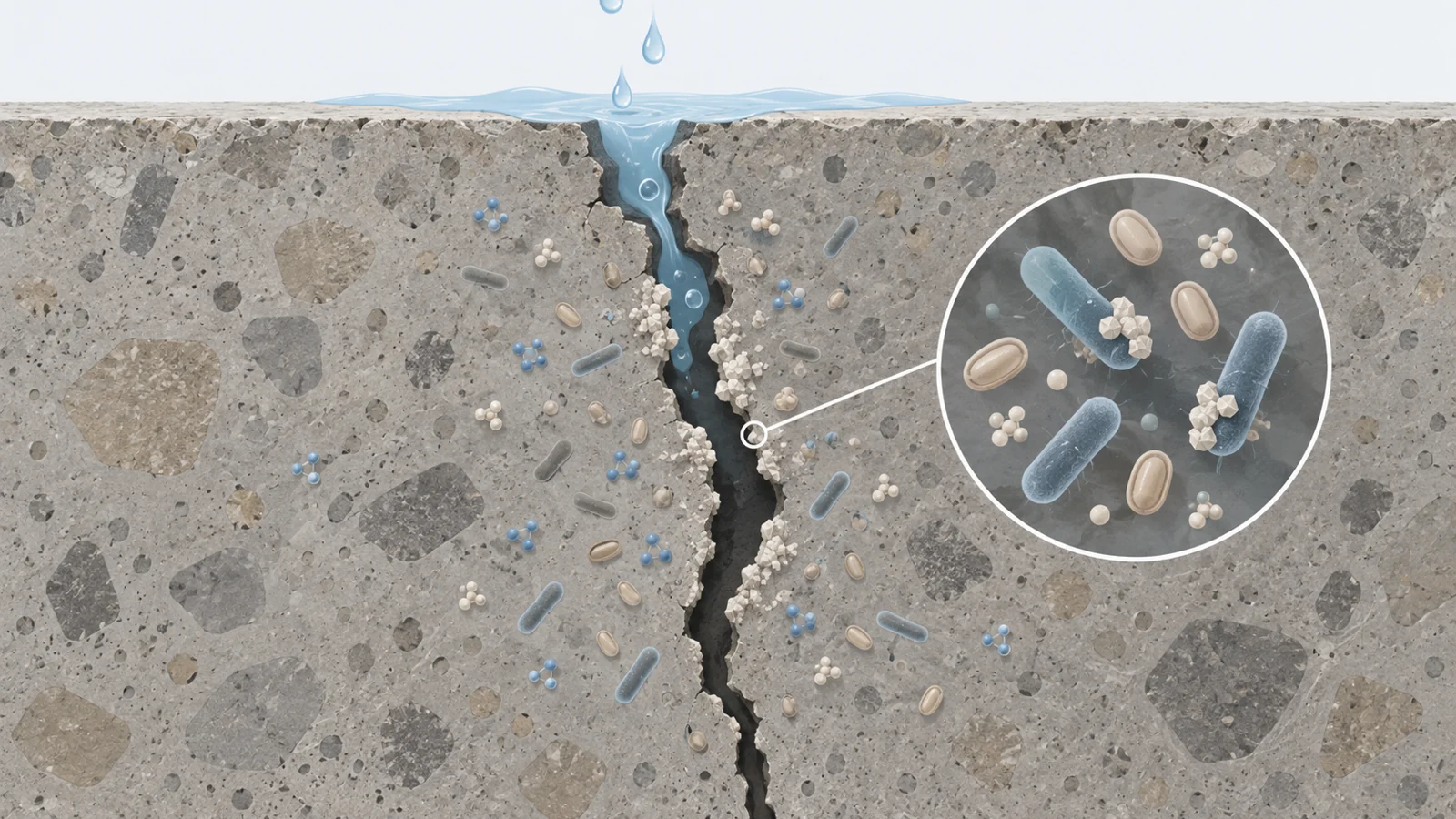
In deliberately cracked laboratory mortar, researchers reported filling cracks up to approximately 0.6 millimeters wide when bacterial spores and suitable ingredients were incorporated and the specimens received water curing. They followed the cracks for 28 days. The result demonstrated filling under those conditions; it did not establish that the material had recovered its original engineering performance.
The research article, published August 29, 2022, investigated a soil isolate identified as Lysinibacillus boronitolerans. Its contribution was to connect the search for a useful bacterium with experiments on the solid mineral it could help produce. The researchers screened strains, tested the selected organism’s tolerance of demanding chemistry, compared curing conditions, and monitored particles as they formed.
That sequence matters because bacteria cannot fill a crack simply by being present. They must become active, produce an enzyme, and encounter the ingredients needed to make a solid deposit. The study examined several parts of that chain.
Finding a bacterium that can do the job
The search began with more than 100 colonies isolated from more than 10 soil samples collected across several regions of China. Seven representative strains were tested for urease activity. Urease is an enzyme that breaks down urea, helping create the chemical conditions for calcium carbonate to precipitate when calcium is available.
Three strains stood out. The researchers compared both their urease activity and their ability to convert dissolved calcium into insoluble deposits. Strain #6 led on both measures. Relative to strain #5, it had about 2.4 times the urease activity and 2.9 times the insoluble calcium conversion in those comparisons. The selection therefore rested on a measured connection between enzyme activity and mineral production.
Partial sequencing of the 16S rRNA gene placed the isolate in the genus Lysinibacillus. Tests of its use of different carbon sources and responses to chemicals helped the authors identify it as L. boronitolerans. They also observed that it formed spores, the dormant bacterial form incorporated into the proposed repair system.
A separate question was whether the organism could grow in chemically challenging surroundings. Cement-based materials are strongly alkaline, so a bacterium chosen only for rapid mineral production in a comfortable culture medium might be poorly suited to the intended setting.
In separate culture tests, the selected strain grew at pH 13 and at a salt concentration of 6% after 24 hours. The reported optical-density readings were approximately 2.0 and 1.0, respectively. These readings measure the cloudiness of a culture as an indicator of growth; they are not measures of crack filling. The tests supported the strain’s candidacy by showing tolerance under specified laboratory conditions. Sustained mineral production inside hardened material remained a different question.
Water and ingredients determined the outcome
For the repair experiments, the team prepared mortar specimens from cement, standard sand, and water, with additions varied between groups. Mortar provided a controlled cement-and-sand material in which to observe cracks. After initial curing and removal from the molds, the researchers created surface cracks by applying pressure and tracked their appearance with a microscope.
The comparisons included specimens with added bacteria, specimens with added chemical ingredients, and specimens with both. The ingredient mixtures included urea and calcium chloride, supplying the enzyme’s substrate and a source of calcium. Different curing conditions tested whether access to water changed the outcome.
The dry-cured specimens showed no crack repair during the observation period. Water was therefore a necessary part of the successful system in these experiments. Adding the biological agent did not overcome its absence.
The other comparisons were more informative than a simple bacteria-versus-no-bacteria result. Some cracks repaired when bacteria were added without the extra mineral salts. The authors attributed this to ingredients already available in the mortar and tap water. Some repair also occurred without the selected bacteria being added, including when supplied ingredients were available to microorganisms from the surrounding environment.
The combination of added bacteria, added ingredients, and tap-water curing produced the best reported repair effect. Together, the controls supported a contribution from the introduced strain while showing that it was operating in a chemically and biologically active setting. They did not assign every deposit exclusively to that strain.
This makes the practical unit of the experiment a recipe plus a curing condition. The organism’s properties mattered, but so did access to water and the materials its chemistry required.
How the reaction becomes a solid deposit
The mineral-forming process begins with urease-driven urea breakdown. That reaction supports the production of carbonate, which can combine with available calcium to form solid calcium carbonate. Bacteria can also provide surfaces where the first mineral deposits begin to assemble. These starting points are called nucleation sites.
Nucleation and subsequent growth do different jobs. Creating many small starting particles does not immediately produce a large accumulation. Material must continue to join the particles, and particles can aggregate into larger structures. The surrounding chemistry influences how much mineral forms and what shapes it takes.
The team used electron microscopy and elemental analysis to investigate the deposits. Images revealed features including rod-shaped cavities similar in size to the bacterial cells. The authors interpreted the microscopic structure and distribution of elements as clues to how bacteria and growing mineral interacted. Such observations help explain the final deposit, but a finished sample alone cannot reveal the full sequence that produced it.
To follow changes over time, the researchers used a Particle Track G400 instrument in a stirred reaction mixture containing bacterial cells and supplied substrates. This added measurements of particle counts and size-related changes during formation, rather than relying only on images collected afterward.
With sufficient substrate, the authors reported a rapid initial increase in particle number, followed by processes involving growth, settling, or breakage. The changing counts need to be understood alongside those processes. A particle population can change because new particles appear, because existing ones become larger, or because larger structures separate.
The authors identified spore germination and urease production as rate-limiting steps for calcium carbonate accumulation in concrete. A dormant spore must resume activity before it can supply newly produced enzyme. Fast precipitation once the reaction is underway therefore does not mean that a dormant biological addition will begin filling a crack immediately. The waiting time for biological activation is part of the material’s response.
What a filled crack actually establishes
The repair work covered hundreds of cracks across dozens of specimens over 28 days. That gave the researchers many opportunities to observe filling under different conditions. It does not turn every crack into an independent experimental replicate. Cracks in the same specimen share its mixture, preparation, and curing environment.
Microscopic observations establish that deposits occupied visible crack space under the tested conditions. They do not by themselves show how firmly the deposits bonded to the crack walls, how completely they filled the crack at depth, or how they would respond to renewed loading. The reported width of approximately 0.6 millimeters describes the experimental result, not a universal upper limit or a guarantee for every crack of that size.
Restored strength and reduced permeability would require their own measurements. A surface that looks closed could still contain connected pathways through which water moves. Likewise, an accumulation that spans a gap in an image does not establish recovery of the material’s ability to carry load.
The specimen design and observation period also leave repeated healing, years of spore survival, and performance under changing field exposures unresolved. Protection of embedded reinforcing steel was not established by these mortar experiments. The study’s strongest contribution is the combined evidence for selecting this strain, obtaining filling under controlled curing, and investigating the mineral formation behind it.
What this could change
If the biological agent remains functional in service and its calcium carbonate deposits form durable seals, concrete could gain a built-in response to small cracks. Water entering a crack could reach incorporated spores and available ingredients, allowing mineral accumulation to begin locally. Suitable moisture and a usable supply of reactants would remain necessary parts of that capability.
For infrastructure owners and maintenance crews, such a response could reduce some manual sealing work by allowing small cracks to develop mineral filling before a separate repair visit. Realizing that benefit would require the deposits to provide useful, lasting sealing under service conditions. This study supplies a bacterial candidate and a closer account of how the filling forms, giving that possible maintenance function a specific biological and material basis to develop.
Key Sources
- Primary source: Strain Screening and Particle Formation: a Lysinibacillus boronitolerans for Self-Healing Concrete.
DOI or Journal Page · Peer-Reviewed Paper · 2022-08-29