
Since the previous research note · Earlier expectation not tested
Track continuity
Since the previous research note: What does concrete need for bacteria to deliver useful crack repair?
Previous expectation: Concrete that sustains crack repair under service conditions could reduce external maintenance interventions.
What this study adds: The July 11, 2022 review explains how deposition can restrict the transport needed for further microbial activity and why surface closure can leave repair depth unresolved. It sharpens the conditions behind the earlier expectation without testing the maintenance benefit.
What changed in this study
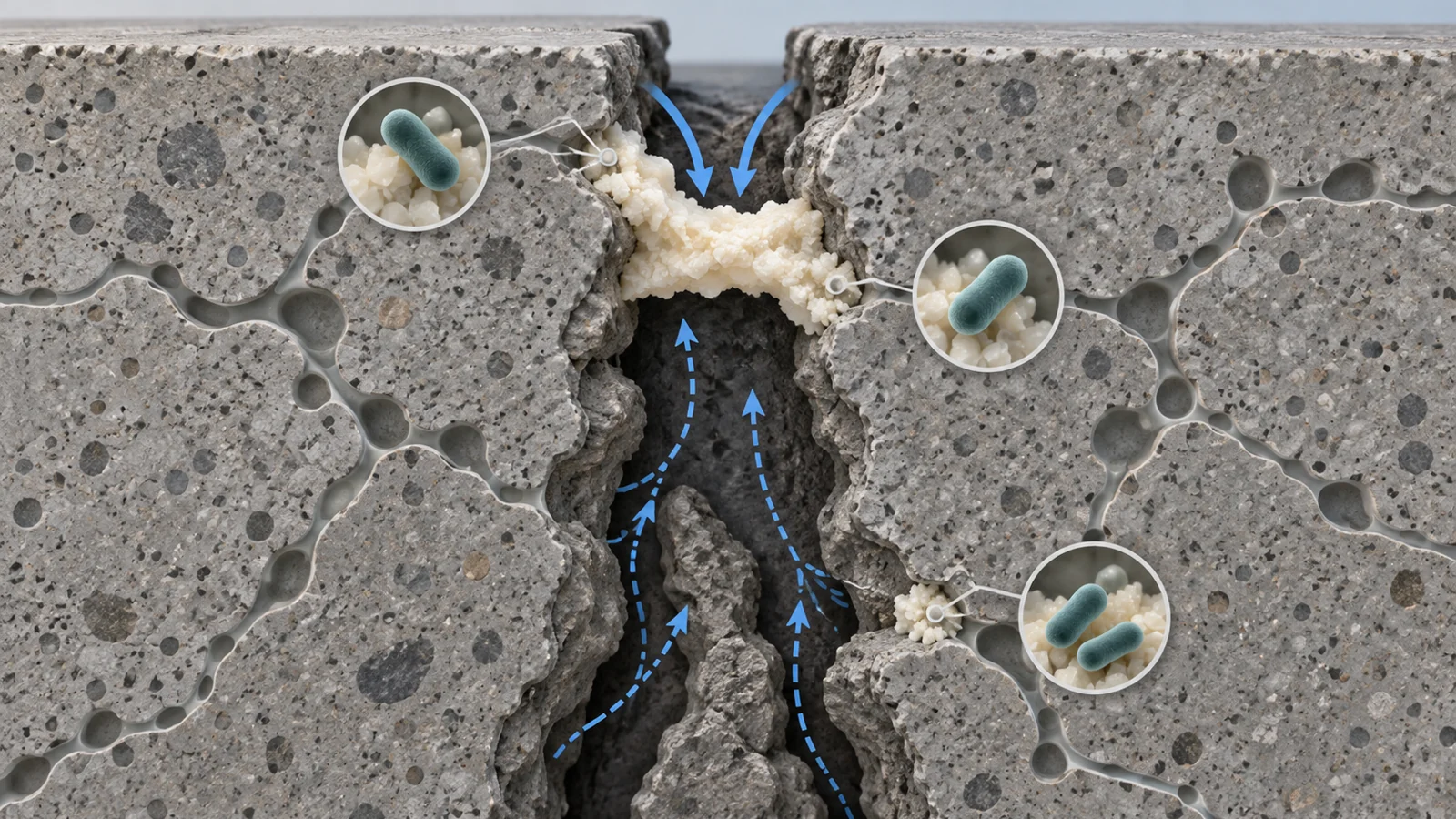
Imagine a mineral bridge joining the two edges of a concrete crack. From the surface, the opening appears closed. Farther inside, space remains unfilled. For some bacterial concrete systems, that bridge can restrict the oxygen supply supporting mineral production deeper in the crack. The process changes its own working environment as it proceeds.
A review published on July 11, 2022, examines this relationship between bacterial life and the evolving conditions inside cement-based materials. Its contribution is an explanation of how healing develops, drawing together experiments and biological mechanisms. It does not introduce a formulation that solves all of these problems.
The distinction matters whenever a photograph of a closed crack is presented as evidence of repair. Closure shows that material has bridged the observed opening. Establishing how much of the crack has filled, whether water passage has fallen, or whether structural capacity has recovered requires evidence beyond that view.
How bacteria help build a mineral deposit
The repair material discussed in the review is calcium carbonate. Bacterial metabolism can supply carbonate ions, which combine with available calcium ions and precipitate as solid mineral when local chemistry permits. Researchers call this process microbiologically induced carbonate precipitation, often shortened to MICP. The bacteria help create the chemical conditions for deposition; the resulting solid is mineral, rather than a mass of growing organisms.
Cells can also contribute a physical starting point for crystals. Chemical groups on their surfaces attract positively charged calcium ions, concentrating them locally and helping crystals begin to form. This process, called nucleation, connects the properties of an individual cell to the development of a much larger deposit. Counting bacteria alone therefore cannot describe everything relevant to mineral production. Their metabolic activity and surface characteristics perform different jobs.
Concrete contains abundant calcium, but much of it is bound into solid material and is not immediately available for precipitation. What matters at a particular repair site is the accessible supply, alongside carbonate production and the surrounding chemical conditions. The review notes that researchers commonly add calcium sources to their healing systems despite concrete’s overall calcium content. A calcium-rich material does not automatically provide the right supply at every cell or crack surface.
Activation has to meet the opening crack
For bacteria incorporated into concrete before damage occurs, mineral production must fit a delayed sequence. Some bacteria can persist as dormant spores through unfavorable conditions. Spores provide a way to wait, but they do not supply the metabolic activity needed for healing. They must return to active cells before contributing carbonate through metabolism.
A crack can create the opportunity for that transition by admitting water and dissolved substances. Whether useful activity follows depends on where the bacteria are, what reaches them, and when they become accessible. A supply of dormant cells elsewhere in the concrete does little for a crack that never encounters them. Likewise, early activity during curing is different from retaining a biological resource until later damage appears.
Encapsulation attempts to coordinate that timing. Bacteria are protected within a carrier or capsule that becomes accessible when cracking occurs. The protective system has several competing demands. It must withstand mixing, remain compatible with the concrete’s mechanical properties, and still release or expose its contents when a crack reaches it. Protection that prevents release can defeat its purpose; a carrier that opens prematurely can miss the period when repair is needed.
The review describes carriers including lightweight aggregates, silica gel, and hydrogels. Their materials, sizes, quantities, and distribution vary across experiments. These choices affect where a healing agent is available and how it is delivered. The useful design question extends beyond keeping cells alive to arranging for active mineral production at the location and time of damage.
The routes through concrete change during healing
A crack is connected to a surrounding network of pores. That network helps determine how water and dissolved substances reach the repair site. Porosity describes the amount of void space; permeability concerns how readily fluid can pass through the material under a pressure difference. A concrete sample can contain substantial pore volume yet transmit little water if many pores are isolated or poorly connected.
This distinction makes the internal arrangement of the material consequential. Water somewhere in a sample is not necessarily accessible water at an active cell. Calcium and nutrients also need routes to the places where mineral formation is occurring. As deposits accumulate, the dimensions and connections of those routes change. The initial concrete and the partly healed concrete present different environments to the bacteria.
At a crack opening, the review describes deposits bridging the edges while leaving the interior incompletely filled. In systems where continued activity depends on oxygen reaching that interior, the bridge can restrict oxygen entry and curtail further microbial work below it. Reduced water access and more difficult ion transport may also constrain activity as openings narrow. Oxygen restriction is one mechanism, with relevance that depends on the bacterial system and its metabolism; it does not explain every instance of incomplete filling.
The geometry of a crack adds another complication. Width is convenient to measure, but a crack also has depth, rough surfaces, and a winding path. Two openings of the same width can present different spaces to fill and different routes for transport. The authors emphasize that the reviewed studies measured healed cracks in terms of width, even though those other dimensions could affect performance. A maximum reported healing width therefore cannot serve as a complete description of repair.
The review discusses possible ways to encourage deeper deposition, including reducing the initial pace of healing or combining microbial and inorganic methods. These are proposed responses to the transport problem. They raise a practical design question about where mineral forms over time, rather than establishing that one approach reliably fills the entire crack.
What the experiments can establish
The experimental literature contains evidence of useful changes in material behavior. In the studies summarized in the review’s permeability table, reported reductions ranged from 12% to 94%. Those results indicate that treatment can reduce water passage under the tested conditions. The wide range also makes it inappropriate to assign bacterial concrete a single expected improvement, especially across different formulations and test methods.
Attribution is a separate issue. The authors report that bacterial contributions were generally inferred by comparing treated samples with controls, while direct monitoring of bacterial activity or viability was largely missing. Such comparisons can show a difference associated with a treatment. They provide much less detail about how active the cells were, how their contribution changed during healing, or how much of the observed effect came from concrete’s own repair processes.
That last distinction becomes especially important in young concrete. The review describes reports of stronger healing during the first 28 days and slower filling afterward, but notes that this pattern may involve the material’s inherent, or autogenous, healing capacity. A decline in crack filling does not by itself reveal whether bacterial activity declined, whether inherent healing diminished, or how the two contributions interacted. Observing the material and observing the organisms answer related but different questions.
Evidence over longer periods also needs attention to location. The review describes one experiment in which new cracks healed in the same samples after 22 months, at different positions from the earlier cracks. That result supports the possibility of retaining healing potential elsewhere in a specimen. It does not establish repeated repair at an already used site or reliable repair throughout a structure’s service life.
Different experimental setups and the absence of universal evaluation methods further limit comparisons. A result obtained with a particular moisture supply, crack geometry, and bacterial preparation cannot simply be carried over to a structure exposed to variable service conditions. The review’s unresolved challenge is to connect biological activity, the resulting mineral distribution, and material performance closely enough to explain when laboratory benefits will persist outside the laboratory.
What this could change
If bacterial activation and mineral deposition can be coordinated through relevant crack depths under service conditions, while preserving concrete performance, components could gain a more durable barrier to damaging ingress. The practical benefit would come from limiting the routes through which water and harmful dissolved substances enter, helping a repaired component resist further deterioration.
For infrastructure owners, that capability could reduce recurring sealing interventions, particularly where reaching damaged concrete is difficult. Achieving it would require a system that delivers useful repair when damage occurs and maintains the needed barrier afterward. From the July 2022 perspective, the review clarifies the biological and material conditions behind that possibility. Reduced maintenance remains a conditional downstream benefit, rather than an outcome measured by this review.
Key Sources
- Primary source: Relationship between Bacterial Contribution and Self-Healing Effect of Cement-Based Materials.
DOI or Journal Page · Review or Meta-Analysis · 2022-07-11