
Since the previous research note · Earlier expectation not tested
Track continuity
Since the previous research note: How packaging bacteria changes crack sealing in mortar
Previous expectation: Embedded bacterial carriers could help restrict water entry through small cracks and reduce later intervention if their sealing behavior persists under practical exposure and material requirements are met.
What this study adds: The current study examines a different delivery approach, using air entrainment with directly incorporated bacteria, and reports short-term bacterial gene-copy, mineral and strength responses. It does not test carrier swelling, crack sealing or water ingress, so it leaves the earlier forecast untested.
What changed in this study
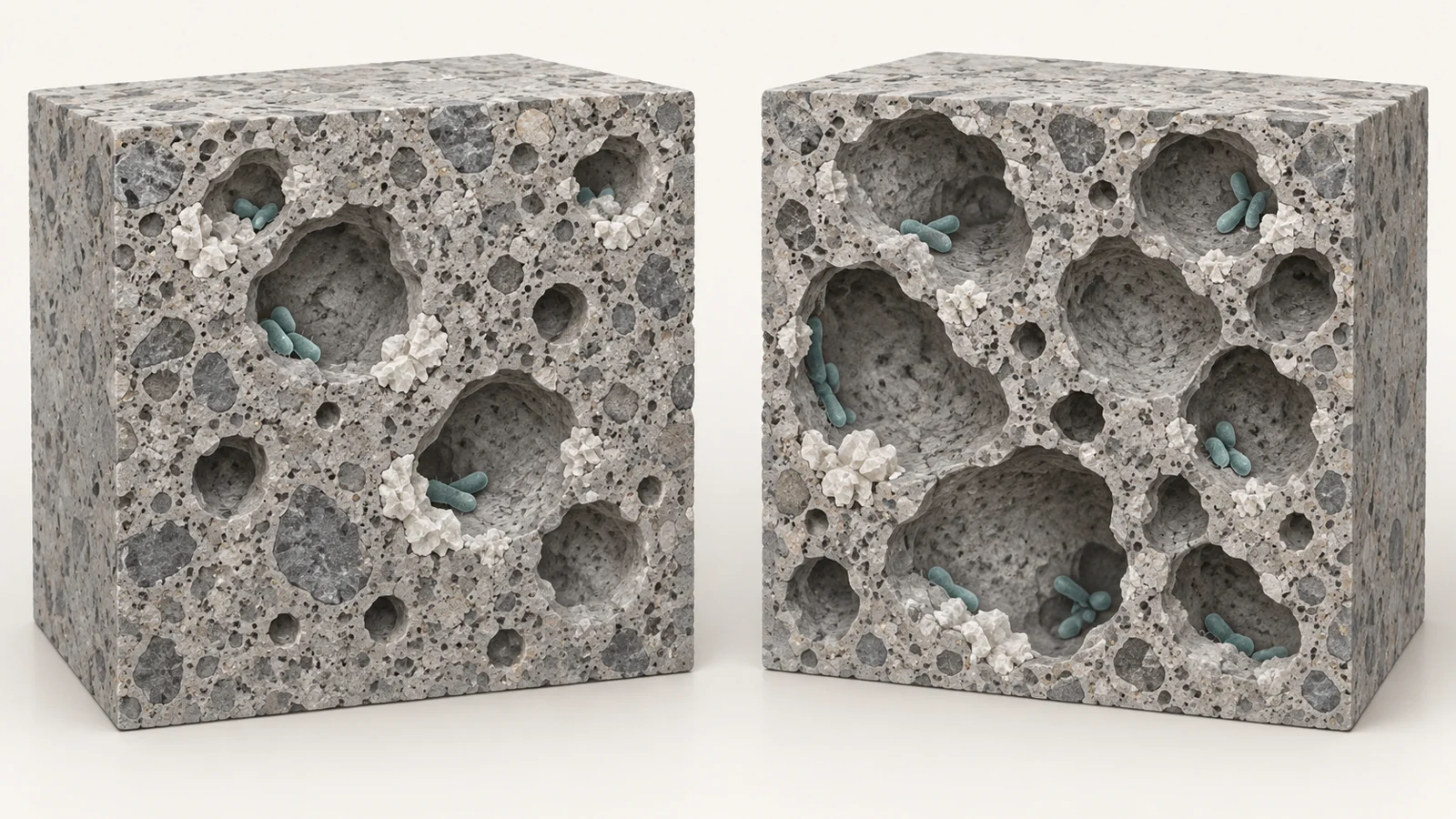
Bacteria intended to help concrete repair itself face an immediate problem. They must endure the hardening of the material before they can contribute to any later repair. Providing small air-filled spaces could help accommodate them, but those spaces also change the material that must carry a load.
A laboratory study published on March 15, 2022, investigates this problem in cement paste and mortar. Researchers mixed bacteria directly into the formulations and varied an air-entraining admixture. Larger additions produced higher estimates of bacterial gene copies in hardened paste. Yet calcium carbonate production and mortar strength reached their highest tested values at a lower addition. Understanding that divergence requires looking separately at the bacteria, their mineral products and the cement’s own hardening reactions.
Mixing bacteria into the material
The researchers used Sporosarcina pasteurii, a bacterium capable of breaking down urea. This process can support the formation of calcium carbonate when calcium is available. The prospect of depositing that solid mineral inside a cementitious material is what makes the organism interesting for research into bacterial self-healing concrete.
Here, the bacterial culture medium replaced ordinary mixing water. The formulations included Portland cement, urea and calcium lactate; sand was included in the mortar specimens. This route puts the biological ingredients directly into the mix without first manufacturing separate protective capsules around them.
The team tested an anionic surfactant air-entraining agent at four dosages: 0, 0.3, 0.6 and 0.9% by cement weight. These numbers describe the mass of admixture added relative to cement. They do not mean that air occupied those percentages of the finished specimens.
Air-entraining agents help disperse bubbles through cementitious mixtures. The authors proposed that the resulting pores could provide spaces where bacteria are less exposed to encroaching hydration products as the cement hardens. The agent also interacts with cement particles and the surrounding liquid, however, so adding it changes more than the accommodation available to bacteria.
What the bacterial measurements actually counted
The researchers first examined compatibility in liquid culture. They measured pH and zeta potential, an electrical property that helps describe interactions between suspended particles. Cultures containing the agent remained alkaline, with pH values around 9.8–9.9, compared with about 9.6 without it. The authors interpreted the culture-medium observations as showing no substantial disruption of bacterial urea breakdown at the tested additions.
Those observations concern bacteria in a liquid medium. To examine what remained after cement hardened, the team sampled water-cured paste at 7 and 14 days. They powdered 20-gram samples, used ultrasound and water to help separate cells from the material, collected pellets by centrifugation and extracted DNA.
They then used quantitative polymerase chain reaction, or qPCR, to measure three bacterial gene targets associated with urease, the enzyme involved in breaking down urea. The targets were ureA, ureB and ureC. Calibration against standards allowed the researchers to estimate gene-copy abundance, with the DNA assays performed in triplicate.
At both sampling ages, the gene-copy estimates increased as the amount of air-entraining agent increased. The authors interpreted this as improved bacterial viability. At 14 days, however, the estimates were lower than at 7 days, indicating that the bacterial DNA detected in the paste declined over that interval despite the benefit associated with admixture addition.
The distinction between detecting DNA and demonstrating living activity matters. This method quantified extracted bacterial DNA; it did not directly measure cells actively breaking down urea, nor did it independently establish that every detected copy came from a living cell. Targeting urease genes identifies relevant genetic material, but does not show that those genes were being expressed when the paste was sampled. The results therefore support an interpretation of improved bacterial retention or survival, with a measurement boundary around the authors’ stronger viability language.
The mineral and strength results followed a different pattern
Calcium carbonate quantity did not keep rising alongside the bacterial gene-copy estimates. The formulation containing 0.3% agent had the most calcium carbonate. Mortar with that dosage also had the highest compressive strength among the tested formulations at 7, 14 and 28 days. Strength fell at the higher additions, and the 0.9% mortar was weaker than the mortar containing no air-entraining agent. More favorable bacterial DNA measurements therefore did not identify the mix with the best mineral output or load-bearing performance.
The authors offered a possible explanation for the mineral response. The surfactant has water-attracting and water-repelling parts and interacts with biological surfaces, nutrients and cement hydration products. They proposed that excessive amounts could hinder contact between bacteria and nutrients, limiting calcium carbonate formation even where more bacterial genetic material remained detectable. This was a proposed mechanism, rather than a direct measurement of nutrient transport to individual cells.
For the strength decline, the authors pointed to excessive entrained air and the resulting porosity. Voids reduce the solid material available to resist compression. That explanation concerns the physical structure of the mortar, while the proposed nutrient-access effect concerns mineral formation. The two processes could help explain why the biological, mineral and mechanical measurements responded differently.
The lowest nonzero dosage was the best performer for mineral quantity and strength in this experiment. Four tested additions in one bacterial system and one admixture product do not establish a universal mixing recommendation for other cements, strains or production conditions.
Cement hardening also contributed
Calcium carbonate is only part of the explanation for a stronger specimen. Cement develops strength through hydration, the reactions between cement and water that create binding products. Because the air-entraining agent also affected those reactions, the strength results cannot be assigned entirely to bacterial mineral deposition.
The study used different measurements to examine different parts of this chemistry. X-ray diffraction identified calcite, a form of calcium carbonate, in the paste. It also showed no significant change in the types of hydration products across the admixture dosages at the examined ages. Identifying the same minerals does not mean that every specimen contained the same quantities of them.
Thermogravimetric analysis addressed quantity by heating samples and using mass losses over characteristic temperature ranges to estimate calcium carbonate and portlandite. Portlandite is a product of cement hydration. Its greater formation in the 0.3% formulation supported the interpretation that the admixture had altered cement hydration as well as the amount of carbonate present.
Heat measurements supplied another piece of that explanation. The reported integrated heat output was 12.27 joules per gram for the 0.3% formulation, compared with 7.91 joules per gram without the agent. The authors interpreted the difference as evidence of accelerated hydration. They proposed that improved cement-particle dispersion could help counter the interference with hydration caused by components of the bacterial culture medium.
Together, these measurements show why compressive strength alone cannot reveal how much the bacteria contributed. Hydration, carbonate precipitation and air-induced changes in pore structure all offer plausible contributions. The experiment did not measure a causal share for each. Its mineral, heat and strength measurements examine related aspects of one laboratory system; they are not independent replications of a self-healing result.
The missing interval between curing and a later crack
The observation periods place a clear limit on the biological result. Bacterial DNA was examined through 14 days, while strength and mineral measurements extended through 28 days. A mortar specimen becoming stronger over four weeks does not establish that embedded bacteria remain functional until a crack develops much later.
The specimen types also matter. The bacterial measurements came from cement paste, whereas the compressive-strength comparisons came from mortar containing sand. Neither provides a direct demonstration of performance in a full concrete structure. Moving toward that use would require the biological ingredients to remain effective under relevant curing, exposure and material conditions, including access to what they need for mineral formation when damage occurs.
No deliberately formed crack was shown closing in this study. The tests did not establish recovered watertightness, reduced water ingress or repeated healing. Calcium carbonate already present in an intact specimen cannot by itself show that new mineral will form in the right place after a later crack opens. That timing and location requirement separates early mineral production from a useful repair function.
What this could change
If direct incorporation can preserve functional bacteria over relevant service periods, and those bacteria can subsequently seal small cracks while the material meets its performance requirements, producers could make biologically active cementitious mixes without separately fabricating bacterial capsules. The culture and compatible admixture would become ingredients in the mixing process, potentially removing a distinct preparation step from this route to self-healing materials.
For infrastructure owners, the downstream possibility would be material that restricts water entry through some small cracks and consequently needs less repair intervention. The causal path depends on lasting bacterial function leading to mineral deposition where cracks form, followed by effective ingress control. This study contributes an early manufacturing insight to that possibility by showing how direct bacterial incorporation responds to an ordinary class of cement admixture.
Key Sources
- Primary source: Effects of Air Entrainment on Bacterial Viability in Cement Paste.
DOI or Journal Page · Peer-Reviewed Paper · 2022-03-15