
Since the previous research note · Earlier expectation not tested
Track continuity
Since the previous research note: How a thin coating changes concrete’s bacterial carriers
Previous expectation: The previous note left open whether protective carrier coatings could keep bacteria usable through curing and long enough to act as a dormant repair reserve when a crack eventually opens.
What this study adds: This study did not test long-term coated carriers. It moved to another part of the repair problem: selecting a stronger bacterial strain and controlling calcite formation in an externally applied treatment.
What changed in this study
Bacteria can help deposit calcium carbonate in concrete defects, but the quantity of mineral and its crystal form are separate engineering objectives. A study published on September 1, 2021, connected both to laboratory repair tests. The researchers selected a bacterium with increased enzyme activity, adjusted its mineral-producing conditions, and applied the resulting process to damaged concrete specimens.
The study’s contribution was this experimental sequence, from biological selection through mineral characterization to measured repair behavior. It examined an externally applied treatment requiring repeated attention over seven days.
Selecting a bacterium with higher enzyme activity
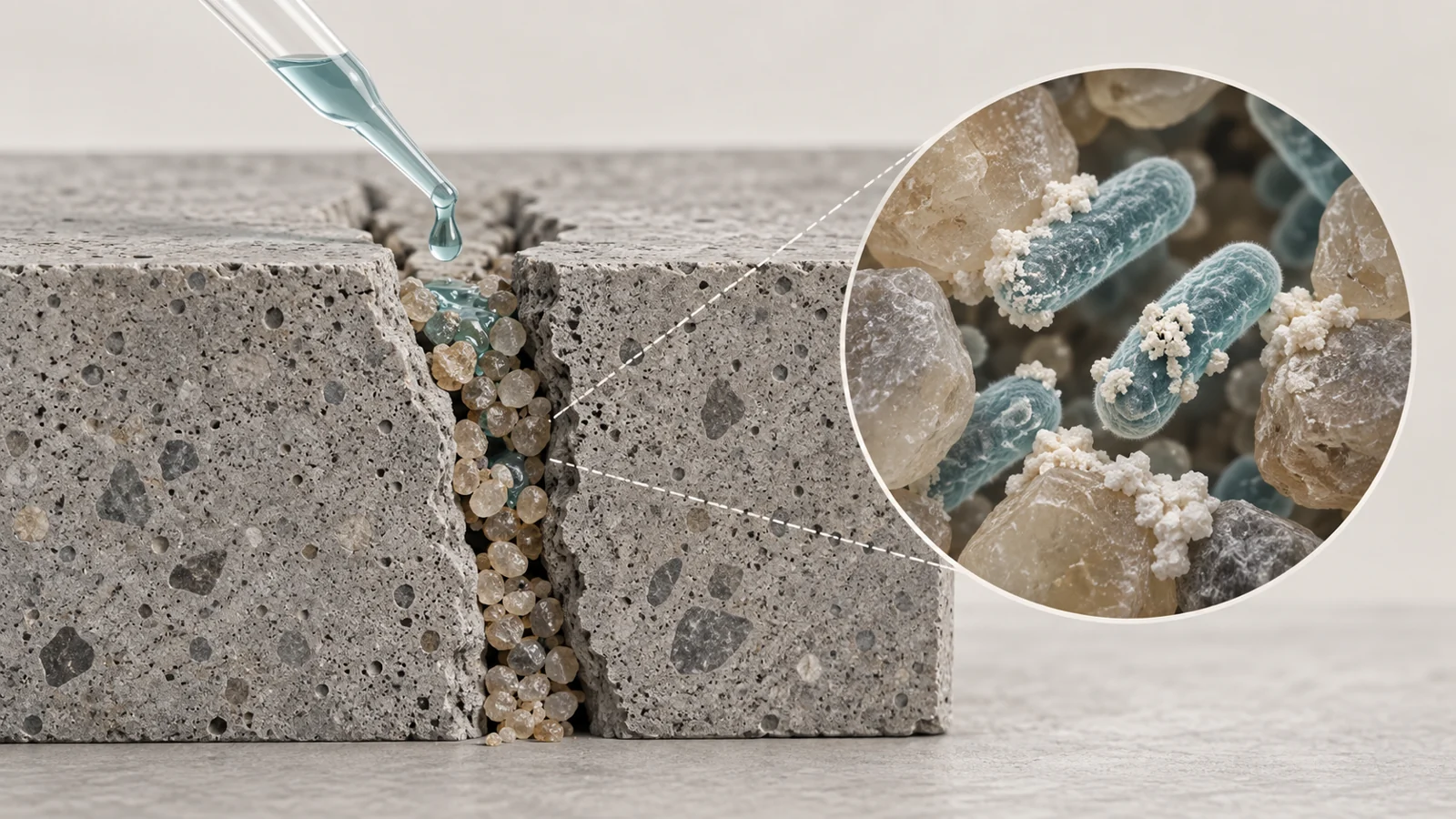
The process starts with urease, an enzyme produced by Sporosarcina pasteurii. Urease breaks down urea, helping create conditions in which carbonate becomes available. With calcium ions present, calcium carbonate can precipitate out of solution. Bacterial surfaces also provide sites where crystals can begin forming, with negatively charged surface molecules attracting calcium ions.
This is microbially induced calcium carbonate precipitation, or MICP. The bacteria help establish the chemistry and starting points for mineral growth. In this study, the researchers sought to improve that activity using S. pasteurii ATCC 11859 as their starting strain.
They exposed bacteria to atmospheric and room temperature plasma, a method used to generate random mutations, then screened the resulting population. This was selection among altered strains rather than the deliberate editing of a known gene. Initial screening favored traits including growth and resistance to alkaline conditions, relevant because concrete presents an alkaline environment.
The researchers took 280 promising mutants into shake-flask screening, narrowed the group to six strains with higher urease activity, and selected B11. Its reported activity was 38.66 ± 0.44 millimoles per liter per minute, 53.53% above the starting strain. That measurement described enzyme activity under the assay conditions; the concrete repair tests came later.
B11 also maintained its urease activity through ten successive rounds of subculture. This supported continued enzyme production during repeated laboratory propagation. The experiment did not identify the responsible mutations or establish how long the trait would persist inside concrete. For the next stage, it gave the researchers a strain with a measured, reproducible biological characteristic to work with.
Finding the conditions that increased mineral yield
A selected strain still needs a suitable reaction environment. Calcium supply, urea concentration and temperature can all influence precipitation, and increasing an ingredient does not necessarily keep increasing output. In the study’s tests, the response to urea eventually leveled off. Calcium concentrations above a certain range likewise failed to produce further gains.
To investigate the processing conditions, the researchers held bacterial concentration fixed and examined six nonbiological variables, including calcium chloride, urea, nutrient additives and temperature. A statistical screening design identified calcium chloride, urea and temperature as the significant factors for mineral yield. Response surface methodology then tested combinations of those three variables to locate favorable conditions within the experimental range.
The response-surface design comprised 15 experiments with three replications. Its purpose was to estimate how the variables behaved together, rather than assume that the best setting for each ingredient in isolation would also produce the best combination.
The model predicted 68.08 grams of calcium carbonate per liter at 0.73 moles per liter of calcium chloride, 45 grams per liter of urea and 40°C. The corresponding experiment produced 67.32 grams per liter. This close agreement supported the model at that tested combination; it did not establish a universal optimum for other strains or treatment environments.
The comparison behind the reported improvement is important. B11 had produced 56.98 grams per liter under the initial conditions. Raising that to 67.32 grams per liter represented an 18.15% increase from processing changes applied to B11. It was a different comparison from the enzyme-activity gain used to select B11 over the original strain. The two percentages describe different measurements and cannot be added together as a single repair improvement.
The mineral’s weight concealed a second result
The yield-optimized precipitate was a mixture of calcite and vaterite, two crystal forms of calcium carbonate. Calcite accounted for just 28.44%. Although the material had the desired chemical composition, most of it had not formed the crystal structure the researchers were seeking.
Calcite was their preferred form because of its stability and compact structure. A balance measuring total precipitate cannot distinguish calcite from vaterite. That made crystal composition a separate question from how much mineral the bacteria could help produce—and a reason to adjust the process again.
Keeping the selected calcium chloride and urea concentrations, the researchers increased the temperature to 45°C and extended the reaction time to 22 hours. Under this second condition, they reported 100% calcite. These were two distinct optimization stages: the first established a favorable yield at 40°C, while the subsequent temperature and time adjustment targeted crystal form.
X-ray diffraction supplied evidence about the ordered crystal structures present. Under the first condition, the diffraction pattern contained features of both calcite and vaterite. Under the second, only calcite was detected. The researchers quantified the crystal proportions using a method calibrated with mixtures of the two forms.
Fourier-transform infrared spectroscopy provided a complementary check by examining characteristic infrared absorption patterns. It also indicated a mixed precipitate under the first condition and calcite alone under the second. Together, the methods supported the reported composition change. “100% calcite” describes that analytical result for the tested precipitate; it does not describe how completely a concrete crack was filled.
Applying the treatment to concrete
The specimen experiments required two delivery methods. For surface defects, the researchers brushed on an agar-containing mixture carrying bacteria and treatment ingredients. For larger cracks, they first added quartz sand, then introduced a bacterial suspension with nutrient salts into the remaining spaces. The sand was therefore part of the crack-repair procedure, while agar helped carry the surface treatment.
The specimens were kept in an incubator at 45°C, and the treatment operations were repeated every 12 hours for seven days. This schedule matters to the meaning of the result. The concrete was receiving repeated external treatment under controlled warm conditions, rather than undergoing a single application left outdoors.
Controls received the corresponding repair procedure without bacteria, with the other conditions held the same. The researchers then evaluated the treated specimens through observations of the repaired surfaces, water absorption and mass loss during ultrasonication.
For water absorption, specimens were dried to a constant weight and weighed again after the repair surface had been saturated with water. The increase in mass, expressed relative to dry mass, indicated how much water the specimen took up under that procedure. Lower uptake was consistent with mineral deposition reducing accessible pores or pathways at the treated defects.
The authors reported more than 70% lower water absorption than in bacteria-free controls after seven days. They also observed dense white calcium carbonate deposits covering small defects and cracks. These findings connected the treatment to a measurable change in how the specimens admitted water.
The adhesion assessment used a different readout. Ultrasonication disturbed the specimens, and the researchers measured how much mass they lost. Bacteria-treated specimens lost less mass than controls, indicating better material retention under that test. This was an indirect assessment of adhesion, not a direct measurement of bond strength or a test of restored load-bearing capacity.
Water uptake and ultrasonic mass loss thus answered different practical questions. One concerned water entering the specimen; the other concerned material coming away during the imposed disturbance. Neither measurement alone described the full mechanical condition of the repaired concrete.
What the comparison can establish
The bacteria-free controls support a contribution from bacterial activity within the combined treatment. They do not separate the repair benefits attributable to selecting B11, increasing mineral yield or shifting the precipitate toward calcite. The concrete experiment did not independently compare each of those steps while holding the others constant. Its result belongs to the treatment package as tested.
Defect geometry also affected performance. For cracks of the same length and width, shallower cracks responded better. The authors suggested that deeper cracks might reduce microbial survival and therefore mineral deposition, but they did not directly establish that mechanism. The observation identifies depth as a relevant variable without defining a universal depth limit for bacterial repair.
The two delivery methods further limit how broadly the outcomes can be combined. Brushing bacteria in agar over a surface and introducing liquid into a sand-filled crack create different treatment situations. A result for one cannot simply be assigned to the other. The reported replication for response-surface experiments also should not be assumed to describe the sample counts in the concrete tests.
The exposure conditions leave a separate practical gap. Seven days of repeated treatment at 45°C do not establish equivalent performance at ambient outdoor temperatures, during weathering or after renewed cracking. The study also did not demonstrate autonomous healing by bacteria incorporated into concrete during manufacture. Its evidence concerns deliberate treatment of existing defects.
Long-term structural durability, comparative cost and lifecycle environmental benefits remained outside the demonstrated results. Describing the approach as biological does not resolve those questions. The supported advance was a controlled connection between strain selection, mineral processing and particular specimen measurements.
What this could change
If strain selection and calcite control can be transferred from repeated 45°C laboratory treatment to practical temperatures and delivery methods, bacterial MICP could become a tunable repair process for existing concrete defects. Instead of treating mineral growth as the end point, a repair could be designed around a function—such as limiting water entry through a particular crack geometry—and around the mineral form and delivery method needed to achieve it.
That could give concrete maintenance a biologically driven way to target different defect types rather than use one fixed treatment recipe. The 2021 study does not establish field durability, ambient-temperature performance, repeated-crack healing or cost. Those are the steps that would have to hold up before the laboratory process could become a practical concrete-repair technology.
Key Sources
- Primary source: Improvement of Biomineralization of <i>Sporosarcina pasteurii</i> as Biocementing Material for Concrete Repair by Atmospheric and Room Temperature Plasma Mutagenesis and Response Surface Methodology.
DOI or Journal Page · Peer-Reviewed Paper · 2021-09-01