
Since the previous research note · Earlier expectation not tested
Track continuity
Since the previous research note: How plastic capsules age inside concrete and change its strength
Previous expectation: The earlier work suggested that capsules could make repair chemistry available when small cracks form if they survive mixing, keep enough payload and open reliably without an unacceptable strength penalty.
What this study adds: This study did not test that capsule-release route. It addressed a different delivery problem: protecting bacteria in coated expanded-clay carriers so more usable cells survive the hostile early life of cement.
What changed in this study
Concrete’s bacterial repair system faces a difficult beginning. Before the bacteria can help fill a crack, they must survive being embedded in fresh concrete. In a laboratory study published on May 21, 2021, researchers found that recoverable bacterial counts dropped tenfold—and sometimes a hundredfold—during the first week of curing, even when the spores were housed in porous expanded clay.
The study, Prolonging Bacterial Viability in Biological Concrete: Coated Expanded Clay Particles, compared eight coating formulations applied around those carriers. Its contribution was practical. It compared which surface treatments offered useful protection and asked whether extra layers or mixed ingredients earned their additional processing. The researchers paired bacterial recovery measurements with optical observations of cracks in water-immersed specimens.
Porous clay provides space and leaves a way in
Expanded clay is a lightweight aggregate with an internal network of pores. The researchers used particles 4–8 millimeters across, loading them under vacuum with spores of Bacillus pseudofirmus, calcium lactate and yeast extract. After drying, each gram of clay held an average of about 22 million recoverable spores. Electron microscopy showed that the spores had entered the particles and attached to their surfaces.
This arrangement places bacteria and nutrients together inside a material that can be mixed into concrete. Under suitable conditions, bacterial activity can promote calcium carbonate precipitation, contributing mineral deposits that narrow cracks. But the same open pores that accommodate the spores also leave routes through which substances in fresh concrete can enter. The paper discusses potentially harmful cement constituents as one possible threat; this experiment did not establish a specific impurity as the cause of bacterial losses.
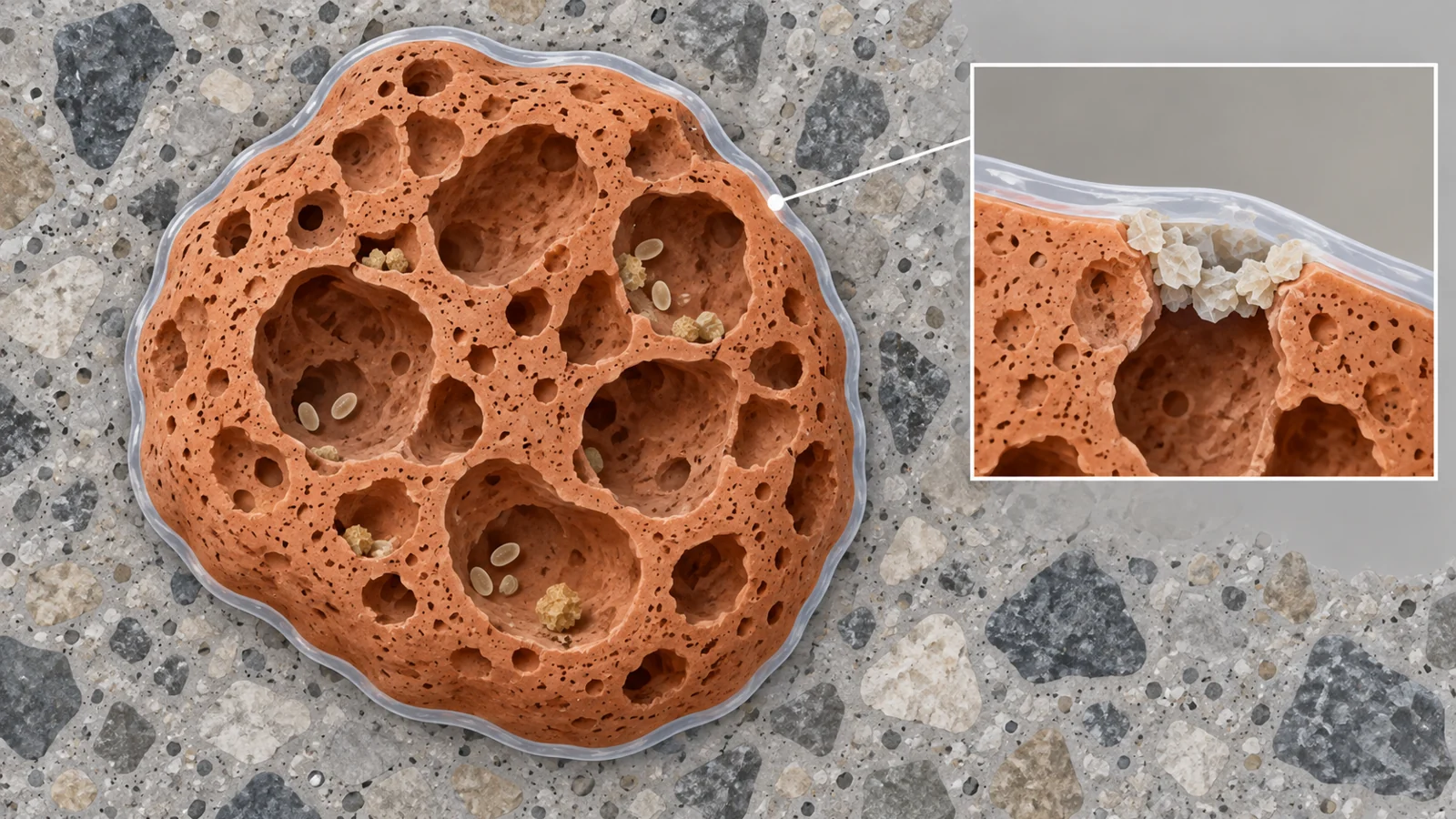
An added coating changes that exposed interface. The styrene–acrylate emulsion produced a visible film, measured at roughly 8–14 micrometers thick, over the clay’s surface pores. The magnesium oxide, or MgO, formulation produced a different surface structure. Microscopy supported pore sealing, while the authors proposed that MgO reacting with water to form poorly soluble magnesium hydroxide helped build the covering.
Those surface observations are consistent with a barrier that limits exposure during curing. They do not directly show which harmful substances were excluded. The useful distinction is between the structures the researchers could see and the protective mechanism they inferred from those structures and the bacterial counts.
What the extra coating steps bought
The eight formulations included single and double layers, a phosphate cement and mixtures of two coating materials. Ingredients were selected with construction-industry cost, availability and workability in mind, although the experiment did not provide a commercial cost comparison.
Formulation Composition and processing choice Bacterial recovery pattern A1 One layer of styrene–acrylate emulsion Among the strongly protective coatings A2 Two layers of the same emulsion Similar viability to A1; no clear gain from the second layer P1 and P2 One or two layers of a water-based latex–acrylic composite Near the uncoated control overall; two layers offered a temporary early benefit MKPC Potassium magnesium phosphate cement coating Little overall improvement over the uncoated control MgO Magnesium oxide-based coating Among the strongly protective coatings AM1 and AM2 Styrene–acrylate and MgO blended at 10:1 or 30:1 Strong protection, without an additional viability advantage over the individual materials
The broad split was clear enough to guide formulation choices. A1, A2, MgO, AM1 and AM2 produced recovered counts on the order of ten times those of uncoated carriers in the reported comparisons. P1, P2 and MKPC fell into the weaker group. After the large first-week decline, counts generally stabilized over the observation period.
More processing did not reliably improve the result. A second styrene–acrylate layer performed much like the first, and combining styrene–acrylate with MgO did not produce an additive viability benefit. The findings suggest that covering the accessible pores may already have achieved much of the protection available from these treatments under the tested conditions.
The weaker coatings also reveal why application details matter. The authors suspected that the latex–acrylic composite lost its protective properties in the wet concrete environment. A second layer delayed the loss of its early advantage, but by day 14 the one- and two-layer results were similar. That explanation remains a proposal, rather than a direct measurement of coating dissolution.
For MKPC, the authors noted that their immersion method differed from the spraying method described in earlier work. Their poor result therefore applies to the formulation and application procedure they tested. It does not establish that every phosphate-cement coating would behave the same way.
What the immersed crack test measured
The comparison began with matched quantities of loaded clay. Researchers weighed the bacteria-containing particles before applying coatings, so each concrete sample received the same amount of the underlying healing agent. Coatings then added their own mass. This matters because the experiment was comparing treatments around a matched carrier loading, rather than giving one formulation more bacteria-containing clay at the outset.
For each coating, six concrete specimens were cast: three for bacterial viability measurements and three for crack monitoring. The work used one concrete mix. After seven days of curing, the crack-test specimens were split with a vise. Tape held the separated parts together, and 0.1-millimeter spacers prevented complete closure when they were secured. The specimens were then immersed in tap water.
Cracks were examined with a digital microscope at marked locations. The researchers selected two or three areas per specimen, avoiding irregularities such as missing aggregate, and measured four points in each area. Samples were dried for a day before imaging to reduce reflections from water. The resulting healing ratio ran from zero for no optical closure to one for complete optical closure.
The paper reports representative ratios after 56 days of immersion of 0.26 for the control without bacteria or coating, 0.31 for uncoated bacterial carriers, 0.84 for styrene–acrylate-coated carriers and 0.60 for MgO-coated carriers. The concrete-only result is an essential part of the comparison because some visible closure occurred without the active bacterial system.
These numbers describe narrowing at the observed crack locations. A ratio of 0.84 does not mean that a specimen recovered 84% of its strength. The optical measurements did not establish restored load-bearing capacity, watertightness or service life, nor did they determine how completely deposits filled the crack through its depth.
Water immersion also defined the opportunity for closure. The surrounding water remained mildly alkaline, at approximately pH 8.5–9, which the authors described as favorable for bacterial activity. That exposure differs from a structure that dries between rain events. The two study clocks should also remain separate. Bacterial recovery was tracked through 56 days after casting, while the quoted closure outcomes were reported after 56 days of immersion following cracking.
Why the pattern is clearer than a precise ranking
Counting bacteria inside concrete required destroying a portion of the sample. At each test, the researchers crushed 6.53 grams of concrete, expected to contain about one gram of loaded expanded clay. They suspended the powder in buffer, diluted it and plated it on nutrient agar. Colonies appearing after incubation supplied the colony-forming-unit, or CFU, count. This measures bacteria recoverable and able to grow under those conditions.
The difficulty is that a small piece of concrete does not necessarily contain exactly the expected amount of carrier. A portion with more clay can yield more colonies even without any improvement in survival. The authors explicitly linked scattered measurements—and some apparent increases over time—to this sampling problem. The division into stronger and weaker formulations is consequently more persuasive than a precise ordering of every coating at every time point. The reported tenfold advantage should not be treated as a fixed multiplier throughout the experiment.
MgO introduces a separate problem of attribution. Its hydration products can expand and may contribute directly to filling cracks. The MgO result can therefore include a contribution from the coating’s own chemistry alongside any bacterial contribution. These tests did not determine the fraction attributable to each process. The fact that untreated concrete also showed closure reinforces the need to distinguish the different sources of deposited material.
The experiment’s duration answers an early survival question. It does not show that bacteria remain available for activation after years of dormancy in aging concrete. The crack specimens were deliberately opened after only a week of curing. With one strain, one concrete mix and three specimens per coating assigned to each type of measurement, the findings also leave open how formulation performance changes with curing conditions, specimen size or other bacterial strains.
What this could change
If a thin coating can keep bacterial spores viable through curing and long periods inside concrete, the carrier could act as a dormant repair reserve that is still biologically available when a crack eventually opens. That would address one of the basic failure modes of bacterial self-healing concrete: losing too many viable cells before they are ever needed.
The practical possibility is a simpler embedded carrier that survives manufacturing without requiring increasingly elaborate multilayer coatings. The 2021 experiment only tests early survival and short-term crack behavior, so it does not show years-long dormancy or durable structural benefit. If later work demonstrates those steps, coating choice could become part of turning bacterial self-healing from a laboratory formulation into a material with a more predictable repair capacity.
Key Sources
- Primary source: Prolonging Bacterial Viability in Biological Concrete: Coated Expanded Clay Particles.
DOI or Journal Page · Peer-Reviewed Paper · 2021-05-21