
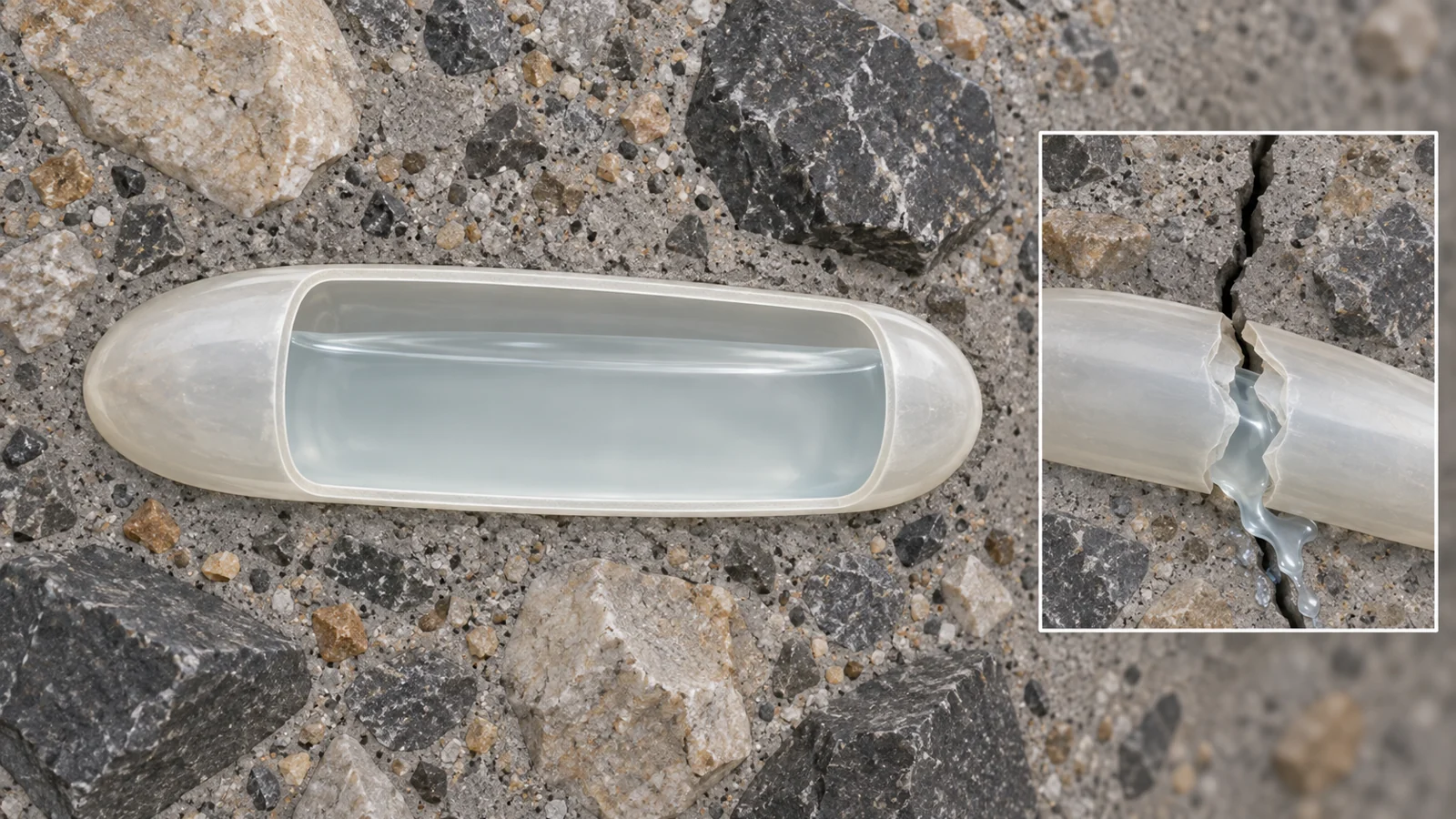
A capsule carrying liquid repair material faces a difficult assignment inside concrete. It must keep its contents through mixing with cement, sand, and gravel, yet open when a crack reaches it later. A shell that breaks too early wastes its payload. One that remains too resistant can leave the liquid inaccessible when it is needed.
A laboratory study published on February 18, 2021, investigates a way to change that balance over time. The researchers made capsules from polylactic acid, or PLA, a biomass-based polymer, and examined how the alkaline environment inside concrete alters the shells. They also tested a question that matters just as much as capsule behavior: what happens to the strength of the concrete containing them?
The experimental repair liquid was sodium silicate. Although encapsulation also matters in approaches involving bacteria, this study tested a chemical payload and provides no results for a living one. Its contribution is a detailed examination of the carrier material and its compatibility with concrete, accompanied by a preliminary demonstration of liquid release and crack filling.
What survived the mixer
The researchers used 3D printing to make capsules with different shapes, dimensions, and wall thicknesses. For the mixing test, they first mixed the concrete ingredients, then added the capsules and continued mixing for five minutes in a revolving drum mixer. They tested 12 groups, with 20 capsules in each group, at an overall capsule volume fraction of 0.82%.
Afterward, they washed and sieved the fresh concrete to retrieve the capsules. This allowed two different counts. An intact capsule had avoided visible breakage; an active capsule also retained its liquid without leaking. Survival was calculated from the active capsules, so an apparently undamaged shell did not automatically count as a success.
Selected groups achieved 95% survival—19 active capsules out of 20. For the thin-walled elongated design selected for subsequent concrete tests, all 20 remained intact, but one leaked. That distinction makes the result useful: it measures containment after this particular mixing procedure. It is neither a healing percentage nor a guarantee that the same fraction will survive every mixer and batch formulation.
The selected capsule had a minor diameter of 9.5 millimeters, approximately three-eighths of an inch, a length twice that dimension, and a wall thickness of 0.4 millimeters. Adding more PLA to the wall did not consistently improve survival across the tested designs. With the external capsule volume held constant, a thicker wall also leaves less room for liquid. The thin shell therefore offered a practical advantage in payload capacity without a consistent survival benefit from extra thickness.
What alkaline aging changed
PLA’s response to alkaline exposure provides the proposed timing mechanism. A material that initially tolerates mixing can lose some of its strength inside the cement environment, potentially making the shell easier for a later crack to rupture. The researchers examined that process using several methods, each answering a different part of the question.
For direct mechanical measurements, they immersed dog-bone-shaped PLA specimens in a sodium hydroxide solution at pH 13, chosen to resemble the alkalinity of concrete pore water. They then pulled the specimens in tension. Compared with unaged PLA, tensile strength fell by 6% after seven days and by 24% after three months. The way the material stretched also changed: early exposure increased elongation at break, while longer exposure reduced it. Aging did more than produce a uniform loss of strength.
Those tests measured separately prepared PLA specimens in liquid. Evidence from shells recovered after being embedded in concrete came from thermal analysis and microscopy. Aged shell samples began thermally decomposing at lower temperatures than unaged material, consistent with changes in the polymer. Cement-derived material attached to the shells also contributed to the residue left during heating, so the recovered samples were not simply clean PLA.
Microscopy supplied the physical detail. The outer shell showed small cracks and separation of fine PLA strands, with cement hydration products on the surface and within the shell. Fracture surfaces also showed close contact between capsules and the surrounding cement matrix. Such contact matters because a crack can travel around an inclusion as well as through it; the observed bonding helps explain why the capsules were intersected during fracture.
Together, these observations support alkaline aging as a plausible way to change capsule behavior after placement. They do not establish a fixed activation schedule. Tensile loss in an immersed specimen and changes in an embedded printed shell are related evidence, but they cannot be converted into one universal number of days until a capsule is ready to open.
The concrete pays a different price under different loads
A useful carrier must coexist with the material it is supposed to help. The concrete strength experiments used gravel-sized capsules at 5% by volume—a different dosage from the mixing-survival test. At 90 days, this concrete had 13.5% lower compressive strength than the capsule-free control. It continued gaining strength with age, but its gain did not eliminate the difference from plain concrete.
Compression tests squeeze a specimen until it fails. The researchers suggested that the relatively large capsules could create locations where stresses concentrate, while degradation could provide easier routes for cracks. They observed liquid escaping during compression, indicating that some capsules ruptured as internal cracking developed before the concrete failed. The carrier’s presence was therefore mechanically consequential even before any subsequent repair could be assessed.
Splitting tensile tests gave a different result. These tests load a cylinder so that it splits across its diameter, assessing a different response from resistance to crushing. At 90 days, capsule-containing concrete reached 4.4 megapascals, 4.8% above the control. A higher splitting tensile result does not cancel a lower compressive result; they describe different loading conditions. Compatibility cannot be reduced to a single statement that the capsules make concrete stronger or weaker.
The smaller capsules were evaluated in mortar, which contains sand but lacks concrete’s coarse gravel aggregate. At a 2% capsule volume fraction, compressive strength was 7.7% below the control at seven days, 13% above it at 28 days, and 3.4% above it at 150 days. By 270 days, the two groups had comparable strength. The pattern shows why the age of the comparison matters.
It would be tempting to credit that result entirely to smaller capsules creating smaller defects. But the mortar experiment also used a lower dosage, a different host mixture, and a different PLA filament. These changes prevent the comparison from isolating capsule size as the cause. With three repetitions reported for compression testing, the results provide bounded laboratory comparisons, rather than a basis for predicting performance across construction mixtures.
Following the liquid into a crack
The healing demonstration began with concrete beams cured for 90 days. The researchers loaded them in three-point bending, using a clamp and supporting arrangement to help create cracks without immediately breaking the beams apart. Once flexural cracks formed, they removed the load and placed the specimens in saturated lime solution at room temperature, about 23 °C, for observation over the following two weeks.
That sequence matters. The observations concern mature laboratory specimens deliberately cracked and then exposed to a calcium-rich liquid. The surrounding solution was part of the conditions under which the released sodium silicate reacted; it cannot be treated as an incidental detail when interpreting the apparent filling of a crack.
Fracture surfaces revealed broken capsules and released sodium silicate. The researchers reported a 100% breakage ratio for capsules found on the observed concrete fracture surfaces. The denominator is crucial: this count concerns capsules intersected by those surfaces. It does not describe every capsule throughout a beam, every possible crack, or the proportion of damage repaired.
The study also reported material filling a crack and deposits associated with the released liquid. The authors attributed the filling to calcium silicate hydrate, or C-S-H, produced through reactions involving sodium silicate, cement hydration products, and lime water. Microscopy showed reaction products near damaged shells, with additional deposits visible after rupture. These observations connect capsule opening to liquid release and subsequent solid formation.
Crack filling leaves performance questions open
A visible deposit is only one endpoint in a repair process. For an infrastructure application, an essential question is whether the filling durably restricts water and aggressive chemicals from entering. Another is whether the cracked material recovers useful mechanical performance under later loading. The healing observations here do not establish post-healing strength recovery, restored watertightness, or an extension of service life.
The distinction is especially relevant because the reported concrete strength measurements assess the effect of incorporating capsules. They do not quantify how much strength a previously cracked specimen regained after healing. Nor does a preliminary crack-filling demonstration provide a complete quantitative account of repair across different crack widths, depths, and exposure conditions.
The laboratory sequence also leaves open how the reaction would proceed with different access to water and calcium, or how the filled crack would respond to continued loading. Repeated healing and manufacturing reliability at construction scale were not established. PLA’s biomass origin identifies a material choice; it does not, by itself, demonstrate lower lifecycle environmental impacts or maintenance costs.
What this could change
Capsules that survive mixing but become easier to rupture after months in alkaline concrete could make repair chemistry part of the material from the day it is cast. If that behavior can be made reliable without an unacceptable strength penalty, small cracks could release sealing liquid soon after they form instead of waiting for an external repair treatment.
The practical payoff would be to limit water and aggressive chemicals entering through early cracks and, potentially, reduce later maintenance demand. The 2021 study does not demonstrate those field outcomes: durable watertightness, repeated cracking, long-term service life and manufacturing reliability still need to be shown. But it identifies the balance a deployable capsule system would have to solve—survive mixing, retain enough payload, open when damage arrives and remain compatible with the host concrete.
Key Sources
- Primary source: Feasibility and Compatibility of a Biomass Capsule System in Self-Healing Concrete.
DOI or Journal Page · Peer-Reviewed Paper · 2021-02-18