
Evidence date · 2024-04-23 · Research note 1 of 3
1 2 3
See current Track status →
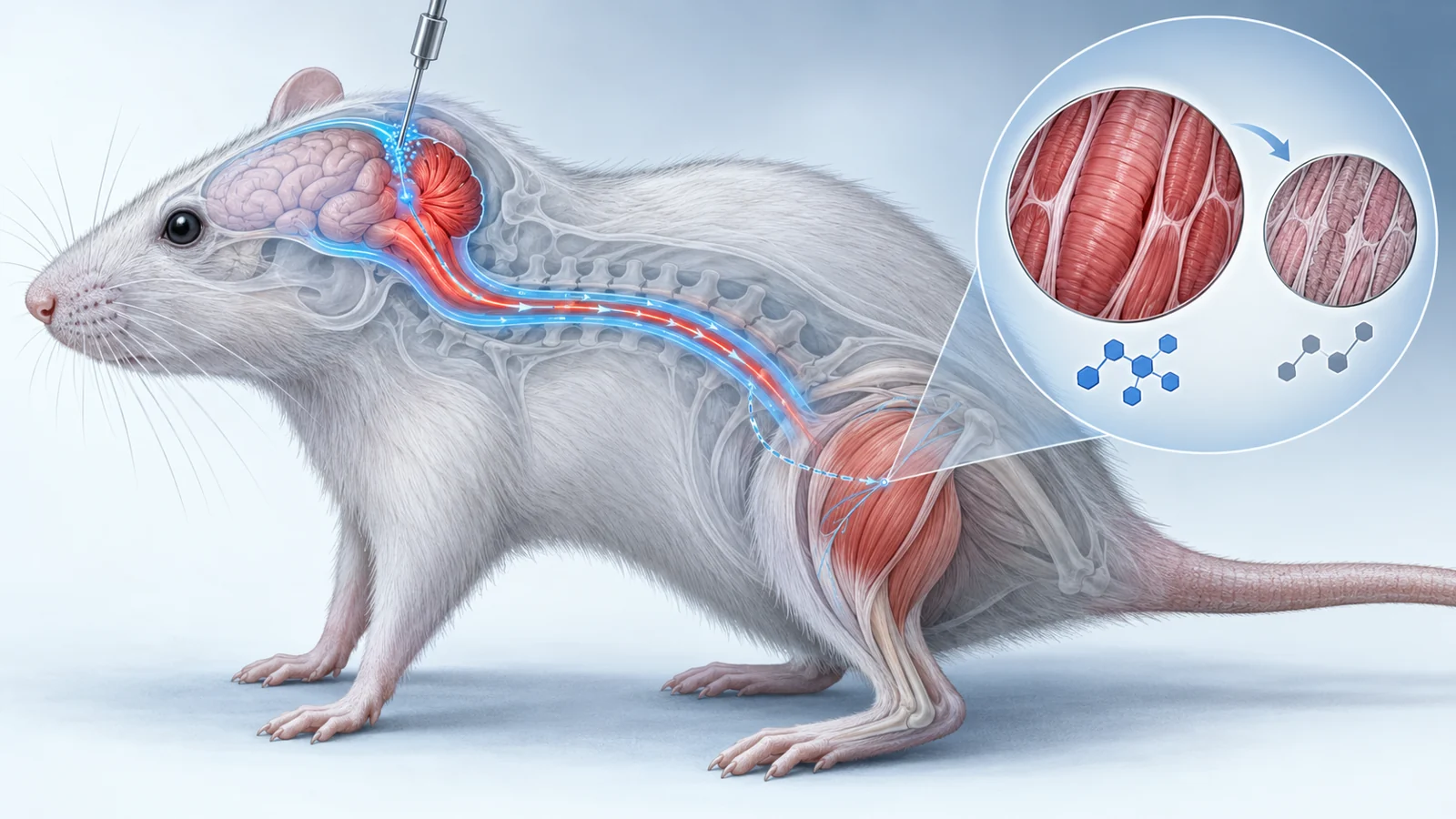
A treatment delivered into a fluid space near the brain helped prevent abnormal movement and underdeveloped muscle fibers in rats with creatine transporter deficiency. The surprising part is that the animals’ muscle creatine remained depleted, and the introduced creatine transporter was not detected in their muscle fibers.
The result comes from an animal experiment published April 23, 2024. Researchers treated male rats carrying the disease-associated Slc6a8Y389C mutation when they were 11 days old, then assessed the animals over the following weeks. The intervention improved selected motor and muscle-development measures, but its reach through the nervous system was uneven. It also did not address every feature associated with creatine transporter deficiency.
Creatine needs both production and transport
Creatine helps cells manage energy by supporting the regeneration and movement of high-energy phosphates. The body can make creatine through a two-step pathway, but cells still need a dedicated transporter to bring it inside. That transporter is SLC6A8, also known as the creatine transporter.
Creatine deficiency syndromes can result from faults in creatine production or in its transport. For production defects, oral creatine can be taken up when the transporter at the blood-brain barrier is still functional. Creatine transporter deficiency is different: the inherited problem affects the machinery needed to move creatine into cells, including cells in the nervous system.
The rat study attempted to restore that missing function rather than edit the inherited mutation. Researchers packaged instructions for a functional rat Slc6a8 transporter into an AAV2/9-2YF viral carrier. They injected the carrier into the cisterna magna, a cerebrospinal-fluid space near the base of the skull, in 11-day-old pups.
This timing matters. The study tested protection during early development, when motor patterns and muscle structure were still developing. It did not test whether an established, longstanding disability could later be reversed.
The treatment reached the back of the nervous system
The delivered transporter was detected mainly in posterior nervous-system structures. Expression was widespread in the spinal cord and present in the cerebellum and pons or medulla oblongata. In the spinal cord, the study reported substantial transporter-positive neuronal labeling in the lumbosacral region. In one posterior cerebellar area, expression was much more concentrated than in most other cerebellar regions.
The distribution was not uniform. Transporter expression was absent or detected only rarely in the olfactory bulbs, cortex, hippocampus, diencephalon and midbrain. This anatomical pattern helps explain why creatine measurements differed from one part of the brain to another.
Measurements in the hippocampus and upper cerebellar regions showed no significant creatine correction after treatment. Those were areas with little or no detected transporter expression. In contrast, liquid chromatography measurements in posterior cerebellar lobules and the medulla found a significant but incomplete increase.
In untreated mutant rats, creatine in the posterior cerebellum was about 80% below wild-type levels, and medulla creatine was about 67% to 72% lower. Treatment raised the measured values relative to untreated mutants by roughly 22% to 32%, depending on the region and time point, but the concentrations remained well below those of wild-type rats. The result was regional biochemical improvement, not restoration of normal creatine throughout the brain.
Movement tests captured a functional benefit
At about 12 weeks after treatment, the researchers assessed activity in an open-field arena and a circular corridor. These tests measured ordinary movement, including how far the animals traveled and how fast they moved. They also recorded rearing, in which a rat stands on its hind legs either with or without support from its front limbs.
Untreated mutant rats traveled less distance and moved more slowly than wild-type controls in both movement tests. Treated mutant rats reached wild-type levels for distance traveled and speed in the open-field and circular-corridor tests. They also tended to spend more time moving in the corridor.
The standing behavior was not equally clear across every measure. Treated animals showed a near-significant recovery in supported rearing and a tendency toward more unsupported rearing. In the group that also received creatine, supported rearing improved significantly compared with untreated mutants, while unsupported rearing showed a near-significant improvement. These results support a meaningful motor effect, while keeping the strength of each behavioral finding separate.
The additional creatine did not explain the main movement result. Whether or not treated mutant rats received creatine supplementation, the distance and speed findings were similar. The supplementation also did not produce a further increase in creatine in the measured posterior brain regions between weeks 5 and 14.
Muscle fibers improved while muscle creatine stayed low
The researchers also examined quadriceps muscle. Untreated mutant rats had thinner muscle fibers and smaller fiber cross-sectional areas than untreated wild-type rats. Treated mutant rats, with or without added creatine, had thicker fibers and fiber dimensions at the level of the wild-type controls.
Yet the muscle itself did not show the expected signs of direct correction. Intramuscular creatine remained strongly reduced in treated mutants, and the study did not detect the introduced Slc6a8-FLAG transporter in their muscle fibers. The treatment therefore did not appear to restore muscle creatine by delivering the transporter directly to muscle.
The authors interpret the combination of findings as evidence that improved nervous-system support may have protected muscle development. Motor function depends on coordinated activity between the nervous system and muscle, and the treated pathway extended through posterior brain structures, the spinal cord and motor-related circuits. A healthier neural signal could therefore have helped developing muscle fibers achieve more typical dimensions even while their own creatine stores remained low.
That explanation is plausible within the study’s results, but the experiment did not isolate a single necessary or sufficient neural pathway. The muscle rescue is an observed association with the nervous-system intervention, not proof that one specific group of neurons caused the entire effect.
Early treatment helped some functions while leaving others open
The rats were examined five and 14 weeks after injection, with behavior assessed during that period. The intervention produced no reported injection-related mortality in the treated animals, and the animals lived through the experimental endpoint without signs of distress described in the supplied methods. These observations belong to this rat experiment and do not establish safety for people or lifelong persistence of benefit.
The restricted distribution also defines what the treatment did not yet accomplish. Because the forebrain received little or no detectable transporter expression, the experiment did not demonstrate correction of the broader neurological features associated with creatine transporter deficiency. The reported findings do not establish recovery of cognition, speech, seizure control or every aspect of the disease phenotype.
The authors suggest that limited delivery to relevant cells at the blood-brain barrier may have contributed to the incomplete creatine correction. Oral creatine could not fully compensate in the measured regions, possibly because the treatment did not restore transporter function in those barrier cells. Whether that explanation accounts for the full regional pattern remains unresolved within this experiment.
The central lesson is therefore specific. Early transporter delivery through the cisterna magna prevented particular motor and muscle-development abnormalities in male rats with one disease-associated mutation. It did so alongside posterior nervous-system expression and partial regional creatine recovery, not through a demonstrated normalization of the whole brain or muscle.
What this could mean for motor development
For children with creatine transporter deficiency, a future treatment that restores transporter function along relevant nervous-system pathways could potentially protect movement and muscle development during early growth. A motor benefit would matter even if broader neurological effects remained difficult to treat, because coordination, strength and the development of muscle structure affect everyday physical function.
The 2024 rat findings make that possibility more concrete, but only as a conditional prospect. A comparable approach would need safe and durable delivery, appropriate distribution through the human nervous system and a benefit that translates beyond this early-treated male rat model. The study’s contribution was to show that nervous-system gene delivery can coincide with preserved movement and muscle-fiber development despite persistently low muscle creatine. It did not yet establish a treatment for people or a complete answer to the disease.
Key Sources
- Primary source: Rescue of myocytes and locomotion through AAV2/9-2YF intracisternal gene therapy in a rat model of creatine transporter deficiency.
DOI or Journal Page · Peer-Reviewed Paper · 2024-04-23