
Evidence date · 2026-03-05 · Research note 3 of 3
1 2 3
See current Track status →
Since the previous research note · Earlier expectation not tested
Track continuity
Since the previous research note: Can patient skin cells make their own creatine when import fails?
Previous expectation: Enabling relevant brain cells to make their own creatine might eventually support brain function despite faulty cellular import.
What this study adds: This study examines a different strategy, restoring the transporter through newborn gene delivery in mice and measuring brain creatine, networks and behaviour through development. It reports selected functional benefits and a cognitive safety concern in wild-type controls, but does not test the synthesis-bypass strategy.
What changed in this study
Creatine transporter deficiency is an inherited disorder caused by loss of the SLC6A8 gene, which encodes the transporter that moves creatine into cells. In the brain, the disorder is associated with developmental and intellectual difficulties, autistic-like behaviour and seizures. Supplying creatine from outside has had limited success because loss of SLC6A8 also affects how creatine is handled within the brain.
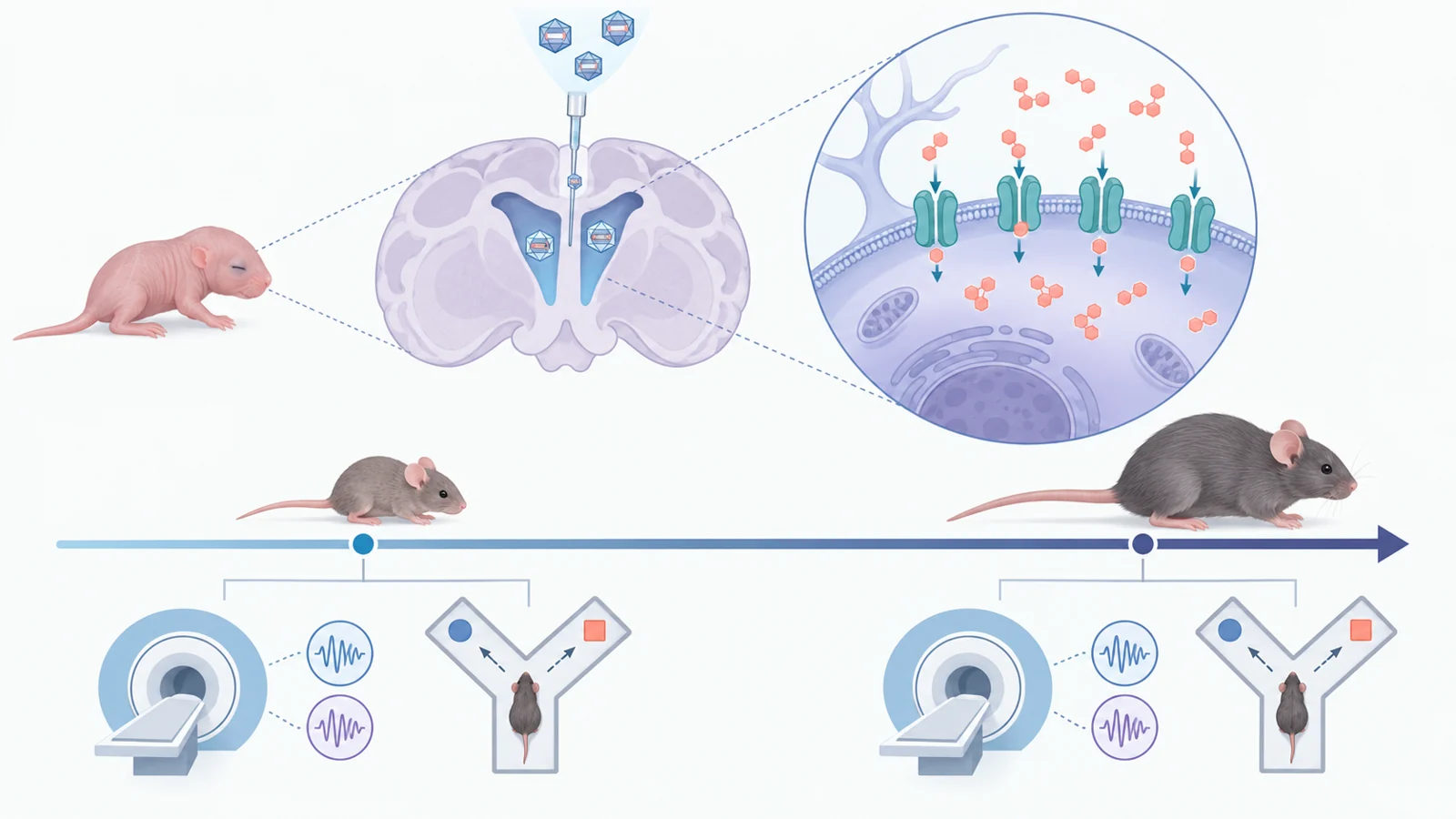
A study reported on March 5, 2026, tested a different approach in mice. Researchers used an AAV9 viral vector carrying a functional human SLC6A8 gene and injected it into the brain ventricles of newborn male mice on postnatal day one. The experiment included Slc6a8-knockout mice, which model the deficiency, and wild-type mice used as controls. Brain creatine, functional MRI measurements and behaviour were then followed as the animals developed.
The important question was not simply whether the treatment raised creatine. It was whether restoring the missing transporter early changed brain coordination and behaviour, and whether those changes amounted to broader cognitive recovery.
The intervention began at the earliest stage tested
Delivery on day one was designed to provide SLC6A8 expression very early, before the disease-related pattern was fully established. This makes the experiment a test of early intervention. It does not show what would happen if treatment began after disability or other symptoms had already emerged.
The vector produced widespread but uneven expression across the brain. Researchers detected the introduced protein in cortical and subcortical regions, with prominent expression in neurons and some expression in oligodendrocytes and microglia. The measured transduction efficiency varied by region, so the intervention did not place the same amount of transporter into every relevant cell population.
That delivery pattern matters because partial restoration is not the same as recreating the normal distribution, amount or timing of SLC6A8 expression. The study therefore tested whether an early increase in transporter activity could influence measurable function even when the biological correction was incomplete.
The MRI pattern depended on age
Functional connectivity here means coordination between spontaneous MRI signals in different brain regions. It is not a direct count of physical connections, nerve fibres or synapses. Resting-state functional MRI was performed in the same mice at about day 40 and day 140, representing juvenile and adult stages in the experiment. The animals were lightly sedated during scanning with a protocol intended to preserve measurable network organization.
Untreated knockout mice showed widespread reductions in functional connectivity at both ages, but the distribution changed as they grew. At day 40, weaker coordination extended across many cortical and subcortical regions, especially somatosensory and motor areas, along with hippocampal and thalamic regions. By day 140, the abnormalities were weaker and more focal, involving the motor cortex and selected subcortical areas such as the striatum, hypothalamus and parts of the thalamus.
Newborn gene delivery prevented the juvenile hypoconnectivity found in untreated knockout mice at day 40. The effect included somatomotor and cingulate connectivity. At day 140, the same intervention produced no appreciable normalization of the adult connectivity pattern.
The scan results therefore point to a developmental timing effect. Early treatment protected the juvenile network pattern measured in this model, while it did not normalize the later pattern that emerged in adulthood. A normal-looking juvenile scan after newborn delivery is not evidence that established human disease could be repaired on the same schedule.
Brain creatine increased without reaching healthy levels
The biochemical response was measurable but incomplete. In treated knockout mice, brain creatine reached approximately 70% of wild-type levels at day 20. By day 40, it was around 50–55% of wild-type levels and remained in that general range across later sampled time points.
The increase is consistent with functional activity of the introduced SLC6A8 transporter, but the treatment did not restore normal brain-creatine concentrations. The animals retained a substantial biochemical difference from wild-type controls.
Some behavioural measures nevertheless moved in a favourable direction. Treatment prevented the increased grooming that appeared in adult knockout mice, and treated animals also showed higher body weight than untreated disease-model controls. Brain creatine and grooming scores were inversely related across relevant knockout groups, although this statistical relationship does not show that the creatine increase directly caused the behavioural change.
The chemistry, imaging and behaviour therefore did not move as one package. Brain creatine rose, juvenile MRI coordination improved and the increase in adult grooming was prevented, while adult connectivity remained abnormal and the memory-related results depended on the assay and age.
The memory result changed with the task
In the Y-maze spontaneous-alternation task, used as a working-memory-related measure, gene delivery did not significantly improve performance in knockout mice. This result appeared in the main behavioural work and in an independent set of tests conducted at a separate laboratory with a different mouse colony.
Object recognition gave a different result. In the independent colony, treated knockout mice showed a significant improvement in the object-recognition test at day 100. The same test did not show a significant treatment benefit at day 40. The study thus found an age- and assay-specific cognitive effect rather than a generalized recovery across memory tests.
The independent colony repeated the Y-maze experiments and added object-recognition testing; it did not independently replicate the object-recognition benefit as a separate finding. At day 100, exploratory behaviour increased in both treated wild-type and treated knockout mice, which argued against a knockout-specific activity difference explaining the object-recognition result.
These details make “improvement” a precise term here. The treatment helped selected behavioural measures, including adult grooming and later object recognition, but it did not improve the Y-maze measure or restore every tested brain-network feature.
Healthy mice revealed an expression-safety concern
Wild-type mice that received the same human SLC6A8 vector added information beyond a comparison of treated and untreated disease-model animals. Their brains already had a normal SLC6A8 system, so this group tested whether adding the transporter could itself alter behaviour.
In the independent behavioural colony, wild-type mice given the vector performed significantly worse on the Y-maze at day 40. At day 100, the direction was similar but did not reach statistical significance. The finding raises a cognitive concern about adding SLC6A8 to a healthy brain; it does not establish the mechanism responsible or define a safe expression level.
Possible explanations include the amount, location or timing of expression, as well as differences in how cell populations use creatine. The authors also considered whether broad promoter activity could produce excessive transporter in some cells while leaving other cells below a useful level. These possibilities remain hypotheses. For a future therapy, restoring missing function would need to be separated from adding uncontrolled activity to circuits that are already functioning.
The adult circuit analysis adds an association
The researchers also used multivariate analysis to examine how connectivity, behaviour and brain creatine varied together in adult mice. The analysis identified a prefrontal–basal-forebrain network, including regions such as the insula and nucleus accumbens, whose connectivity covaried with stereotyped behaviour in wild-type animals. The relationship between the same network and behavioural measures was reversed or otherwise disrupted in knockout mice.
This links measurements of brain chemistry, circuit activity and behaviour within the disease model, but it does not show that changing the network would correct the behaviour. The statistical model combined several distinct behavioural measures into one latent component rather than measuring a single unified cognitive ability. It is therefore an exploratory brain-behaviour association, not a validated clinical predictor or a direct treatment mechanism.
The study’s limitations also shape its clinical meaning. The cohorts were male mice treated as newborns, not people with established CTD. The experiment did not establish a human dose, a safe expression threshold, an appropriate delivery schedule or the consequences of altering SLC6A8 over a human lifetime. The behavioural replication came from a separate laboratory and mouse colony using saline controls rather than the imaging cohort’s control vector. The study also lacked electrophysiological analysis of the epileptic phenotype, so it does not establish seizure rescue.
The authors proposed that expression may take time to reach a biologically useful level, even after a day-one injection, and that the incomplete restoration of brain creatine could help explain the uneven cognitive response. Different brain cells may also require different creatine levels, making broad expression an imperfect substitute for normal regulation. These proposed explanations remain to be tested.
What early gene delivery could mean for children with creatine transporter deficiency
A future treatment that addresses the missing transporter itself could potentially preserve useful cognitive and behavioural function for children with creatine transporter deficiency, reducing some lifelong difficulties for affected children and their families. That possibility depends on safe, appropriately timed expression reaching the relevant human brain cells and producing reliable functional gains.
The mouse study provides a disease-modifying direction beyond symptom management, but it has not demonstrated lifelong benefit or clinical readiness. Its incomplete brain-creatine restoration, age-dependent imaging results and poorer working-memory performance in treated healthy mice show why any human approach would need to protect function without disturbing healthy brain circuits.
Key Sources
- Primary source: Connectomic and behavioural alterations in creatine transporter deficiency are partially normalized by gene therapy.
DOI or Journal Page · Peer-Reviewed Paper · 2026-03-05