
Evidence date · 2022-06-28 · Research note 2 of 3
1 2 3
See current Track status →
Since the previous research note · Earlier expectation not tested
Track continuity
Since the previous research note: Can a porous material help the immune system act beyond one tumor?
Previous expectation: An immune response extending beyond a treated tumor and persisting against returning disease could eventually broaden protection for people with cancer.
What this study adds: The June 2022 abstract reports a copper-containing framework combining two reactive-oxygen pathways with immune activation and tumor-growth inhibition alongside anti-PD-1. This adds a distinct material and combination-treatment strategy to the timeline.
What changed in this study
A material designed to connect two treatment ideas
Cancer treatment can involve directly damaging tumor cells while also encouraging the immune system to recognize what has happened. A June 2022 research article describes a material designed to bring those ideas into one strategy: a three-dimensional covalent organic framework containing copper ions.
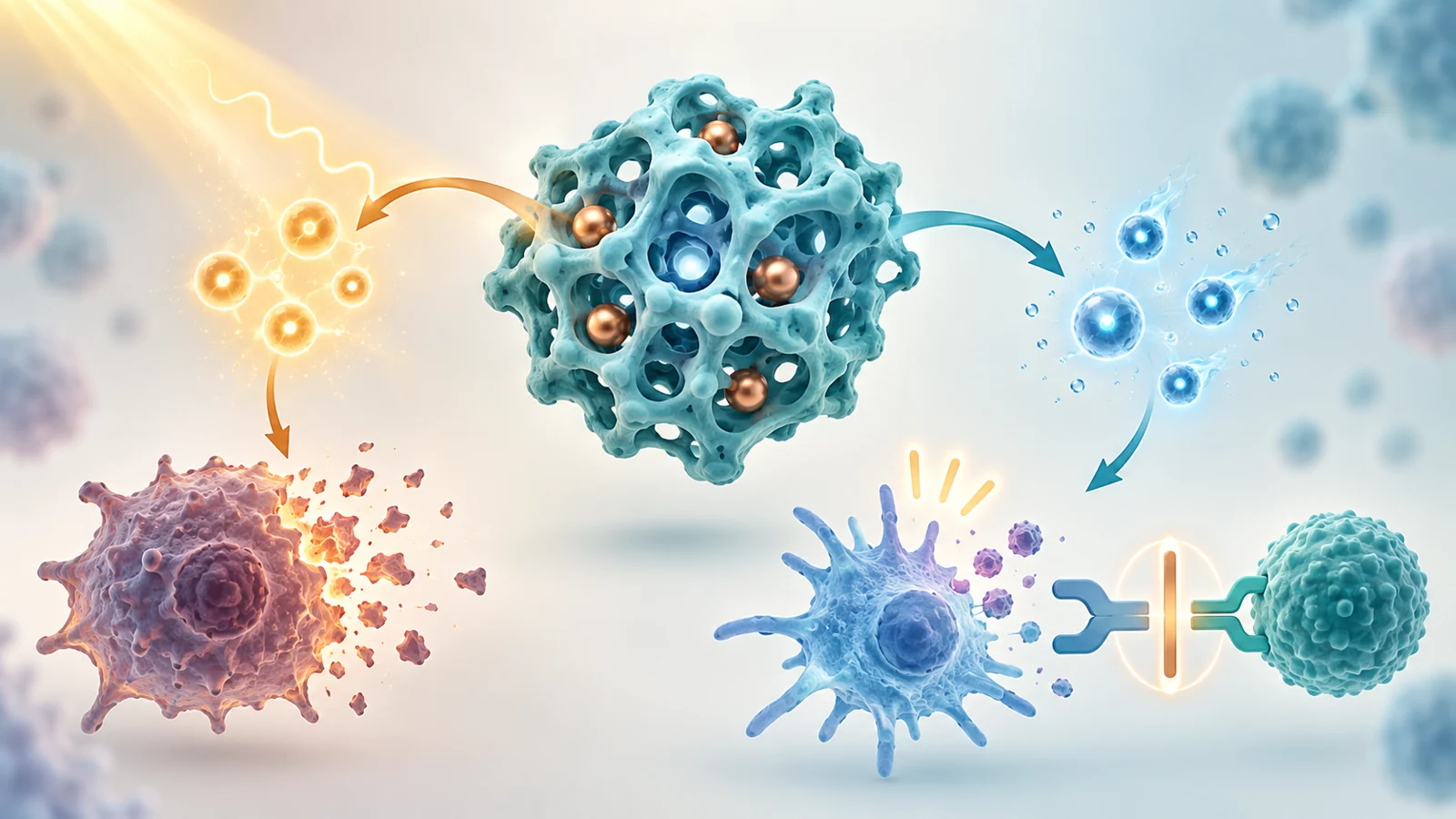
A covalent organic framework is an interconnected molecular scaffold. In this work, the framework, called 3D COF-TATB, was prepared with copper ions embedded in its structure. The authors describe the resulting material, 3D Cu@COF-TATB, as a way to generate more than one kind of reactive oxygen species and connect that chemistry with an immune response.
Two chemical routes start from the same scaffold
The framework contains porphyrin components with two relevant roles. When activated by light, they act as photosensitizers that generate singlet oxygen, a reactive oxygen species capable of damaging nearby biological material. The same porphyrins also provide binding sites for copper ions, helping place the metal within the molecular structure.
The copper route is separate. The abstract describes glutathione, a molecule present in cells, reducing Cu2+ to Cu+. The resulting copper state can participate in a Fenton-like reaction that produces hydroxyl radicals. This gives the material a second reactive-oxygen pathway alongside the light-responsive singlet-oxygen pathway.
The significance is not simply that the material produces more chemical activity. Each route depends on a different part of the design: light activates the porphyrin chemistry, while glutathione participates in the copper-mediated pathway. The supplied evidence supports the authors’ description of these mechanisms, but it does not establish that every reactive species contributes equally to treatment performance.
How cell injury is linked to immune treatment
The authors report that the generated reactive oxygen species induce immunogenic cell death. In plain terms, this is cell death that can provide signals capable of provoking an immune response, rather than being only a local destructive event. The proposed sequence is therefore chemical injury, a more noticeable form of cancer-cell death, and activation of immune defenses.
The material was also combined with anti-PD-1, an immune-checkpoint treatment intended to support T-cell activity by blocking the PD-1 pathway. The abstract reports that this combination effectively inhibited tumor growth. That finding connects the material’s reactive chemistry with an immune-treatment component, but it does not by itself show tumor eradication, longer survival, protection against recurrence or benefit for patients.
What the 2022 abstract can and cannot show
This account is based on the research article’s PubMed abstract. The supplied abstract does not identify the experimental model behind the tumor-growth result, and it does not provide effect sizes, comparison-group performance or a quantified interaction between the material and anti-PD-1. Those details are important for judging how much of the reported effect came from the scaffold, the checkpoint treatment or their combination.
Safety findings and clinical readiness are also outside what can be concluded here. The available evidence does not establish distant-tumor protection, durable immune memory or prevention of recurrence. These are limits on this article’s claims rather than assertions about what the full paper did or did not investigate.
What this approach could mean for cancer treatment
If the reported chemistry and immune effects prove reproducible and safe, a material-based component could eventually help combine light-triggered tumor injury with immune stimulation in one cancer-treatment strategy. That possibility could matter for people with cancer because it links a local chemical intervention to a broader biological response while using anti-PD-1 as an accompanying treatment.
Reaching that point would require reliable therapeutic effects and safe, effective use in people. The June 2022 evidence supports the idea as a research direction, not as proof of durable protection or an established treatment.
Key Sources
- Primary source: Cu 2+ Embedded Three-Dimensional Covalent Organic Framework for Multiple ROS-Based Cancer Immunotherapy.
DOI or Journal Page · Peer-Reviewed Paper · 2022-06-28