
Evidence date · 2021-09-15 · Research note 1 of 3
1 2 3
See current Track status →
On September 15, 2021, researchers reported a material-design approach for turning chemically joined molecules into a possible cancer-immunotherapy tool. Their starting amine building blocks were described as inactive at inducing immunogenic cell death, while the resulting three-dimensional frameworks showed strong activity in the authors’ experiments. The key question is what changed when those molecules were connected into a porous structure.
When inactive ingredients became active
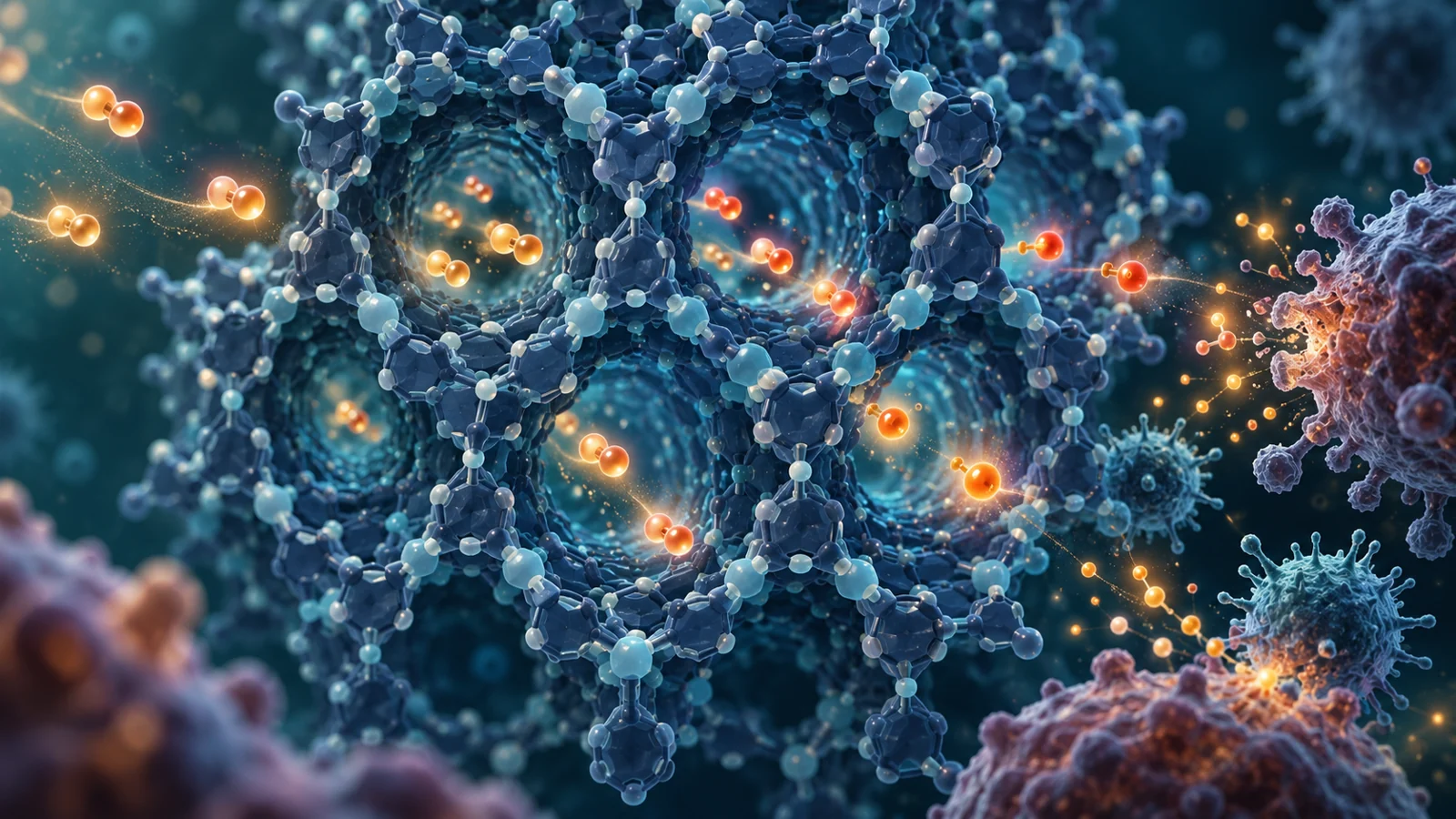
Covalent organic frameworks, or COFs, are structures made by chemically linking molecular building blocks into an ordered network with pores. The team used three triple-topic amine building blocks to make COF-607, COF-608, and COF-609. The individual starting materials did not induce the form of cell death highlighted in the study: immunogenic cell death, meaning cell death that can help prompt an immune response.
The reported change was not simply that the same ingredients were placed together. Linking them into a framework altered the materials’ optical properties. According to the study’s abstract, those changes enabled the COFs to produce reactive oxygen species, or ROS—chemically reactive oxygen-containing molecules associated here with the ability to trigger immunogenic cell death. The framework therefore served as a way to tune the behavior of the ingredients, rather than acting only as a passive container.
Pores that help reactive oxygen move
The authors describe two related physical functions. Framework assembly adjusted the optical behavior connected with ROS production. Its three-dimensional, cross-linked pores then favored the exchange and diffusion of oxygen and ROS. In plain terms, the material was designed both to generate reactive oxygen and to provide interconnected routes through which oxygen and those reactive molecules could move.
The abstract compares this porous arrangement with lung structure, but the useful point for interpreting the result is the exchange function: a connected three-dimensional network can support movement through the material. The authors link that combination of tuned optical properties and porous transport to the frameworks’ ability to induce immunogenic cell death.
This is a material-level explanation, not proof that every part of the design contributed equally. The supplied evidence does not include enough numerical comparison to separate the contribution of framework assembly, optical behavior, pore structure, or the individual starting molecules. It does, however, establish the study’s central design claim: connecting otherwise inactive building blocks produced a new material with a different reported biological activity.
What the mouse experiment actually reported
COF-609 was the member associated in the abstract with the strongest animal-level description. In a mouse model of breast cancer, the authors report abscopal effects, meaning effects at tumors away from the treated site, along with long-lasting immune-memory effects. The abstract does not provide enough experimental detail here to independently assess the arrangement of tumors, the scale of the distant response, or how immune memory was tested.
The clearest numerical result is separate and specific. More than 95% of mice survived to the reported 110-day point after treatment with COF-609 plus αCD47, an anti-CD47 treatment. That statement describes the combination, not COF-609 alone. It also does not show how much of the observed outcome came from either component, and 110 days should not be read as 110 days of continuous dosing.
The result is striking because it connects a designed material to an immune-related animal outcome, but the available account does not supply group sizes, comparator outcomes, statistical estimates, treatment schedules, or sufficient methods to judge the magnitude of benefit. Those are limits of the evidence package available for this article, not claims that the full paper lacked such information.
Reading the result without overextending it
The study supports a concise chain of interpretation: molecular building blocks were assembled into three-dimensional COFs; the resulting structures had optical properties associated with ROS production; interconnected pores were proposed to aid oxygen and ROS movement; and COF-609 was linked to reported distant-tumor and immune-memory effects in mice. Each link matters because the biological activity was presented as a consequence of the material’s constructed form.
The evidence remains an original animal study represented here by one verified PubMed abstract. It does not establish treatment benefit in people, clinical safety, or readiness for patient use. Nor does the survival figure establish recurrence prevention or quantify the durability and testing of immune memory beyond the authors’ description. The contribution of anti-CD47 to the combination result is also unresolved in the supplied evidence.
What durable cancer immunity could make possible
A treatment approach that helps immune defenses act beyond a treated tumor and retain a response against returning disease could eventually offer people with cancer a way to extend protection beyond the site that was directly targeted. In September 2021, that remained a conditional possibility: the reported distant-tumor and memory effects would need to prove reproducible, and the approach would need to become safe and effective in people. The material concept made that future capability worth investigating, but the mouse result was not yet a patient benefit.
Key Sources
- Primary source: Three-Dimensional Covalent Organic Frameworks with Cross-Linked Pores for Efficient Cancer Immunotherapy.
DOI or Journal Page · Peer-Reviewed Paper · 2021-09-15