
Since the previous research note · Earlier expectation not tested
Track continuity
Since the previous research note: How recorded missions teach a language model to approach a spacecraft
Previous expectation: Controllers learning from recorded maneuvers could eventually reduce step-by-step human direction if they generalize, respond promptly and operate within validated safety constraints.
What this study adds: The current source supplies a competition placement and describes prompt augmentation, alternative training inputs and response latency as elements of a simulated spacecraft operator. Those details extend the engineering account but do not establish the operational transfer required by the earlier forecast.
What changed in this study
An AI system trained on text can do more than describe a spacecraft maneuver. Given observations and a way to issue commands, it can help choose one. In an arXiv v1 preprint dated May 26, 2025, researchers report that their language-model agent placed second in the Kerbal Space Program Differential Games competition, which challenges autonomous software to maneuver simulated spacecraft during non-cooperative encounters.
That is a concrete achievement inside a game-based testing environment, not evidence of dependable control in flight. Its interest lies in how the researchers turned a language model into a participant in a moving system. Software prepared observations, prompts described the task, and the model selected actions whose usefulness depended partly on how quickly they arrived.
The study examines prompting and further training of GPT and LLaMA models. Along the way, it makes an engineering question tangible: how much of an apparently intelligent maneuver comes from the model, and how much depends on the information and machinery surrounding it?
Why this simulator makes learning difficult
The competition uses the Kerbal Space Program game engine to test spacecraft agents. Non-cooperative operations involve encounters in which spacecraft are not simply working together toward a shared maneuvering goal. Pursuit and evasion provide an intuitive picture of the challenge: an operator must respond to another vehicle’s changing motion.
For many AI control approaches, a useful training environment allows enormous amounts of practice. Reinforcement learning, for example, learns through repeated interactions and feedback. Running many trials simultaneously or faster than real time can make that practice more practical.
The researchers describe constraints that prevent this particular environment from serving that role well. Its engine lacks the accelerated, parallel, and headless operation needed for high-throughput training. Headless operation means running without the normal graphical display. Without those capabilities, accumulating simulated experience is cumbersome.
The authors also describe the competition environment as intended primarily for evaluation. Its purpose is to test agents while limiting overfitting, in which a system becomes especially good at the situations it repeatedly encounters during development. These constraints motivate trying an existing language model, whose prior training offers a different starting point from learning a controller through vast numbers of interactions with this simulator.
What the model gets to decide
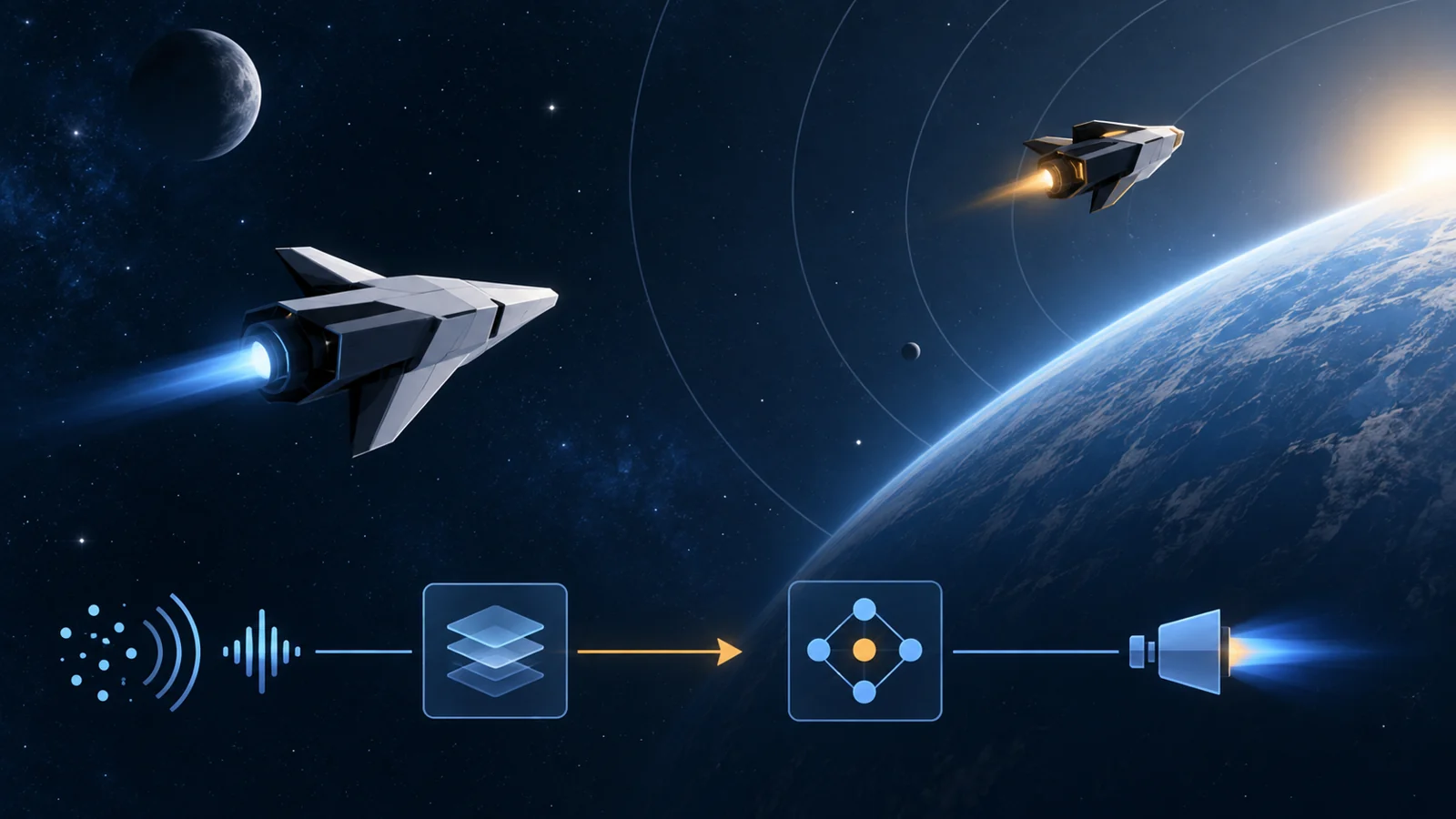
The proposed operator receives telemetry, meaning measurements describing the simulation’s current state. That information enters a prompt alongside an explanation of the system and the mission goal. The model uses the resulting description to choose an action that the surrounding software can turn into a command.
Preparing that input is an active part of the design. The researchers generated prompt variations, tested them in simulations, and selected versions that performed well. They report that effective prompts gave concise explanations of the system, observations, and objectives. The wording and presentation of a spacecraft’s situation were therefore engineering choices with consequences for the agent’s behavior.
The software also supplied a calculated direction cue. The paper calls it a prograde vector; in plain language, it indicates the direction of motion. Providing that cue helped address the difficulty language models can have with arithmetic involving large numbers. The model could receive a useful derived quantity instead of having to work it out entirely from the underlying measurements.
This division of labor matters. Calculating a direction and choosing whether or how to thrust are different jobs. A prepared direction cue supplies information for the decision; it does not, by itself, select the maneuver. Here, conventional computation helps describe the situation, while the language model occupies the action-selection role.
The resulting operator is a system assembled around a model. Its behavior depends on which observations are available, how software processes them, how instructions express the goal, and how the model responds. Calling it a language-model agent identifies a central component, but the supporting software helps make that component useful.
Instructions and training examples do different jobs
The study explores two main ways to adapt existing models. Prompting changes what a model is told at the moment it is asked to act. Few-shot prompting adds a small number of examples to those instructions so the model can infer the desired pattern. Fine-tuning goes further by changing the model through additional training on task-specific examples.
For human-derived training material, the researchers recorded gameplay as pairs of observations and thrust actions every 0.5 seconds. Actions became discrete labels expressed relative to the spacecraft’s reference frame. That creates a concrete learning task: given an observed situation, predict an action resembling the one in the recording.
The LLaMA experiments also used synthetic training material derived from flight logs of Navball bot, a programmed system that aligns with the direction of motion and is designed to minimize thrust and corrections. Those examples have a different origin from human gameplay. They capture the behavior of an existing programmed agent rather than a person’s decisions.
The distinction helps explain what adaptation can teach. Recorded examples carry the choices of whoever—or whatever—generated them. Prompting makes examples available during a request; fine-tuning attempts to incorporate patterns from examples into the model itself. Neither description requires treating all the study’s datasets as interchangeable or assuming that every adaptation produced the same benefit.
A useful decision has an expiration time
A spacecraft simulation keeps moving while an agent prepares its response. A command based on an earlier observation may arrive after the situation has changed enough to require a different correction. Choosing a plausible action and delivering it in time are therefore connected parts of the control problem.
The authors identify response latency—the delay before a decision becomes available—as consequential. In their account, orbital motion can make piloting errors difficult to correct if the agent responds too slowly. Fine-tuning was partly motivated by the prospect of reducing that delay, alongside improving the suitability and consistency of responses. That motivation should not be read as a measured speed improvement across the tested models.
The half-second recording interval belongs to a different clock. It describes how frequently observation-and-action examples were collected during gameplay. It does not establish that a trained model produced a fresh decision every half second. A dataset can describe rapid sequences even when generating a response from that data takes longer.
This makes timing more than a convenience. In a conversational task, waiting longer may simply postpone an answer. In control, waiting can change which answer would be useful.
A placing, a matching score, and a dependable controller
The study brings together results that answer different questions. A competition placing describes how an entrant ranked under that event’s conditions. It gives a reason to examine the approach, but it does not establish broad superiority over spacecraft-control methods in general.
The described action-accuracy metric asks whether a predicted action matches a reference label. That is useful for assessing how well a model reproduces recorded choices. It is a different measurement from whether a sequence of actions completes an encounter successfully. Agreement with individual labels does not by itself demonstrate a safe trajectory.
Dependable control beyond the tested setting is a larger claim still. It would require evidence that decisions remain useful across relevant situations, arrive promptly enough, and operate within validated safety constraints. The reported simulation result and action-matching approach do not establish that operational transfer.
The GPT fine-tuning passage also describes small datasets and few runs, which limits the breadth of inference those experiments can support. The evidence considered here does not justify precise claims about mission-success rates, latency gains, statistical variability, or a performance ranking of every model and training variant. It supports examining an implemented approach, while leaving those broader comparisons unresolved.
The contribution is consequently specific and useful. Language-model action selection was put to work in a spacecraft simulation, with prepared observations, alternative sources of training examples, and response timing all treated as practical design concerns. Each of those choices helps explain the reported behavior without turning a competition outcome into a forecast of flight reliability.
What this could change
From the May 2025 perspective, the longer-term possibility is a change in what mission operators delegate. If models can turn telemetry into timely maneuvering decisions, generalize to the situations they encounter, and operate within validated safety constraints, humans could eventually spend less time directing individual corrections and more time supervising the goals and progress of an encounter.
The causal path runs through the control loop. Software prepares a usable account of the spacecraft’s state; the model selects an action while it is still relevant; validated constraints bound what the system may do. If those pieces become dependable together, an operator could assign more of the detailed maneuvering to the system while retaining oversight at the mission level. The potential benefit would be less need for step-by-step human direction as an encounter unfolds.
Key Sources
- Primary source: Large Language Models as Autonomous Spacecraft Operators in Kerbal Space Program
arXiv · Preprint · 2025-05-26