
Since the previous research note · Earlier expectation not tested
Track continuity
Since the previous research note: How text-generating AI learns commands to slow a tumbling spacecraft
Previous expectation: Spacecraft teams could delegate bounded stabilization decisions with readable strategy explanations if hardware performance, timely execution and dependable constraint handling were established.
What this study adds: The current source investigates a different layer of autonomy, translating mission priorities into behavior sequences and waypoint constraints for trajectory optimization. Its numerical comparisons report improvements in solver convergence and intent satisfaction within close-proximity scenarios.
What changed in this study
A spacecraft operating near another spacecraft may have several physically feasible ways to move. Choosing among them requires more than finding a path that obeys the equations of motion. A mission might prioritize conserving fuel, finishing quickly, obtaining useful observations or maintaining a larger safety margin. A trajectory can satisfy its operating constraints while serving the wrong priority.
An April 19, 2026 arXiv preprint, Intent-aligned Autonomous Spacecraft Guidance via Reasoning Models, investigates how an autonomous guidance system could make that choice. In numerical experiments involving close-proximity operations, the researchers test a division of work between learned models and trajectory optimization. Their results address two separate questions: whether the optimizer can produce a solution, and whether the resulting trajectory satisfies the mission’s highest-priority performance criteria.
From maneuver choices to a computed path
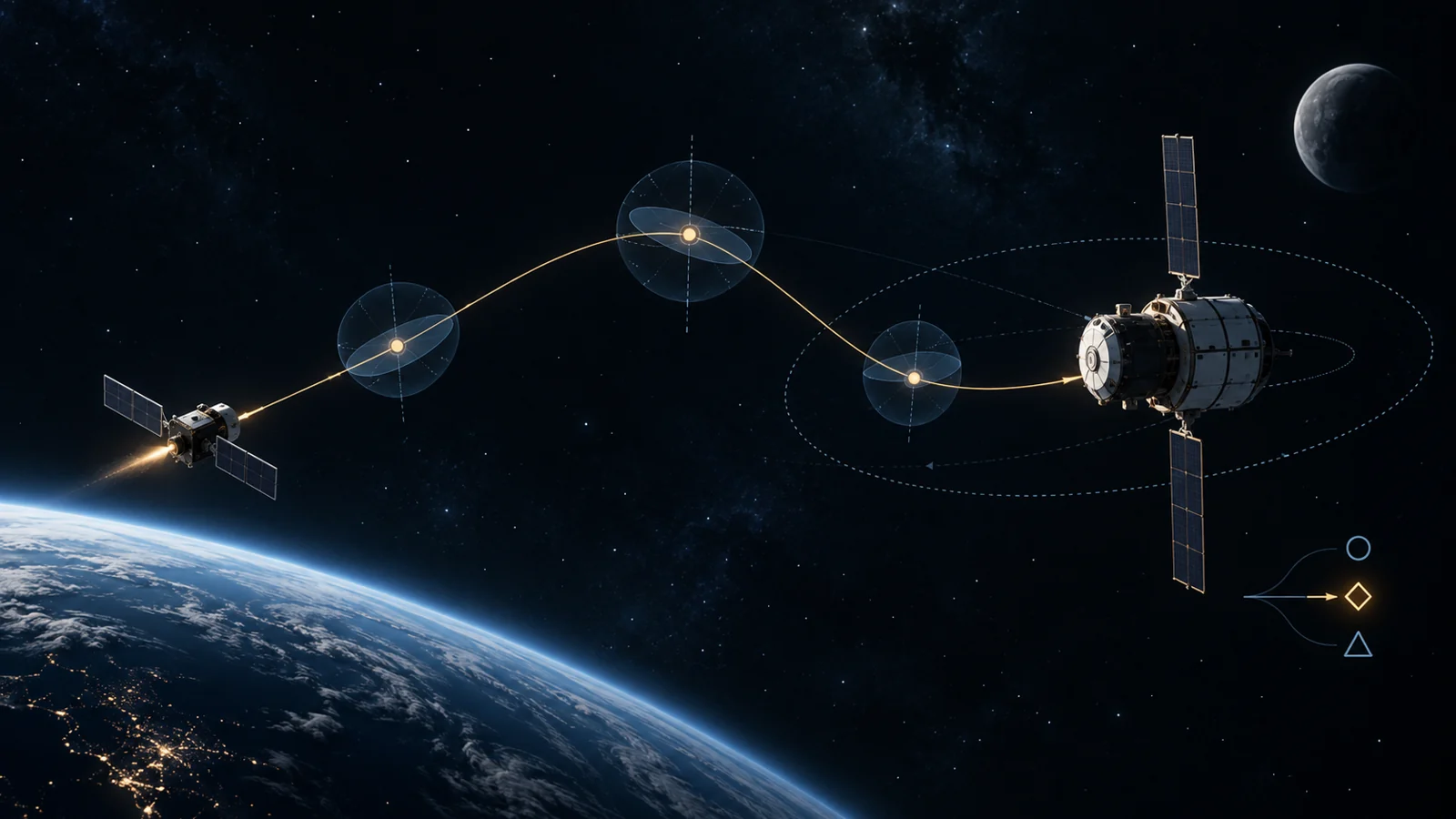
The proposed system begins with the scenario and an ordered set of mission priorities. A reasoning model selects a behavior plan built from predefined maneuver building blocks, called behavior primitives. These describe choices at a higher level than individual control commands. Station-keeping, for example, is one of the behaviors in the paper’s construction.
A second model converts that plan into waypoint constraints. These are intermediate geometric requirements for the route, expressed through the spacecraft’s orbit relative to its target. A numerical optimizer then computes the detailed trajectory. The reasoning model therefore chooses a maneuver sequence; the optimization stage handles the trajectory calculation under the modeled dynamics and constraints.
This division provides specific places for inspection or intervention. Engineers can examine the selected behavior sequence before considering its geometry, or inspect the waypoint requirements before trajectory generation. If a plan needs adjustment, they have a structured maneuver choice or geometric condition to work with. They do not have to interpret a single model output that bundles the mission objective and every detail of the flight path together.
The distinction also helps explain the problem the authors are tackling. A request to favor observation quality does not uniquely specify where a spacecraft should go. Many trajectories might serve that objective to different degrees. Selecting a behavior sequence narrows the decision before the waypoint model and optimizer resolve its geometric details.
Learning from calculated performance
The training process uses computed trajectories to give the models examples of what works. For the waypoint generator, the researchers define a reward combining control cost and observation quality across the trajectory. The model learns a distribution of waypoint choices conditioned on its inputs, with higher-reward examples receiving more weight during training. This encourages waypoint choices associated with better results under that particular reward.
That reward is distinct from the mission’s ordered priorities. Combining control cost and observation quality into a training score does not, by itself, express every possible ordering of fuel, time, observation and safety margin. The behavior-selection training addresses this other part of the problem by comparing candidate plans according to the specified priority order.
To construct those examples, candidate behavior plans are evaluated using the already-trained waypoint generator and the trajectory optimizer. The resulting trajectories yield measurements for the four intent dimensions. A pretrained language model then turns structured candidate comparisons into a selected behavior plan and a concise rationale consistent with the priorities. Calculated performance thus supplies the basis for the choices used in training.
The information available later is more limited. When deployed in the proposed pipeline, the reasoning model receives the scenario context and mission intent, without seeing the downstream waypoint or trajectory performance metrics. It must infer which behavior sequence is appropriate before those results are available. The experiment therefore tests whether supervision built from evaluated candidates can teach useful choices from the information available at decision time.
The generated rationale is deliberately brief, referring to one or two top-priority metrics. Such a sentence can communicate the stated basis for a selection. It does not independently validate the trajectory or establish that the explanation faithfully reveals the model’s internal decision process.
Two improvements with different meanings
The waypoint comparison reports approximately 90% downstream solver success for both neural waypoint models, compared with 72% for the heuristic baseline. The solver uses sequential convex programming, or SCP, to tackle the trajectory optimization problem. Here, success means that the numerical procedure converges under the experiment’s conditions. Better waypoint proposals can make the downstream problem more likely to reach a solution.
The reward-weighted waypoint model also achieves the highest mean reward, with comparable variation in outcomes. The authors characterize the quality gains from reward weighting as modest but consistent. That result concerns the chosen combination of control cost and observation quality; it should be read alongside the separate evaluation of mission priorities.
For the end-to-end comparison, the researchers test 500 scenarios using four combinations of heuristic and trained reasoning and waypoint modules. Crossing the two kinds of modules allows them to examine behavior selection and waypoint generation within the same experimental setting, rather than treating the entire pipeline as an indivisible component.
Separately, the abstract reports a 1.5-fold higher rate of generating trajectories that satisfy the top intent-prioritized performance criteria than heuristic decision-making. This measures how often a trajectory meets the priority-based criteria. It is not a finding that spacecraft use 50% less fuel, move 50% faster or achieve a 50% improvement in overall mission performance.
The two headline results answer different questions. Solver convergence concerns obtaining a numerical solution; intent satisfaction concerns whether the trajectory meets the criteria given priority by the mission. A converged trajectory need not be the best match for those priorities. Equally, the roughly 90% convergence result is not a probability of safe flight, collision avoidance or successful mission completion. Those outcomes require evidence beyond solving the modeled trajectory problem.
The geometry bounds the result
The scenarios are constructed within a deliberately restricted range of relative orbits. The dataset uses five domains defined in relative-orbit coordinates, along with prescribed behavior transitions between them. Waypoints are sampled subject to geometric restrictions that keep them inside the intended domains.
The construction reduces waypoint sampling from an originally six-dimensional space to two dimensions. In practical terms, the models are choosing within a much narrower family of orbital configurations than a general spacecraft guidance problem could present. That restriction makes the experiment manageable and gives candidate behaviors a defined setting in which to be compared. It also shapes what the reported success rates can tell us.
Five hundred test scenarios provide repeated tests within this construction. Their number alone does not establish that the learned choices transfer to a broader range of relative orbits or mission conditions. The authors explicitly identify a more rigorous analysis of the learned reasoning capability’s generalization as future work. The unresolved question is how much of the useful decision-making survives when the circumstances extend beyond the geometry and choices used to build the examples.
These are numerical guidance results from a preprint. Establishing operational readiness would additionally require evidence that the system can execute dependably on suitable hardware and within the timing demands of spacecraft operations. The present results support progress in selecting and calculating maneuvers within the tested setting; they do not establish flight validation or onboard real-time readiness.
What this could change
If the learned choices generalize adequately and the system can execute reliably in operations, spacecraft teams could delegate more of the selection among nearby-spacecraft maneuvers. Operators could specify which objectives take precedence, while onboard guidance chooses a behavior sequence and develops the corresponding path. Engineers would retain intervention points at the behavior and waypoint levels.
The practical payoff would be less expert work translating each high-level objective into a fresh set of geometric requirements. For a proximity operation emphasizing observation, for example, a team could state that priority and let the guidance system select among the permitted maneuver options. A different ordering could favor fuel or time. That would give spacecraft greater discretion over how to carry out bounded tasks, while keeping mission priorities and the available maneuver choices under deliberate human design.
Key Sources
- Primary source: Intent-aligned Autonomous Spacecraft Guidance via Reasoning Models
arXiv · Preprint · 2026-04-19